in Thoreau’s Journal:
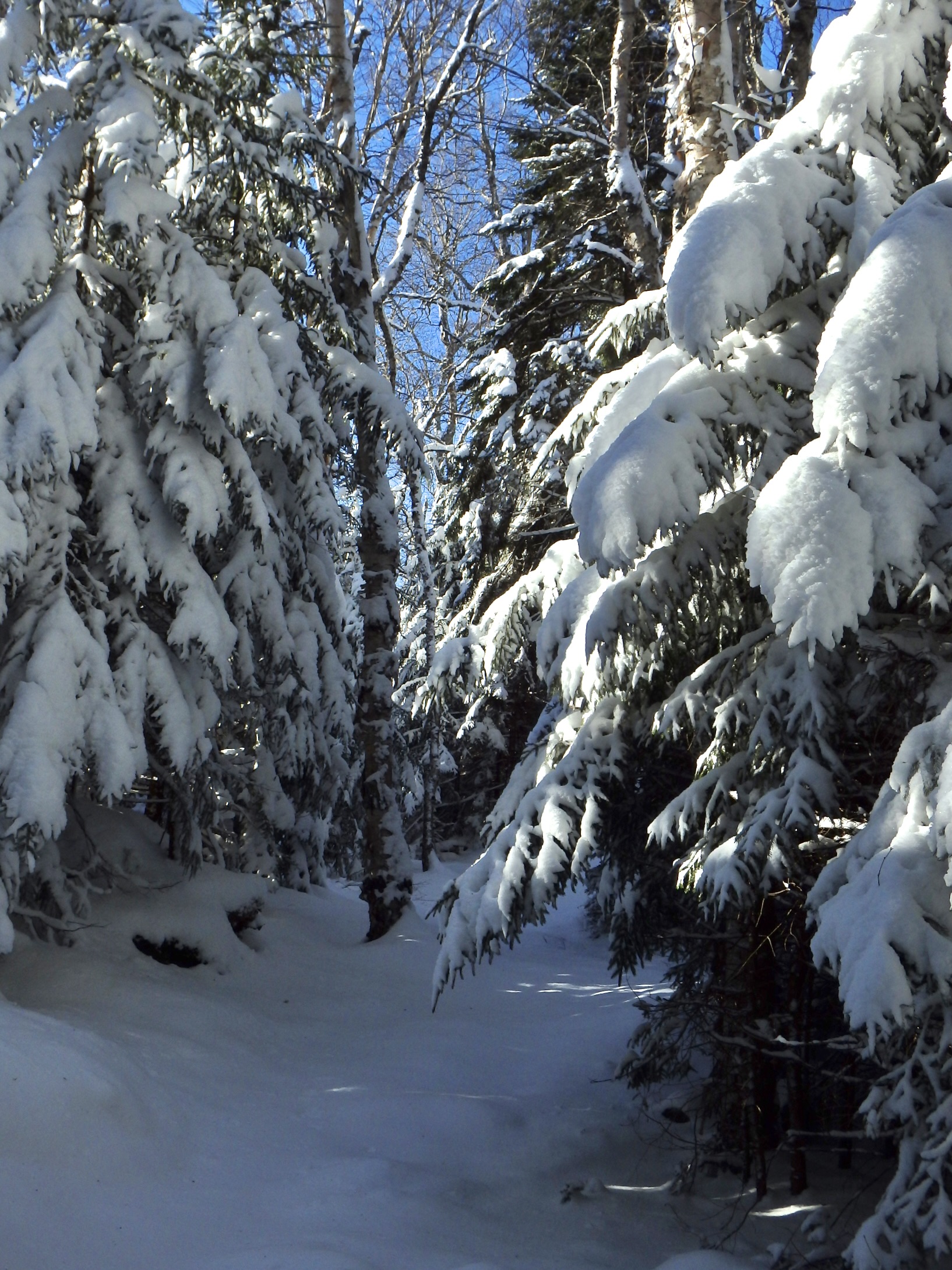
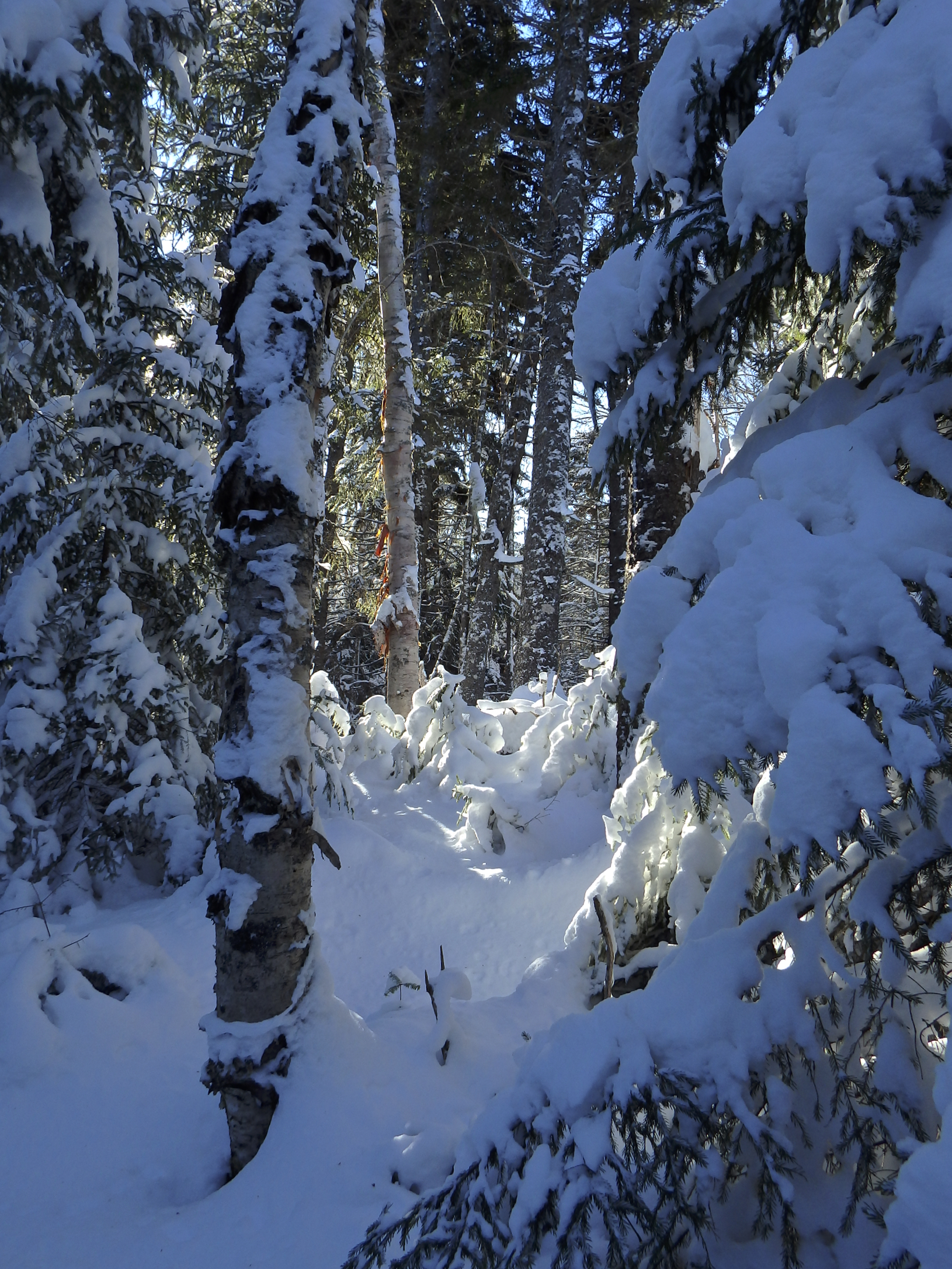
P. M. — The damp snow still drives from the northwest nearly horizontally over the fields, while I go with C. toward the Cliffs and Walden. There is not a single fresh track on the back road, and the aspect of the road and trees and houses is very wintry. Though considerable snow has fallen, it lies chiefly in drifts under the walls. We went through the Spring Woods, over the Cliff, by the wood-path at its base to Walden, and thence by the path to Brister’s Hill, and by road home. It was worth the while to see what a burden of damp snow lay on the trees notwithstanding the wind. Pitch pines were bowed to the ground with it, and birches also, and white oaks. I saw one of the last, at least twenty-five feet high, splintered near the ground past recovery. All kinds of evergreens, and oaks which retain their leaves, and birches which do not, up to twenty-five feet or more in height, were bent to the earth, and these novel but graceful curves were a new feature in the woodland scenery. Young white pines often stood draped in robes of purest white, emblems of purity, like a maiden that has taken the veil, with their heads slightly bowed and their main stems slanting to one side, like travellers bending to meet the storm with their heads muffled in their cloaks. The windward side of the wood, and the very tops of the trees everywhere, for the most part, were comparatively bare, but within the woods the whole lower two thirds of the trees were laden with the snowy burden which had sifted down on to them. The snow, a little damp, had lodged not only on the oak leaves and the evergreens, but on every twig and branch, and stood in upright walls or ruffs five or six inches high, like miniature Chinese walls, zigzag over hill and dale, making more conspicuous than ever the arrangement and the multitude of the twigs and branches; and the trunks also being plastered with snow, a peculiar soft light was diffused around, very unlike the ordinary darkness of the forest, as if you were inside a drift or snow house. This even when you stood on the windward side. In most directions you could not see more than four or five rods into this labyrinth or maze of white arms. This is to be insisted on. On every side it was like a snow-drift that lay loose to that height. They were so thick that they left no crevice through which the eye could penetrate further. The path was for the most part blocked up with the trees bent to the ground, which we were obliged to go round by zigzag paths in the woods, or carefully creep under at the risk of getting our necks filled with an avalanche of snow. In many places the path was shut up by as dense a labyrinth, high as the tree-tops and impermeable to vision, as if there had never been a path there. Often we touched a tree with our foot or shook it with our hand, and so relieved it of a part of its burden, and, rising a little, it made room for us to pass beneath. Often singular portals and winding passages were left between the pitch pines, through [which], stooping and grazing the touchy walls, we made our way. Where the path was open in the midst of the woods, the snow was about seven or eight inches deep. The trunks of the trees so uniformly covered on the northerly side, as happens frequently every winter, and sometimes continuing so for weeks, suggested that this might be a principal reason why the lichens watered by the melting snow flourished there most. The snow lay in great continuous masses on the pitch pines and the white, not only like napkins, but great white table-spreads and counterpanes, when you looked off at the wood from a little distance. Looking thus up at the Cliff, I could not tell where it lay an unbroken mass on the smooth rock, and where on the trees, it was so massed on the last also. White pines were changed into firs by it, and the limbs and twigs of some large ones were so matted together by the weight that they looked like immense solid fungi on the side of the trees, or those nests of the social grosbeak of Africa which I have seen represented. Some white pine boughs hung down like fans or the webbed feet of birds. On some pitch pines it lay in fruit-like balls as big as one’s head, like cocoanuts. Where the various oaks were bent down, the contrast of colors of the snow and oak leaves and the softened tints through the transparent snow — often a delicate fawn-color — were very agreeable.
As we returned over the Walden road the damp, driving snowflakes, when we turned partly round and faced them, hurt our eyeballs as if they had been dry scales.


 allandibiase.com
You must be logged in to post a comment.