
in Thoreau’s Journal:
Feb. 13. P. M. — On ice to Fair Haven Pond.
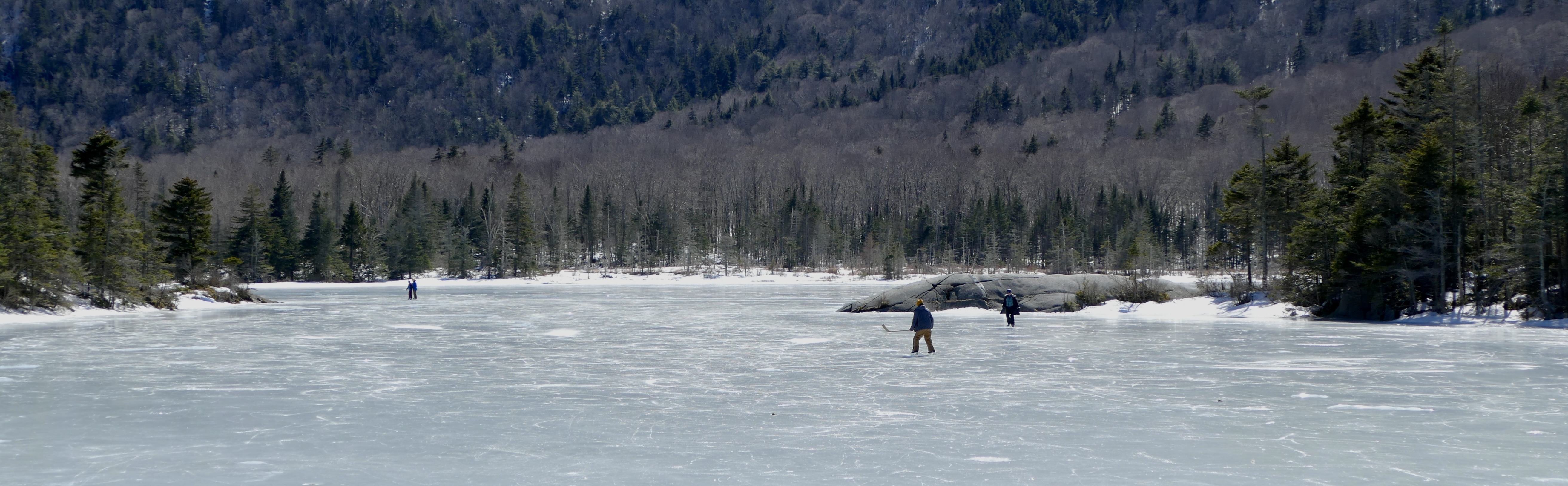
Yesterday there was no skating, unless you swept the snow from the ice; but to-day, though there has been no rain nor thaw, there is pretty good skating. Yesterday the water which had flowed, and was flowing, back over the ice on each side of the river and the meadows, a rod or two in width, was merely skimmed over, but last night it froze so that there is good skating there. Also the wind will generally lay bare some portion of the ice, unless the snow is very deep.
This yellowish ice which froze yesterday and last night is thickly and evenly strewn with fibrous frost- crystals very much like bits of asbestos, an inch or more long, sometimes arranged like a star or rosette, one for every inch or two; but where I broke in yesterday, and apparently wherever the water overflowed the thin ice late in the day, there are none. I think that this is the vapor from the water which found its way up through the ice and froze in the night. It is sprinkled like some kind of grain, and is in certain places much more thickly strewn, as where a little snow shows itself above the ice.
The old ice is covered with a dry, powdery snow about one inch deep, from which, as I walk toward the sun, this perfectly clear, bright afternoon, at 3.30 o’clock, the colors of the rainbow are reflected from a myriad fine facets. It is as if the dust of diamonds and other precious stones were spread all around. The blue and red predominate. Though I distinguish these colors everywhere toward the sun, they are so much more abundantly reflected to me from two particular directions that I see two distant rays, or arms, so to call them, of this rainbow-like dust, one on each side of the sun, stretching away from me and about half a dozen feet wide, the two arms including an angle of about sixty degrees. When I look from the sun, I see merely dazzling white points. I can easily see some of these dazzling grains fifteen or twenty rods distant on any side, though the facet which reflects this light cannot be more than a tenth or twelfth of an inch at most. Yet I might easily, and commonly do, overlook all this.
Winter comes to make walking possible where there was no walking in summer. Not till winter do we take possession of the whole of our territory. I have three great highways raying out from one centre, which is near my door. I may walk down the main river or up either of its two branches. Could any avenues be contrived more convenient ? With this river I am not compelled to walk in the tracks of horses.
 allandibiase.com
You must be logged in to post a comment.