in Thoreau’s Journal:
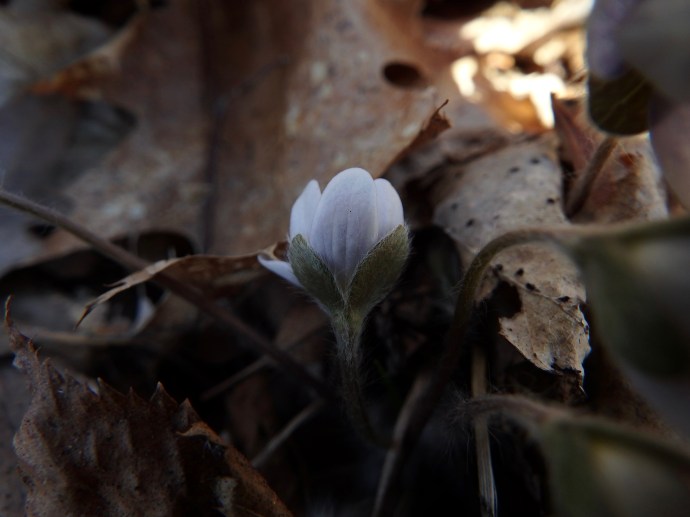
I want things to be incredible,––too good to appear true…. If you would be wise, learn science and then forget it.
in Thoreau’s Journal:
I want things to be incredible,––too good to appear true…. If you would be wise, learn science and then forget it.
in Thoreau’s Journal:
….I perceive the faintest possible flower-like scent as from the earth—reminding me of anemones & houstonias. Can it be the budded mouse-ears under my feet? downy-swaddled—they lie along flat to the earth like a child on its mother’s bosom.

I sit on a rock awhile just below the old trough. These are those early times when the rich golden brown tassels of the alder tremble over the brooks—& not a leaf on their twigs.
in Thoreau’s Journal:

….red maple in a warm place shows anthers & will open to-morrow if pleasant say 22nd.
in Thoreau’s Journal:

The calm bright hour after the sun came out was very pleasant.
April 19, 2012 Photo
in Thoreau’s Journal:
For the first time I perceive this spring that the year is a circle— I see distinctly the spring arc thus far. It is drawn with a firm line…
Why should just these sights & sounds accompany our life? Why should I hear the chattering of blackbirds—why smell the skunk each year? I would fain explore the mysterious relation between myself & these things. I would at least know what these things unavoidably are- —make a chart of our life & when—know why just this circle of creatures completes the world. Can I not by expectation affect the revolutions of nature—make a day to bring forth something new?

As Cawley loved a garden, so I a forest.
Observe all kinds of coincidences—as what kinds of birds come with what flowers.
An East Wind, I hear the clock strike plainly 10 or 11 PM.
——————
Thought for April 18, 2016: The 2,000,000 words of his Journal are like a very long hike during which the reader must ask questions (as in the above) in order to keep awake to her/his surroundings. Then, just as we can excerpt from the Journal every day, we can remember those aspects of our hike and assemble them for particular and new purposes.
in Thoreau’s Journal:

The sun-light in the wood across the stream.
in Thoreau’s Journal:
I think our overflowing river—far handsomer & more abounding in soft and beautiful contrasts—than a merely broad river would be- A succession of bays it is-a chain of lakes-an endlessly scalloped shore — — rounding wood & field-cultivated field & wood & pasture and house are brought into ever new & expected positions & relations to the water.

There is just stream enough for a flow of thought—that is all.
in Thoreau’s Journal:
Walden is but little more melted than yesterday.

Photo, Dinsmore Pond, Sandwich, NH: April 22, 2015
in Thoreau’s Journal:

The golden brown tassels of the alder are very rich now—
in Thoreau’s Journal:
A driving snow storm in the night & still raging…All birds have turned into snow birds. Trees and houses have put on the aspect of winter. The travelers carriage wheels, the farmer’s wagon are converted into white disks of snow through which the spokes hardly appear.

April 13, 2013: Photo
But it is good now to stay in the house & read & write. We do not now go wandering all abroad & dissipated—but the imprisioning storm condenses our thoughts— I can hear the clock tick as not in pleasant weather— My life is enriched— I love to hear the wind howl. I have a fancy for sitting with my book or paper—in some mean & apparently unfavorable place—in the kitchen for instance where the work is going on—rather a little cold than comfortable— — My thoughts are of more worth in such places than they would be in a well-furnished & warmed studio.
in Thoreau’s Journal:

It is fit that the almost earliest spring flower should be yellow the color of the sun.
in Thoreau’s Journal:
A pure brook is a very beautiful object to study minutely.
 It will bear the closest inspection….
in Thoreau’s Journal:
….maples and birches in front–with pines in the rear—making a low wild shore…The young trees & bushes now making apparent islands on the meadows are there nearly in this proportion I should think i.e. in deep water— Young maples—willows—button bushes—red osier…

April 9, 2016 Photo
in Thoreau’s Journal:
The male red maple buds now show 8 or 10 (counting everything) scales alternately crosswise—

& the pairs successively brighter red or scarlet, which will account for the gradual reddening of their tops. They are about ready to open.
in Thoreau’s Journal:
The epigaea is not quite out. The earliest peculiarly woodland herbaceous flowers are epigaea, anemone, thalictrum, and (by the first of May) Viola pedata. These grow quite in the woods amid dry leaves, nor do they depend so much on water as the very earliest flowers.

I am perhaps more surprised by the growth of the Viola pedata leaves by the side of paths amid the shrub oaks, and half covered with oak leaves, than by any other growth, the situation is so dry and the surrounding bushes so apparently lifeless.
in Thoreau’s Journal:
Now the sun is low in the west the northeasterly water is of a peculiarly etherial light blue, more beautiful than the sky—

and this broad water with innumerable bays & inlets running up into the land on either side—& often divided by bridge causeways—as if it were the very essence & richness of the heavens distilled and poured upon the earth, contrasting with the clean russet land—& the paler sky from which it has been subtracted—nothing can be more elysian. Is not the blue more etherial when the sun is at this angle— The river is but a long chain of flooded meadows—
in Thoreau’s Journal:

The flower buds of the red maple have very red inner scales now being more & more exposed—which color the tree tops a great distance off.
in Thoreau’s Journal:
You may see anything now, —the buff-edged butterfly and many hawks along the meadow;

and hark! while I was writing down that field note, the shrill peep of the hylodes was borne to me from afar through the woods.
in Thoreau’s Journal:
Not only are the evergreens brighter,

but the pools…have a peculiarly warm and bright April look, as if ready to be inhabited by frogs….
in Thoreau’s Journal:
Hosmer is overhauling a vast heap of manure in the rear of his barn, turning the ice within it up to the light. Yet he asks despairingly what life is for, and says he does not expect to stay here long. But I have just come from reading Columella, who describes the same kind of spring in that, to him, new spring of the world with hope, and I suggest to be brave and hopeful with nature.

Human life may be transitory and full of trouble, but the perennial mind whose survey extends from that spring to this, from Columella to Hosmer, is superior to change. I will identify myself with that which did not die with Columella and will not die with Hosmer.


You must be logged in to post a comment.