December 6, 1858

in Thoreau’s Journal:

Go out at 9 AM to see the glaze. It is already half fallen, melting off. The dripping trees and wet falling ice will wet you through like rain in the woods. It is a lively sound, a busy tinkling, the incessant brattling and from time to time rushing, crashing sound of this falling ice, and trees suddenly erecting themselves when relieved of their loads. It is now perfect only on the north sides of woods which the sun has not touched or affected. Looking at a dripping tree between you and the sun, you may see here or there one or another rainbow color, a small brilliant point of light.

PB290020.jpg

December 5, 1853

P1010001.jpgin Thoreau’s Journal:

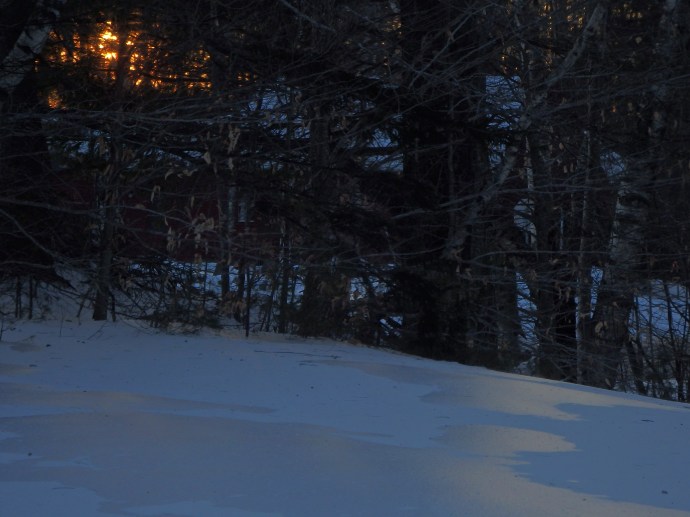
Before I got home the whole atmosphere was suddenly filled with a mellow yellowish light equally diffused—so that it seemed much lighter around me than immediately after the sun sank behind the horizon cloud 15 minutes before — Apparently not till the sun had sunk thus far did I stand in the angle of reflection.

December 3, 1853

December 3, 1853 in Thoreau’s Journal:
I see along the sides of the river 2 to 4 inches above the surface—but all at one level clear drop shaped crystals of ice—either held up by some twig—or hanging by a dead vine of climbing mikania— They are the remains of a thin sheet of ice, which melted as the river went down & in drops formed around & ran down these cores—& again froze & being thicker than the surrounding ice have outlasted it.

PB250027.jpg

December 2, 1839

December 2, 1839 in Thoreau’s Journal:

A rare landscape immediately suggests a suitable inhabitant, whose breath shall be its wind, whose moods its seasons, and to whom it will always to be fair. To be chafed and worried, and not as serene as nature, does not become one whose nature is as steadfast….PC010048.jpg


December 1, 1853

P4090007.jpg

December 1, 1853 in Thoreau’s Journal:

We may infer that every withered culm of grass or sedge—or weed that still stands in the fields—answers some purpose by standing— Those trees & shrubs which retain their withered leaves through the winter—shrub oaks—& young white red & black oacks—the lower branches of larger trees of the last mentioned species—horn-beam &c & young hickories seem to form an intermediate class between deciduous & evergreen trees— They may almost be called the ever-reds. Their leaves which are falling all winter long serve as a shelter to rabbits & partridges & other winter quadrupeds & birds—even the little chickadees love to skulk amid them & peep out from behind them. I hear their faint silvery lisping notes‚ like tinkling glass—& occasionally a sprightly day-day-day—as they inquisitively hop nearer & nearer to me. They are our most honest & innocent little bird—drawing yet nearer to us as the winter advances—& deserve best of any of the walker.

P4290034.jpg

November 30, 1851

November 30, 1851 in Thoreau’s Journal:

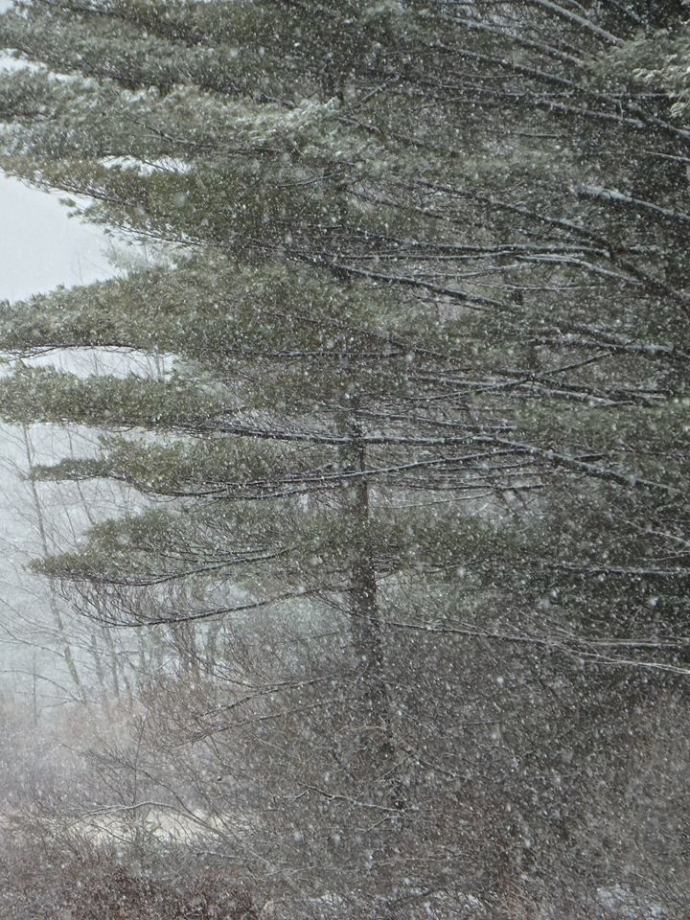
The squirrel is always an unexpectedly large animal to see frisking about. My eye wanders across the valley to the pine woods which fringe the opposite side, and in their aspect my eye finds something which addresses itself to my nature. Methinks that in my mood I was asking nature to give me a sign— I do not know exactly what it was that attracted my eye— I experienced a transient gladness at any rate at something which I saw. I am sure that my eye rested with pleasure on the white pines now reflecting a silvery light—the infinite stories of their boughs—tier above tier—a sort of basaltic structure—a crumbling precipice of pine horizontally stratified. Each pine is like a great green feather stuck in the ground. A myriad white pine boughs extend themselves horizontally one above & behind another each bearing its burden of silvery sun-light—with darker seams between them—as if it were a great crumbling piny precipice thus stratified—On this my eyes pastured while the squirrels were up the trees behind me. That at any rate it was that I got by my afternoon walk —a certain recognition from the pine. some congratulation. Where is my home? It is indistinct as a old cellar hole now a faint indentation merely in a farmer’s field—which he has ploughed into & rounded off its edges—years ago and I sit by the old site on the stump of an oak which once grew there. Such is the nature where we have lived— Thick birch groves stand here & there dark brown? now with white lines more or less distinct—

P1210026 - Version 2.jpg