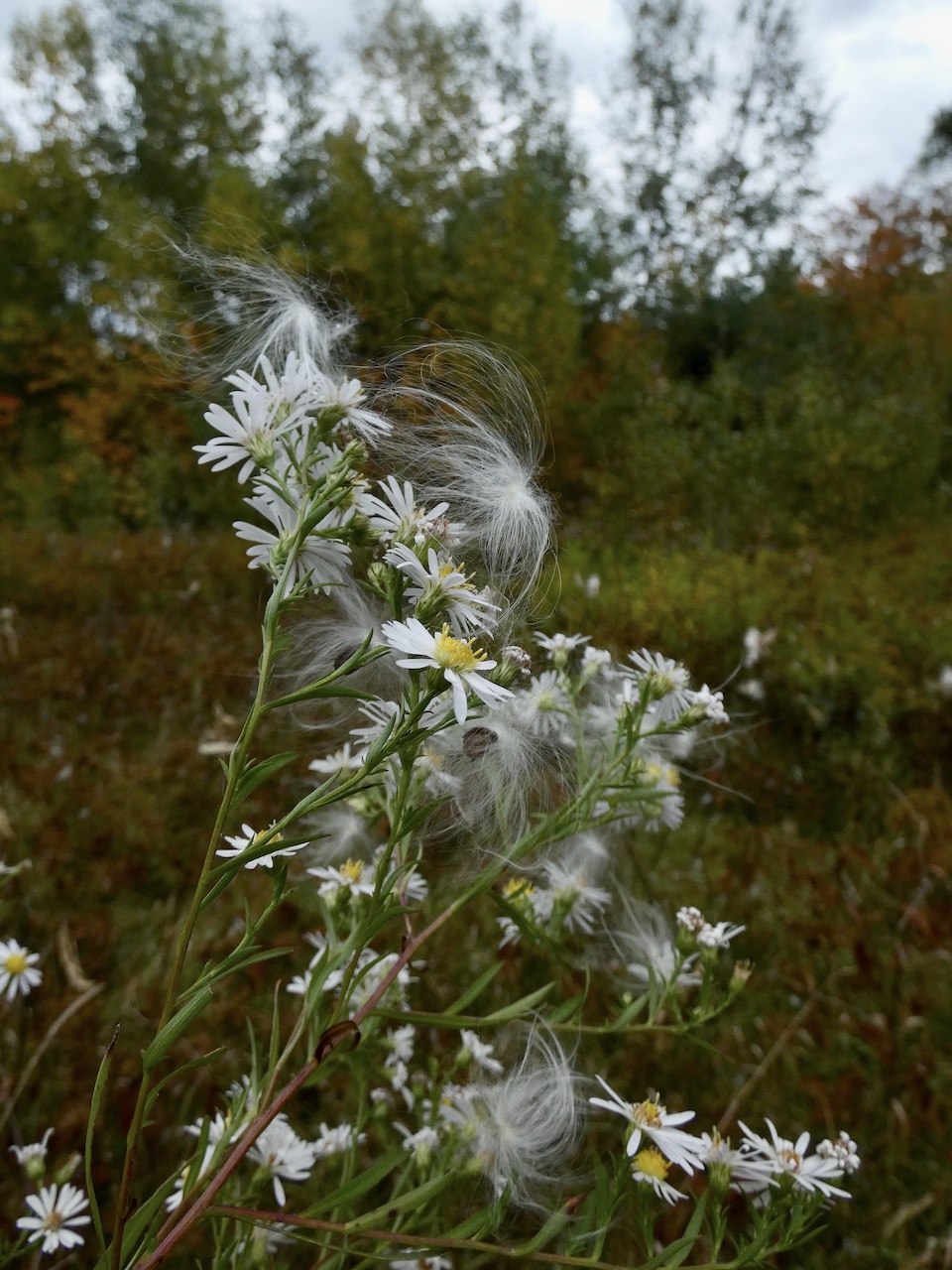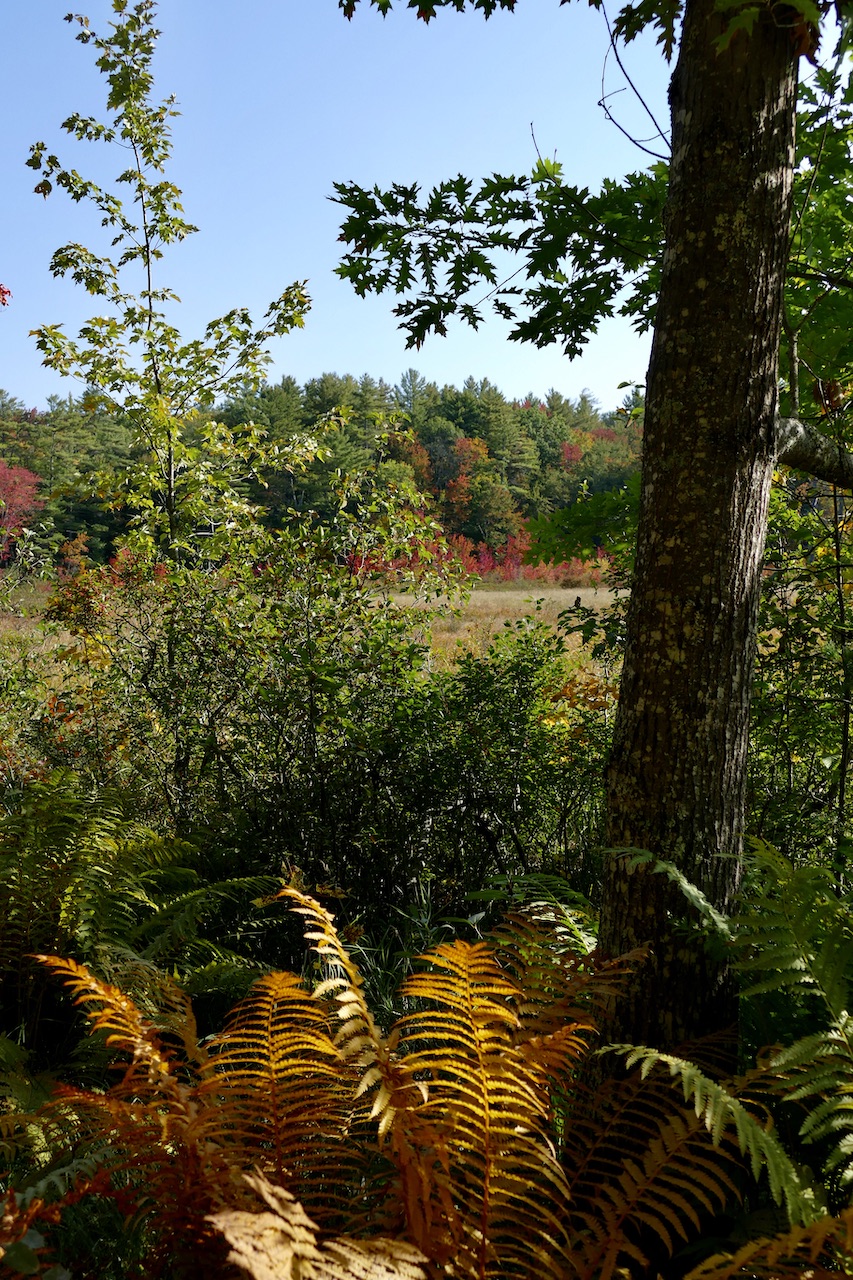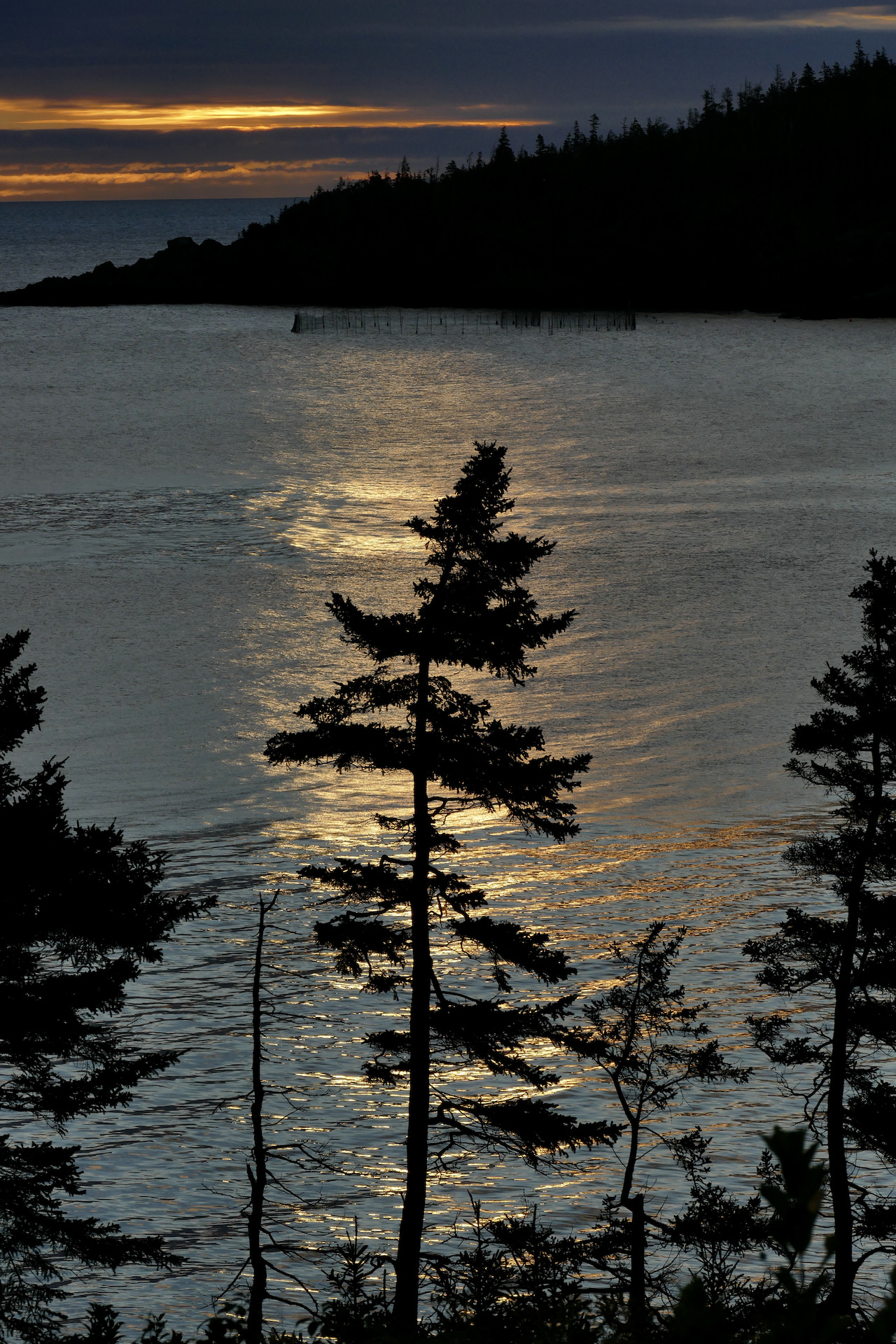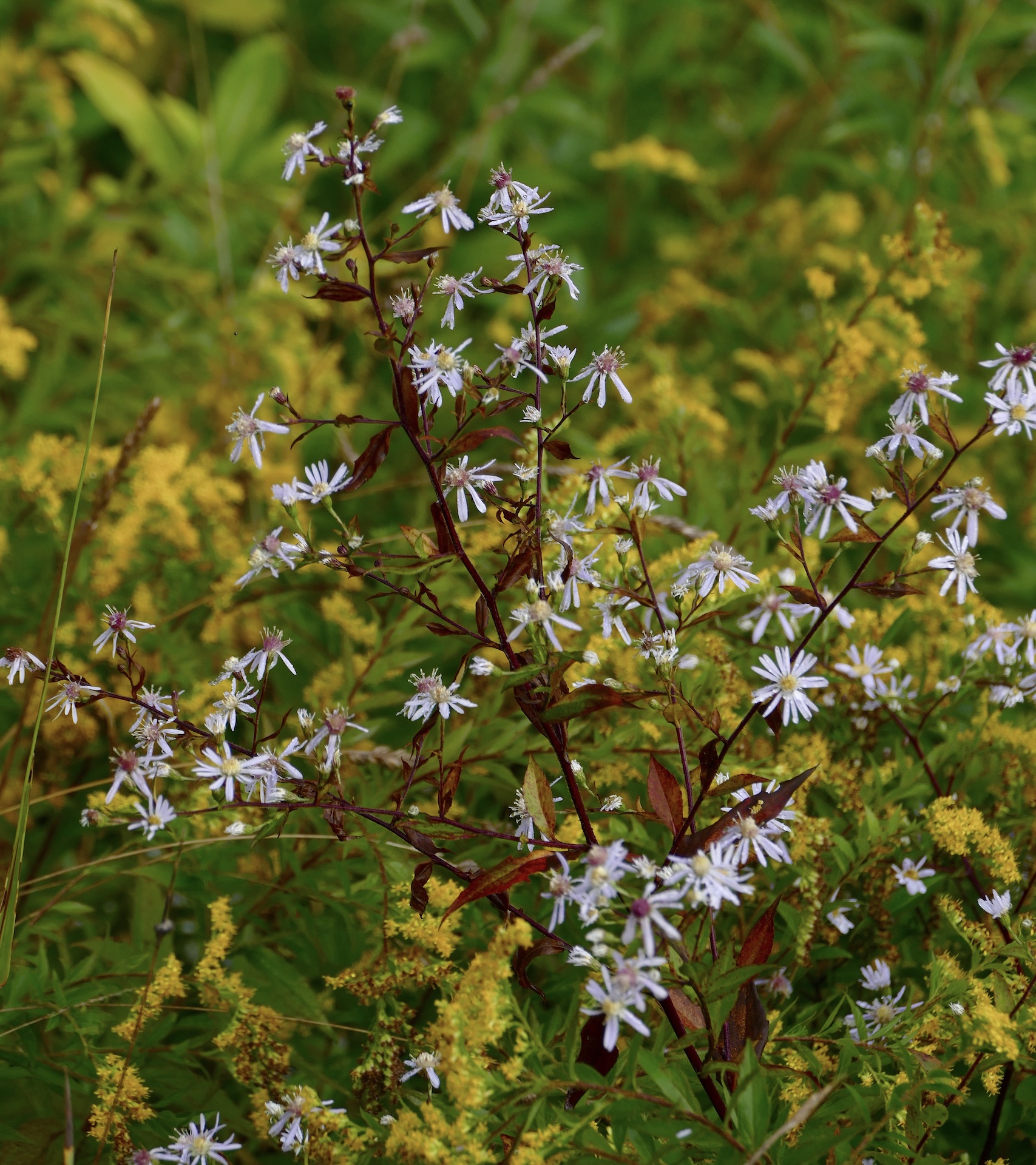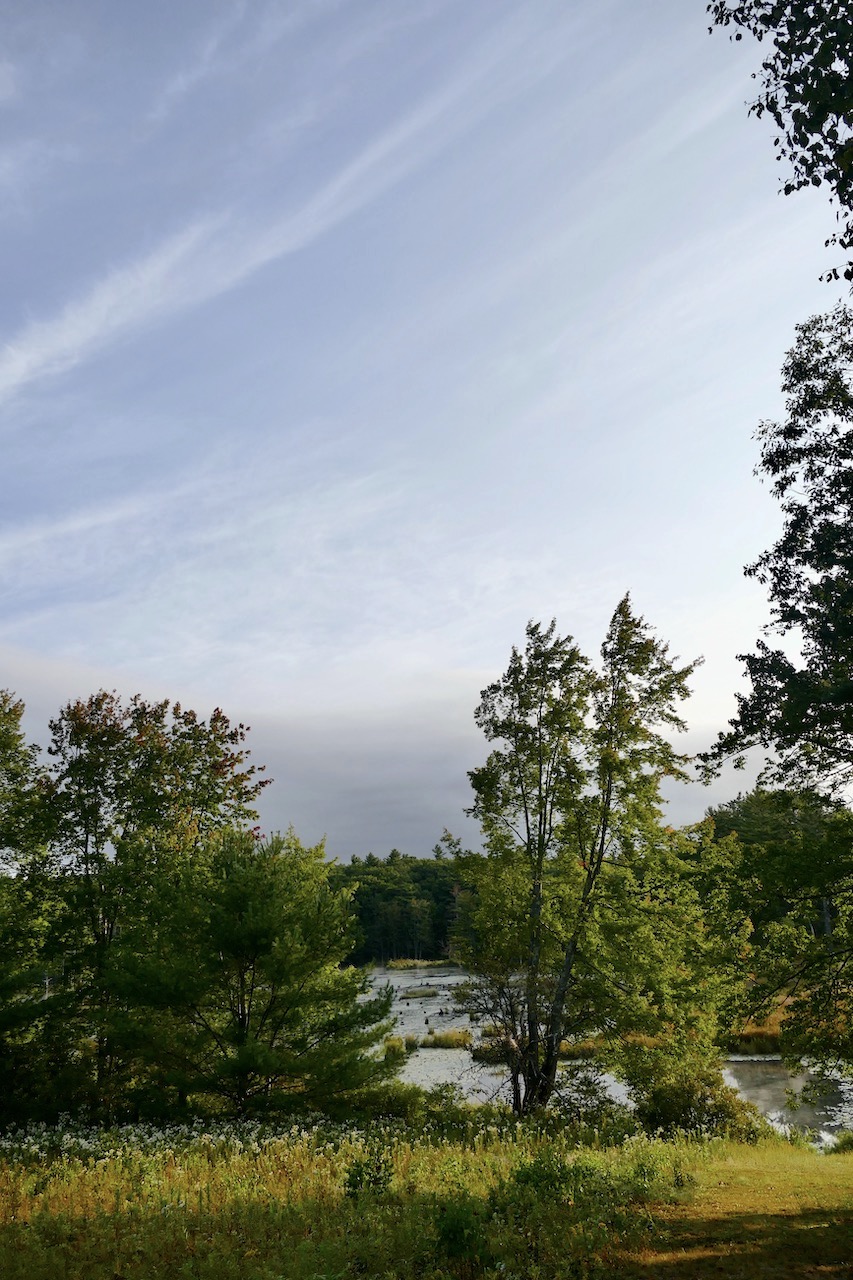
The grass in the high pastures is almost as dry as hay –– The seasons do not cease a moment to revolve, and therefore Nature rests no longer at her culminating point than at any other. If you are not out at the right instant, the summer may go by & you not see it. How much of the year is spring & fall! How little can be called summer! The grass is no sooner grown than it begins to wither.
What means this sense of lateness that so comes over one now––as if the rest of the year were down hill & we had not performed anything before––we should not now–– The season of flowers or of promise may be said to be over & now is the season of fruits; but where is our fruit? The night of the year is approaching, what have we done with our talent?
All nature prompts & reproves us–– How early in the year it begins to be late. The sound of the crickets even in the spring makes our hearts beat with its aweful reproof––while it encourages with its seasonable warning. It matters not by how little we have fallen behind––it seems irretrievably late. The year is full of warnings of its shortness––as is life–– The sound of so many insects & the sight of so many flowers affect us so–– The creak of the cricket & the sight of the Prunella & Autumnal dandelion. They say––for the night cometh in which no man may work.
The High black-berries are now in their prime—the richest berry we have.
The wild black currant by Union Turnpike ripe—(in Gardens some time). The knapweed now conspicuous like a small thistle. Did I set it down too early? Rain Rain rain again! Good for grass & apples…
These are locust days. I hear them on the elms in the street—but cannot tell where they are—loud is their song—drowning many others—but men appear not to distinguish it—though it pervade their ears as the dust their eyes.
The river was exceedingly fair this afternoon—and there are few handsomer reaches than that by the leaning oak—the deep place, where the willows make a perfect shore…
I must look for the Rudbeckia which Bradford says he found yesterday behind Joe Clarks.
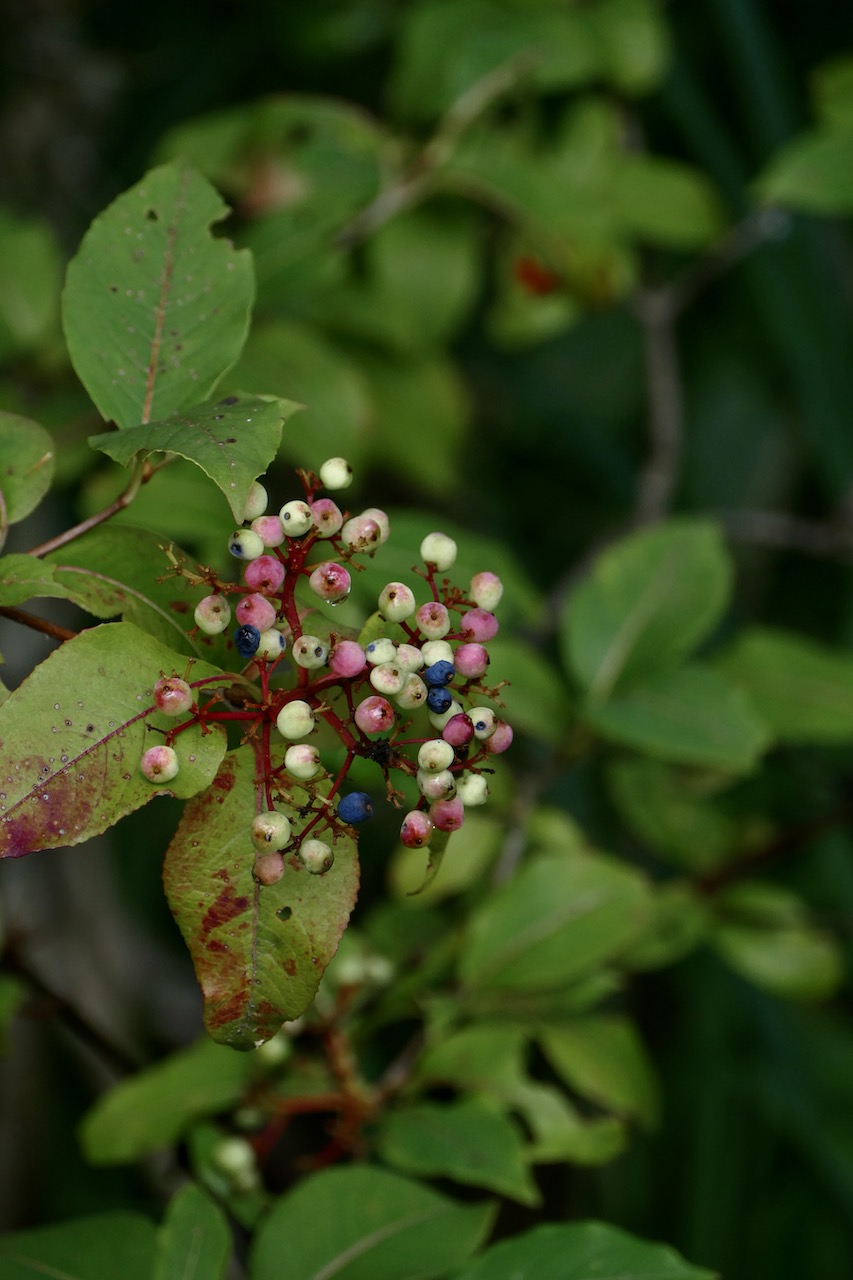
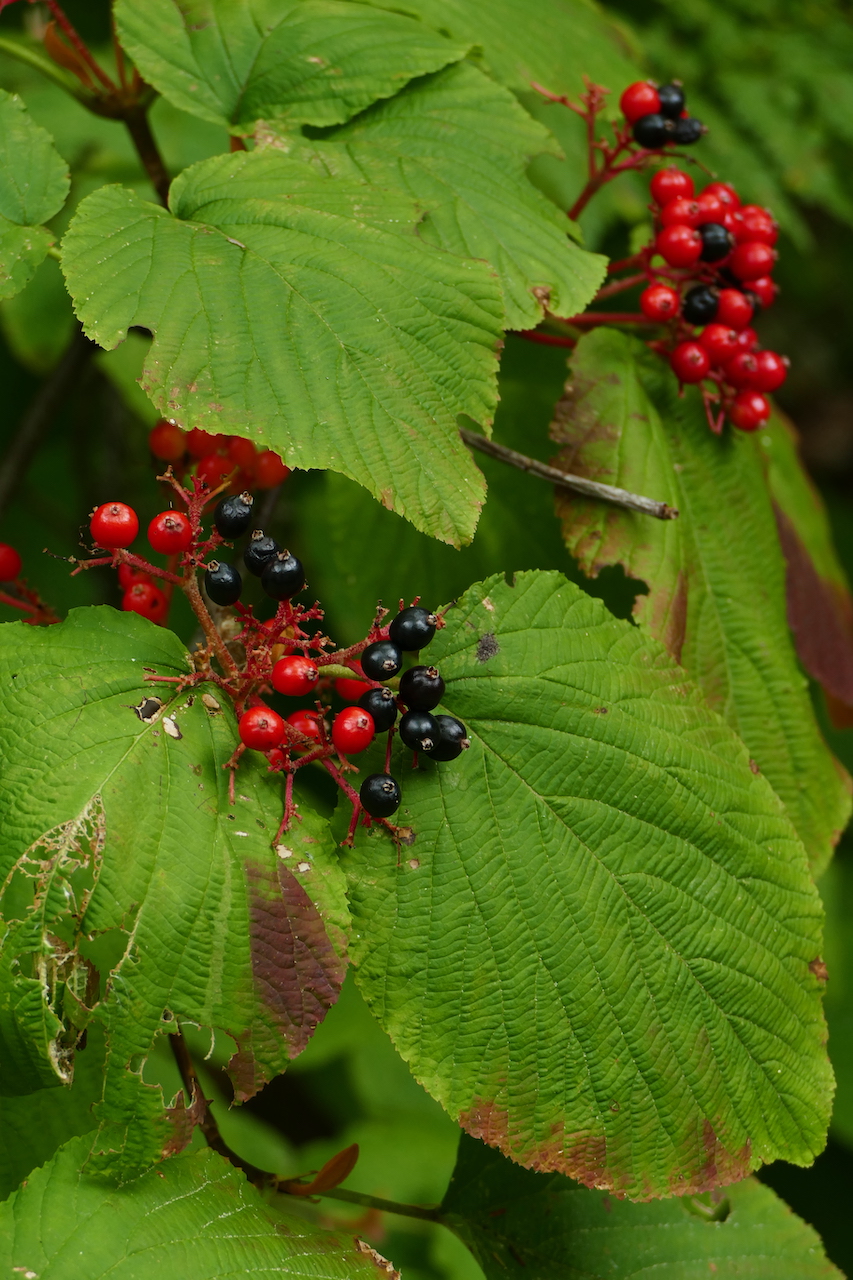
Elder-berry ripe. The river was lowest early in July. Some time past I have noticed meadow-grass floating on the river, reminding me that they were getting the hay up the stream. Some naked viburnum berries are quite dark purple amid the red, while other bunches are wholly green yet. The red choke-berry is small and green still. I plainly distinguish it, also, by its woolly under side. In E. Hubbard’s swamp I gather some large and juicy and agreeable rum cherries. The birds make much account of them. They are much finer than the small ones on large trees; quite a good fruit. Some cranberries turned red on one cheek along the edges of the meadows. Now a sudden gust of wind blows from the northwest, cooled by a storm there, blowing the dust from roads far over the fields. The whole air, indeed, is suddenly filled with dust, and the outlines of the clouds are concealed. But it proves only the wind of the ball, which apparently passes north of us. That clear ring like an alder locust (is it a cricket ?) for some time past is a sound which belongs to the season, —autumnal. Here is a second crop of clover almost as red as the first. The swamp blackberry begins. Saw a blue heron on the meadow. Aster amplexicaulis of Bigelow, apparently; probably for a day or two. An orchis by the brook under the Cliffs with only three white flowers, only smaller than the fringed white; spurs half an inch long. May it be another species?
First marked dog-day; sultry and with misty clouds. For ten days or so we have had comparatively cool, fall-like weather.
I remember only with a pang the past spring and summer thus far. I have not been an early riser. Society seems to have invaded and overrun me. I have drank tea and coffee and made myself cheap and vulgar. My days have been all noontides, without sacred mornings and evenings. I desire to rise early henceforth, to associate with those whose influence is elevating, to have such dreams and waking thoughts that my diet may not be indifferent to me.
Tuesday. 1.30 a. m. —Full moon. Arose and went to the river and bathed, stepping very carefully not to disturb the household, and still carefully in the street not to disturb the neighbors. I did not walk naturally and freely till I had got over the wall. Then to Hubbard’s Bridge at 2 a. m. There was a whip-poor-will in the road just beyond Goodwin’s, which flew up and lighted on the fence and kept alighting on the fence within a rod of me and circling round me with a slight squeak as if inquisitive about me. I do not remember what I observed or thought in coming hither.
The traveller’s whole employment is to calculate what cloud will obscure the moon and what she will triumph over. In the after-midnight hours the traveller’s sole companion is the moon. All his thoughts are centred in her. She is waging continual war with the clouds in his behalf. What cloud will enter the lists with her next, this employs his thoughts; and when she enters on a clear field of great extent in the heavens, and shines unobstructedly, he is glad. And when she has fought her way through all the squadrons of her foes, and rides majestic in a clear sky, he cheerfully and confidently pursues his way, and rejoices in his heart. But if he sees that she has many new clouds to contend with, he pursues his way moodily, as one disappointed and aggrieved he resents it as an injury to himself. It is his employment to watch the moon, the companion and guide of his journey, wading through clouds, and calculate what one is destined to shut out her cheering light. He traces her course, now almost completely obscured, through the ranks of her foes, and calculates where she will issue from them. He is disappointed and saddened when he sees that she has many clouds to contend with.
Sitting on the sleepers of Hubbard’s Bridge, which is being repaired, now, 3 o’clock a. m., I hear a cock crow. How admirably adapted to the dawn is that sound! as if made by the first rays of light rending the darkness, the creaking of the sun’s axle heard already over the eastern hills.
Though man’s life is trivial and handselled, Nature is holy and heroic. With what infinite faith and promise and moderation begins each new day! It is only a little after 3 o’clock, and already there is evidence of morning in the sky.
He rejoices when the moon comes forth from the squadrons of the clouds unscathed and there are no more any obstructions in her path, and the cricket also seems to express joy in his song. It does not concern men who are asleep in their beds, but it is very important to the traveller, whether the moon shines bright and unobstructed or is obscured by clouds. It is not easy to realize the serene joy of all the earth when the moon commences to shine unobstructedly, unless you have often been a traveller by night.
The traveller also resents it if the wind rises and rustles the leaves or ripples the water and increases the coolness at such an hour.
A solitary horse in his pasture was scared by the sudden sight of me, an apparition to him, standing still in the moonlight, and moved about, inspecting with alarm, but I spoke and he heard the sound of my voice; he was at once reassured and expressed his pleasure by wagging his stump of a tail, though still half a dozen rods off. How wholesome the taste of huckleberries, when now by moonlight I feel for them amid the bushes!
And now the first signs of morning attract the traveller’s attention, and he cannot help rejoicing, and the moon begins gradually to fade from his recollection. The wind rises and rustles the copses. The sand is cool on the surface but warm two or three inches beneath, and the rocks are quite warm to the hand, so that he sits on them or leans against them for warmth, though indeed it is not cold elsewhere. As I walk along the side of Fair Haven Hill, I see a ripple on the river, and now the moon has gone behind a large and black mass of clouds, and I realize that I may not see her again in her glory this night, that perchance ere she rises from this obscurity, the sun will have risen, and she will appear but as a cloud herself, and sink unnoticed into the west (being a little after full (a day ?)). As yet no sounds of awakening men; only the more frequent crowing of cocks, still standing on their perches in the barns. The milkmen are the earliest risers, though I see no lanterns carried to their barns in the distance, —preparing to carry the milk of cows in their tin cans for men’s breakfasts, even for those who dwell in distant cities. In the twilight now, by the light of the stars alone, the moon being concealed, they are pressing the bounteous streams from full udders into their milk-pails, and the sound of the streaming milk is all that breaks the sacred stillness of the dawn; distributing their milk to such as have no cows. I perceive no mosquitoes now. Are they vespertinal, like the singing of the whip-poor-will? I see the light of the obscured moon reflected from the river brightly. With what mild emphasis Nature marks the spot! —so bright and serene a sheen that does not more contrast with the night.
4 A. M. —It adds a charm, a dignity, a glory, to the earth to see the light of the moon reflected from her streams. There are but us three, the moon, the earth which wears this jewel (the moon’s reflection) in her crown, and myself. Now there has come round the Cliff (on which I sit), which faces the west, all unobserved and mingled with the dusky sky of night, a lighter and more ethereal living blue, whispering of the sun still far, far away, behind the horizon. From the summit of our atmosphere, perchance, he may already be seen by soaring spirits that inhabit those thin upper regions, and they communicate the glorious intelligence to us lower ones. There real divine, the heavenly, blue, the Jove-containing air, it is, I see through this dusky lower stratum. The sun gilding the summits of the air. The broad artery of light flows overall the sky. Yet not without sadness and compassion I reflect that I shall not see the moon again in her glory. (Not far from four, still in the night, I heard a nighthawk squeak and boom, high in the air, as I sat on the Cliff. What is said about this being less of a night bird than the whip-poor-will is perhaps to be questioned. For neither do I remember to have heard the whip-poor-will sing at 12 o’clock, though I met one sitting and flying between two and three this morning. I believe that both may be heard at midnight, though very rarely.) Now at very earliest dawn the nighthawk booms and the whip-poor-will sings. Returning down the hill by the path to where the woods [are] cut off, I see the signs of the day, the morning red. There is the lurid morning star, soon to be blotted out by a cloud.
There is an early redness in the east which I was not prepared for, changing to amber or saffron, with clouds beneath in the horizon and also above this clear streak.
The birds utter a few languid and yawning notes, as if they had not left their perches, so sensible to light to wake so soon, —a faint peeping sound from I know not what kind, a slight, innocent, half-awake sound, like the sounds which a quiet housewife makes in the earliest dawn. Nature preserves her innocence like a beautiful child. I hear a wood thrush even now, long before sunrise, as in the heat of the day. And the pewee and the catbird and the vireo, red-eyed? I do not hear —or do not mind, perchance—the crickets now. Now whip-poor-wills commence to sing in earnest, considerably after the wood thrush. The wood thrush, that beautiful singer, inviting the day once more to enter his pine woods. (So you may hear the wood thrush and whip-poor-will at the same time.) Now go by two whip-poor-wills, in haste seeking some coverts from the eye of day. And the bats are flying about on the edge of the wood, improving the last moments of their day in catching insects. The moon appears at length, not yet as a cloud, but with a frozen light, ominous of her fate. The early cars sound like a wind in the woods. The chewinks make a business now of waking each other up with their low yorrick in the neighboring low copse. The sun would have shown before but for the cloud. Now, on his rising, not the clear sky, but the cheeks of the clouds high and wide, are tinged with red, which, like the sky before, turns gradually to saffron and then to the white light of day.
The nettle-leaved vervain (Verbena urticifolia) by roadside at Emerson’s. What we have called hemp answers best to Urtica dioica, large stinging nettle? Now the great sunflower’s golden disk is seen.
The days for some time have been sensibly shorter; there is time for music in the evening.
I see polygonums in blossom by roadside, white and red.
A eupatorium from Hubbard’s Bridge causeway answers to E. purpureum, except in these doubtful points, that the former has four leaves in a whorl, is unequally serrate, the stem is nearly filled with a thin pith, the corymb is not merely terminal, florets eight and nine. Differs from verticillatum in the stem being not solid, and I perceive no difference between calyx and corolla in color, if I know what the two are. It may be one of the intermediate varieties referred to.
The tinkling notes of goldfinches and bobolinks which we hear nowadays are of one character and peculiar to the season. They are not voluminous flowers, but rather nuts, of sound, ––ripened seeds of sound. It is the tinkling of ripened grains in Nature’s basket. It is like the sparkle on water, ––a sound produced by friction on the crisped air.
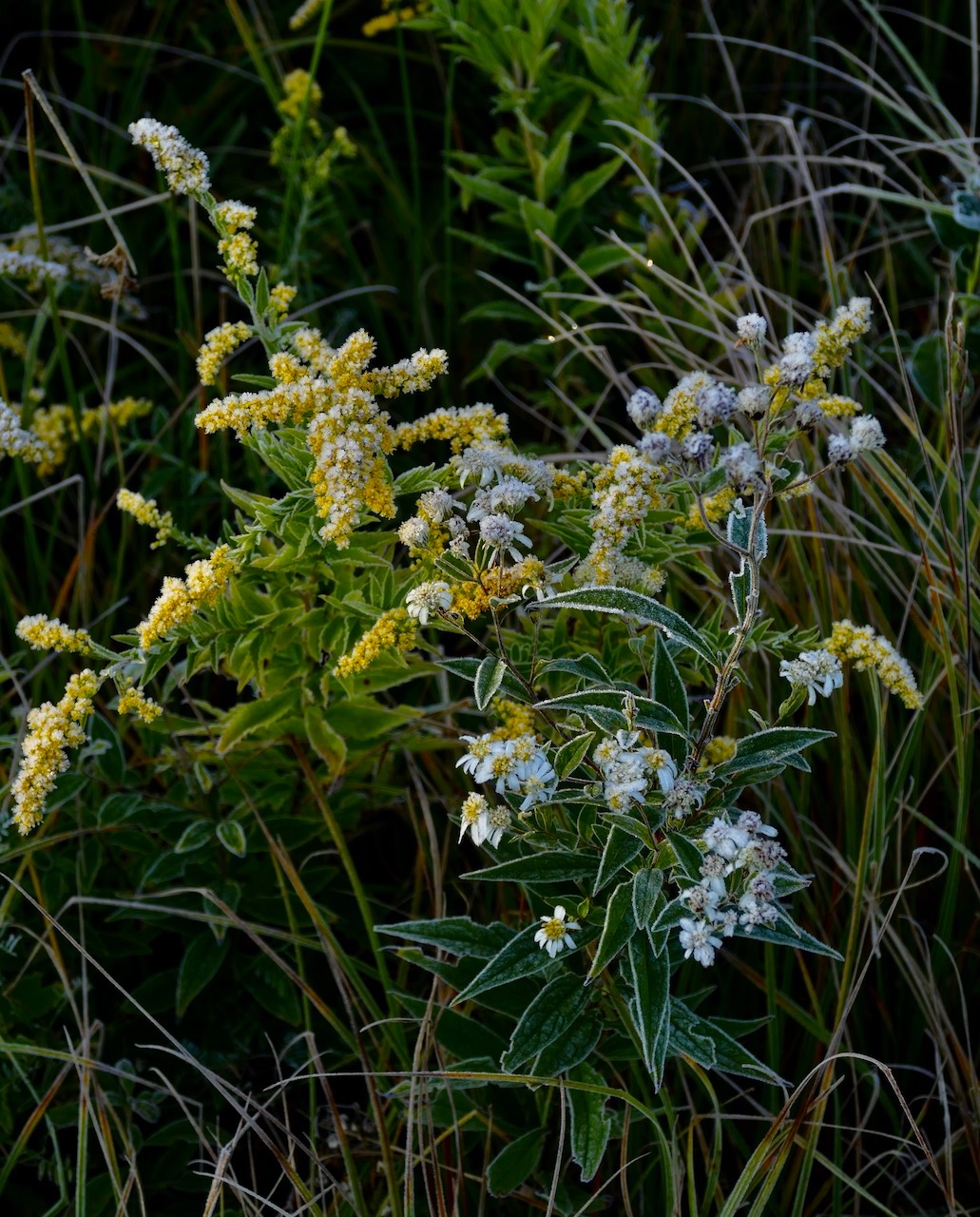
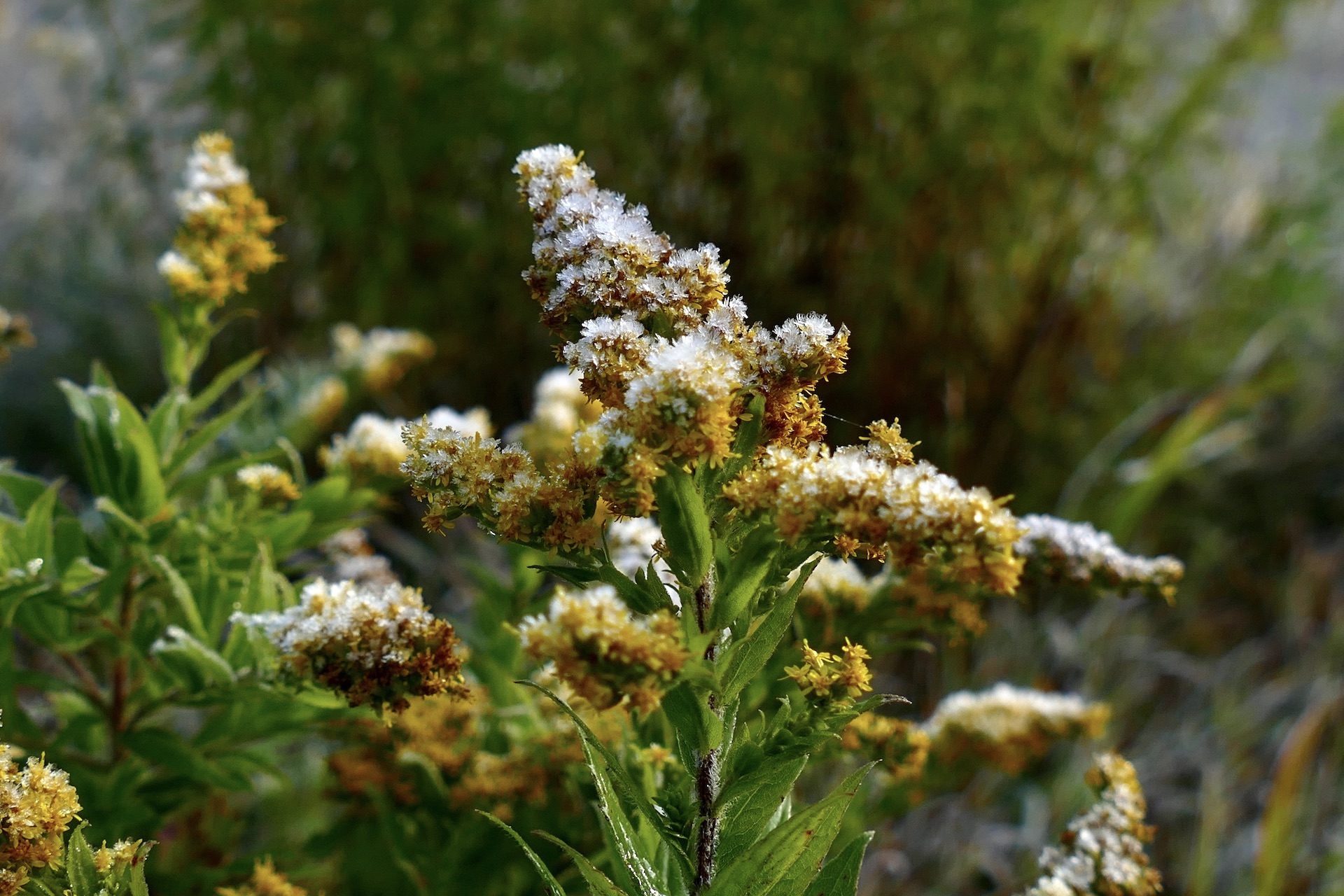
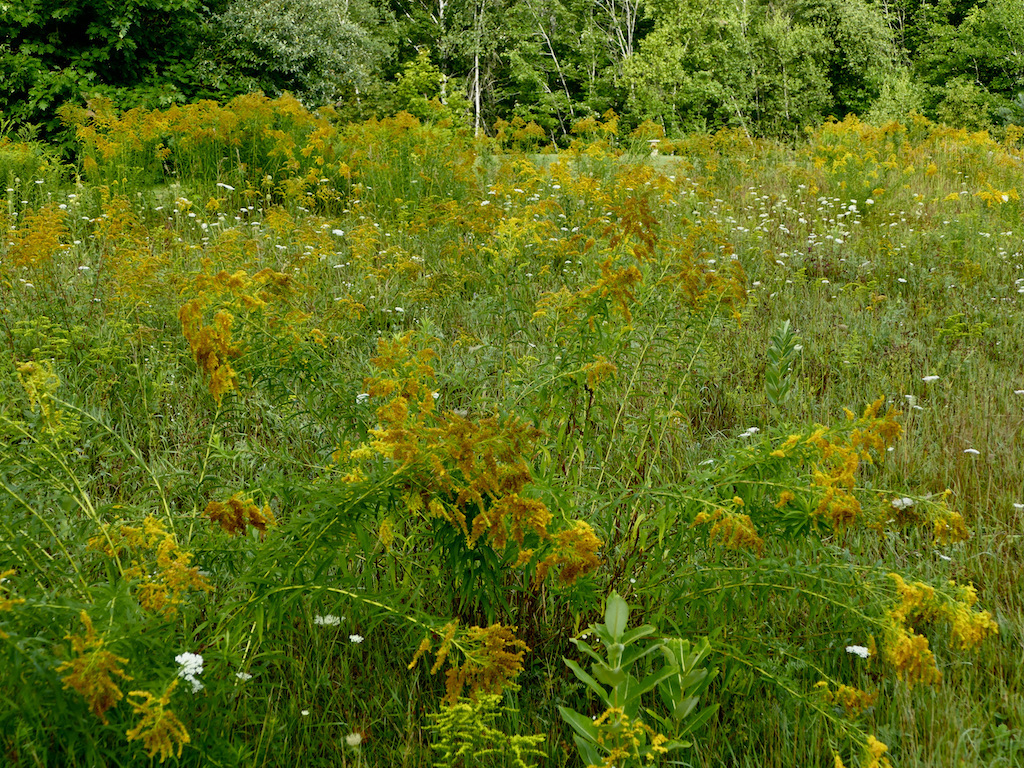
How fatally the season is advanced toward the fall! I am not surprised now to see the small rough sunflower –– There is much yellow beside now in the fields. How beautiful now the early golden rods–– S. stricta rising above the wiry grass of the Great Fields in front of Peters where I sit (which is not worth cutting) not solid yellow like the sunflower––but little pyramidal or sheaf like golden clouds or mists supported by almost invisible leafy columns––which wave in the wind––like this elms which run up very tall & slender without a branch & fall over like a sheaf on every side. They give a very indefinite but rich mellow & golden aspect to the fields–– They are the agreeable for the indistinctness of their outline these pillars of fire, clouds which glow only on one side.
Rattlesnake plantain is budded…..No man ever makes a discovery––ever an observation of the least importance––but he is advertised of the fact by a joy that surprises him. The powers thus celebrate all discovery.
….Still autumnal–breezy with a cool vein in the wind––so that passing from the cool & breezy into the sunny & warm places you begin to love the heat of Summer–– It is the contrast of the cool wind with the warm sun. I walk over the pin-weed field. It is just cool enough––in my thin clothes–– There is a light on the earth & leaves as if they were burnished–– It is the glistening autumnal side of Summer
–– I feel a cool vein in the breeze––which braces my thought––& I pass with pleasure over sheltered & sunny portions of the sand where the summers heat is undiminished––& I realize what a friend I am losing….This off side of summer glistens like a burnished shield. The waters now are some degrees cooler––winds show the undersides of the leaves–– The cool nocturnal creak of the crickets is heard in the mid-afternoon–– Tansy is ap. now in its prime & the early golden-rods have acquired a brighter yellow––
I do not hear this morning the breathing of chip birds—nor the song of robins. Are the mornings now thus ushered in—are they as spring-like? Has not the year grown old. Methinks we do ourselves at any rate some what tire of the season–& observe less attentively and with less interest the opening of new flowers—and the song of the birds– It is the signs of the fall that affect us most. It is hard to live in the summer content with it.
Ah, what a poor, dry compilation is the “Annual of Scientific Discovery!” I trust that observations are made during the year which are not chronicled there, — that some mortal may have caught a glimpse of Nature in some corner of the earth during the year 1851. One sentence of perennial poetry would make me forget, would atone for, volumes of mere science. The astronomer is as blind to the significant phenomena, or the significance of phenomena, as the wood-sawyer who wears glasses to defend his eyes from sawdust. The question is not what you look at, but what you see.
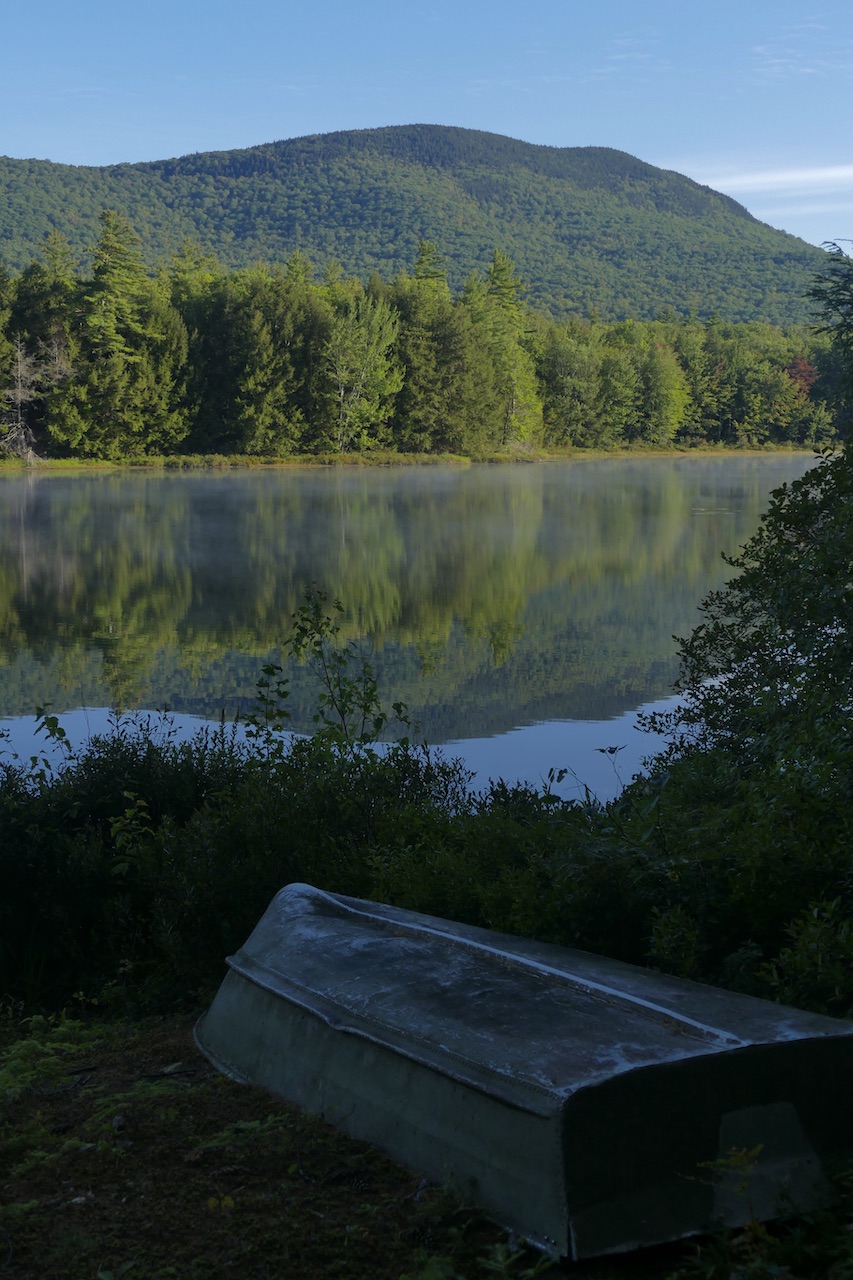
Most huckleberries–& blue berries & low blackberries are in their prime now. A pleasant time to behold a small lake in the woods is in the interval of a gentle rainstorm at this season––when the air & water are perfectly still but the sky still overcast. 1st because the lake is very smooth at such a time––2nd as the atmosphere is so shallow & contracted––being low roofed with clouds––the lake as a lower heaven is much larger in proportion to it–– With its glassy reflecting surface it is somewhat more heavenly & full of light––than the regions of the air above it.
My attic chamber has compelled me to sit below with the family at evening for a month. I feel the necessity of deepening the stream of my life; I must cultivate privacy. It is very dissipating to be with people too much. As C. says, it takes the edge off a man’s thoughts to have been much in society. I cannot spare my moonlight and my mountains for the best of man I am likely to get in exchange––
I am inclined now for a pensive evening walk
Methinks we think of spring mornings and autumn evenings. I go via Hubbard Path. Chelone say two days X at Conants meadow beyond Wheelers. July has been to me a trivial month. It began hot and continued drying, then rained some toward the middle, bringing anticipations of the fall, and then was hot again about the 20th. It has been a month of haying, heat, low water, and weeds. Birds have grown up and flown more or less in small flocks, though I notice a new sparrow’s nest and eggs and perhaps a catbird’s eggs lately. The woodland quire has steadily diminished in volume.
At the bass I now find that that memorable hum has ceased and the green berries are formed. Now blueberries, huckleberries, and low blackberries are in their prime. The fever-bush berries will not be ripe for two or three weeks.
At Bittern Cliff the Gerardia quercifolia (?), apparently four or five days at least. How interesting the small alternate cornel trees, with often a flat top, a peculiar ribbed and green leaf, and pretty red stems supporting its harmless blue berries inclined to drop off ! The sweet viburnum, not yet turning. I see apparently a thistle-down over the river at Bittern Cliff; it is borne toward me, but when it reaches the rock some influence raises it high above the rock out of my reach. What a fall-like look the decayed and yellow leaves of the large Solomon’s-seal have in the thickets now! These, with skunk-cabbage and hellebore, suggest that the early ripeness of leaves, etc., has somewhat normal in it,— there is a fall already begun. Eupatorium sessilifolium, one or two stamens apparently for two days; its smooth leaf distinguishes it by the touch from the sunflower.
I sat on the Bittern Cliff as the still eve drew on. There was a man on Fair Haven furling his sail and bathing from his boat. A boat on a river whose waters are smoothed, and a man disporting in it! How it harmonizes with the stillness and placidity of the evening! Who knows but he is a poet in his yet obscure but golden youth? Few else go alone into retired scenes without gun or fishing-rod. He bathes in the middle of the pond while his boat slowly drifts away. As I go up the hill, surrounded by its shadow, while the sun is setting, I am soothed by the delicious stillness of the evening, save that on the hills the wind blows. I was surprised by the sound of my own voice. It is an atmosphere burdensome with thought. For the first time for a month, at least, I am reminded that thought is possible. The din of trivialness is silenced. I float over or through the deeps of silence. It is the first silence I have heard for a month. My life had been a River Platte, tinkling over its sands but useless for all great navigation, but now it suddenly became a fathomless ocean. It shelved off to unimagined depths.
I sit on rock on the hill top––warm with the heat of the departed sun, in my thin summer clothes. Here are the seeds of some berries in the droppings of some bird on the rock. The sun has been set fifteen minutes, and a long cloudy finger, stretched along the northern horizon, is held over the point where it disappeared. I see dark shadows formed on the south side of the woods east of the river. The creaking of the crickets becomes clear and loud and shrill, —a sharp tinkling, like rills bubbling up from the ground. After a little while the western sky is suddenly suffused with a pure white light, against which the hickories further east on the hill show black with beautiful distinctness. Day does not furnish so interesting a ground. A few sparrows sing as in the morning and the spring; also a peawai and a chewink. Meanwhile the moon in her first quarter is burnishing her disk. Now suddenly the cloudy finger and the few scattered clouds glow with the parting salute of the sun; the rays of the sun, which has so long sunk below the convex earth, are reflected from each cloudy promontory with more incomparable brilliancy than ever.
The hardhack leaves stand up so around the stem that now, at first starlight, I see only their light undersides a rod off. Do they as much by day? The surface of the forest on the east of the river presents a singularly cool and wild appearance, —cool as a pot of green paint, ––stretches of green light and shade, reminding me of some lonely mt side. The nighthawk flies low-skimming over the ground now. How handsome lie the oats which have been cradled in long rows in the field, a quarter of a mile uninterruptedly!
The thick stub ends, so evenly laid, are almost as rich a sight to me as the graceful tops. A few fireflies in the meadows. I am uncertain whether that so large and bright and high was a fire-fly or a shooting star. Shooting stars are but fireflies of the firmament. The crickets on the causeway make a steady creak, on the dry pasture-tops an interrupted one. I was compelled to stand to write where a soft, faint light from the western sky came in between two willows.
Fields today sends me a specimen copy of my “Walden” It is to be published on the 12 inst.
How much of beauty–of color as well as form–on which our eyes daily rest goes unperceived by us! No one but a botanist is likely to perceive nicely the different shades of green which the open surface of the earth is clothed–not even a landscape painter if he does not know the species of sedges and grasses which paint it. With respect to the color of grass, most of those even who attend peculiarly to the aspects of Nature only observe that it is more or less dark or light, green or brown, or velvety, fresh or parched, etc. But if you are studying grasses you look for another and different beauty, and you find it, in the wonderful variety of color, etc., presented by the various species.
Take the bare, unwooded earth now, and consider the beautiful variety of shades (or tints ?) of green that clothe it under a bright sun. The pastured hills of Conantum, now just imbrowned (probably by the few now stale flowering tops of the red-top which the cows have avoided as too wiry), present a hard and solid green or greenish brown, just touched here and there delicately with light patches of sheep’s fescue (though it may be only its radical leaves left), as if a dew lay on it there, —and this has some of the effect of a watered surface, —and the whole is dotted with a thousand little shades of projecting rocks and shrubs. Then, looking lower at the meadow in Miles’s field, that is seen as a bright-yellow and sunny stream (yet with a slight tinge of glaucous) between the dark-green potato-fields, flowing onward with windings and expansions, and, as it were, with rips and waterfalls, to the river meadows.
You must be logged in to post a comment.