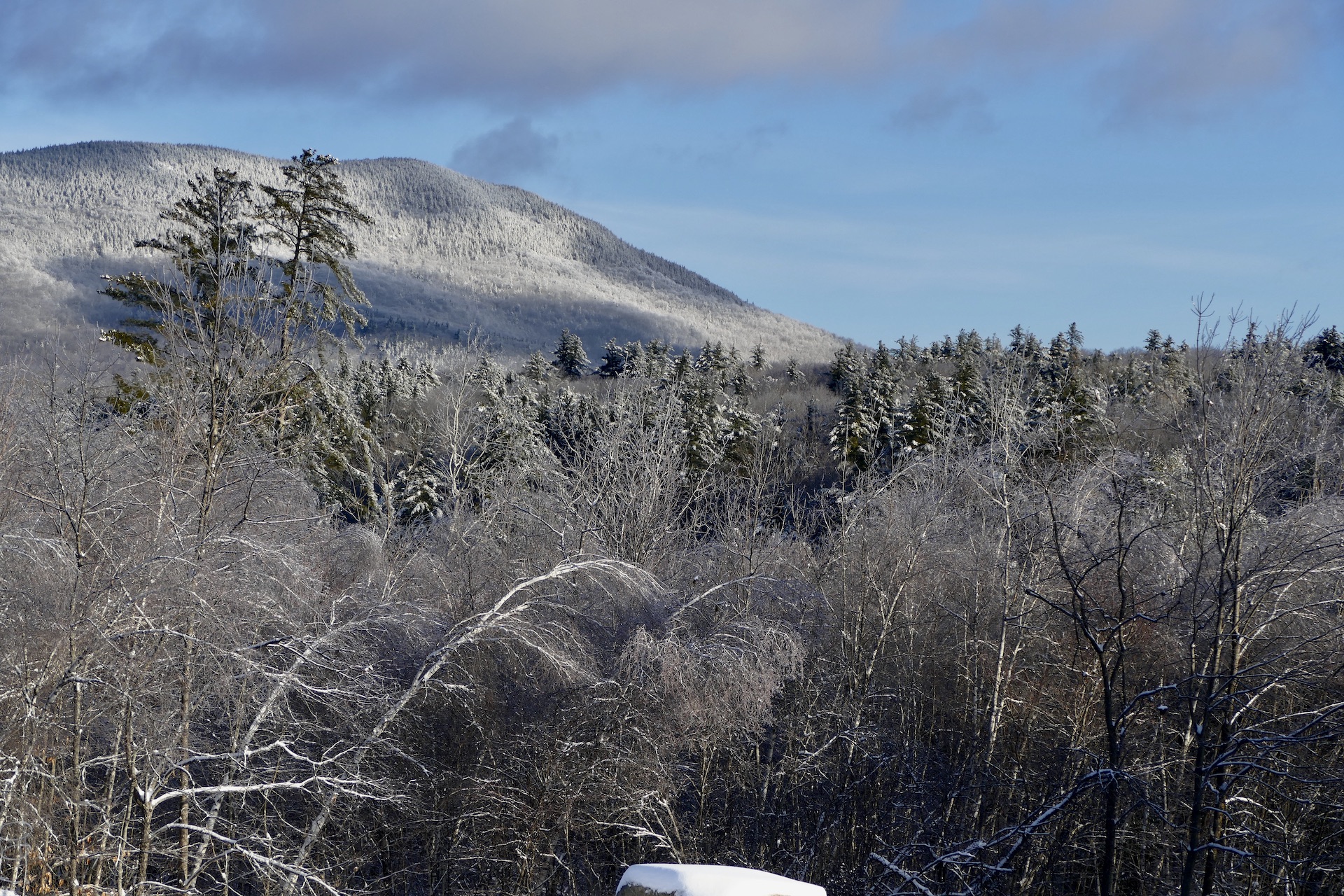
In this clear air and bright sunlight, the ice covered trees have a new beauty, especially the birches along under the edge of Warren’s wood….bent quite to the ground in every kind of curve….The birch is remarkable, perhaps, from the feathery form of the tree, whose numerous small branches sustain so great a weight, bending it to the ground; and, moreover, because, from the color of the bark, the core is less observable….The birches droop over in all directions, like ostrich feathers.
If there were no other vicissitudes but the seasons, with their attendant and consequent changes, our interest would never flag. Much more is a-doing than Congress wots of in the winter season. What journal do the persimmon and buckeye keep, or the sharp-shinned hawk? What is transpiring from summer to winter in the Carolinas, and the Great Pine Forest, and the Valley of the Mohawk? The merely political aspect of the land is never very cheering— Men are degraded when considered as members of a political organisation….
In society you will not find health, but in nature— You must converse much with the field and woods if you would imbibe such health into your mind and spirit as you covet for your body.
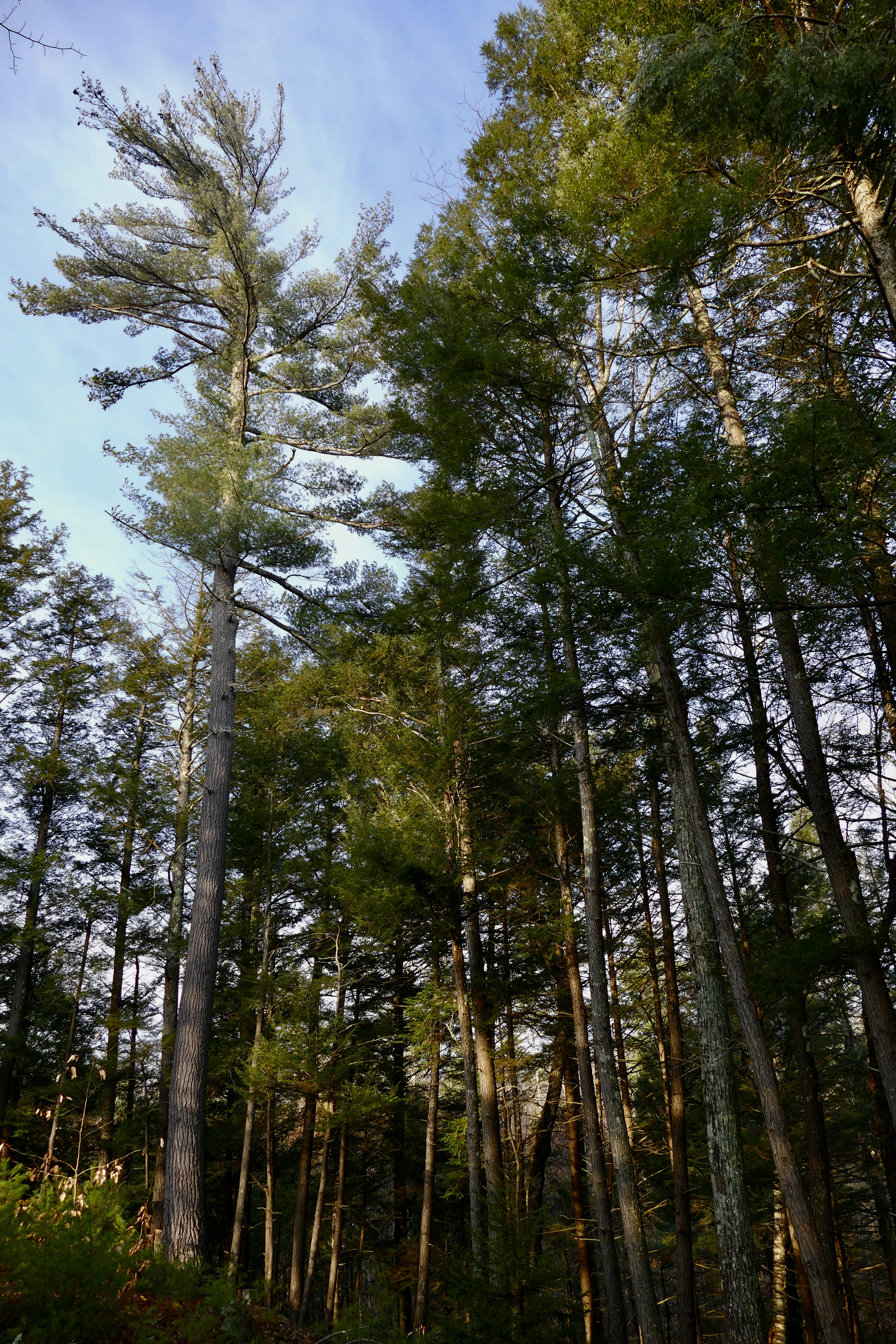
This afternoon, being on Fair Haven Hill, I heard the sound of a saw, and soon after from the Cliff saw two men sawing down a noble pine beneath, about forty rods off. I resolved to watch it till it fell, the last of a dozen or more which were left when the forest was cut and for fifteen years have waved in solitary majesty over the sprout-land. I saw them like beavers or insects gnawing at the trunk of this noble tree, the diminutive manikins with their cross-cut saw which could scarcely span it. It towered up a hundred feet as I afterward found by measurement, one of the tallest probably in the township and straight as an arrow, but slanting a little toward the hillside, its top seen against the frozen river and the hills of Conantum. I watch closely to see when it begins to move. Now the sawyers stop, and with an axe open it a little on the side toward which it leans, that it may break the faster. And now their saw goes again. Now surely it is going; it is inclined one quarter of the quadrant, and, breathless, I expect its crashing fall. But no, I was mistaken; it has not moved an inch; it stands at the same angle as at first. It is fifteen minutes yet to its fall. Still its branches wave in the wind, as if it were destined to stand for a century, and the wind soughs through its needles as of yore; it is still a forest tree, the most majestic tree that waves over Musketaquid. The silvery sheen of the sunlight is reflected from its needles; it still affords an inaccessible crotch for the squirrel’s nest; not a lichen has forsaken its mast-like stem, its raking mast, —the hill is the hulk. Now, now ‘s the moment! The manikins at its base are fleeing from their crime. They have dropped the guilty saw and axe. How slowly and majestically it starts! as if it were only swayed by a summer breeze, and would return without a sigh to its location in the air. And now it fans the hillside with its fall, and it lies down to its bed in the valley, from which it is never to rise, as softly as a feather, folding its green mantle about it like a warrior, as if, tired of standing, it embraced the earth with silent joy, returning its elements to the dust again. But hark! there you only saw, but did not hear. There now comes up a deafening crash to these rocks, advertising you that even trees do not die without a groan. It rushes to embrace the earth, and mingle its elements with the dust. And now all is still once more and forever, both to eye and ear.
I went down and measured it. It was about four feet in diameter where it was sawed, about one hundred feet long. Before I had reached it the axemen had already half divested it of its branches. Its gracefully spreading top was a perfect wreck on the hillside as if it had been made of glass, and the tender cones of one year’s growth upon its summit appealed in vain and too late to the mercy of the chopper. Already he has measured it with his axe, and marked off the mill-logs it will make. And the space it occupied in upper air is vacant for the next two centuries. It is lumber. He has laid waste the air. When the fishhawk in the spring revisits the banks of the Musketaquid, he will circle in vain to find his accustomed perch, and the hen-hawk will mourn for the pines lofty enough to protect her brood. A plant which it has taken two centuries to perfect, rising by slow stages into the heavens, has this afternoon ceased to exist. Its sapling top had expanded to this January thaw as the forerunner of summers to come. Why does not the village bell sound a knell ? I hear no knell tolled. I see no procession of mourners in the streets, or the woodland aisles. The squirrel has leaped to another tree; the hawk has circled further off, and has now settled upon a new eyrie, but the woodman is preparing [to] lay his axe at the root of that also.
We must go out and re-ally ourselves to nature every day. We must make root, send out some little fibre at least, even every winter day. I am sensible that I am imbibing health when I open my mouth to the wind. Staying in the house breeds a sort of insanity always. Every house is, in this sense, a sort of hospital. A night and a forenoon is as much confinement to those wards as I can stand. I am aware that I recover some sanity, which I had lost, almost the instant that I come abroad.
Both for bodily and mental health, court the present. Embrace health wherever you find her. A clump of birches raying out from one centre make a more agreeable object than a single tree. The rosettes in the ice, as Channing calls them, now and for some time have attracted me.
It is worth the while to apply what wisdom one has to the conduct of his life, surely. I find myself oftenest wise in little things and foolish in great ones. That I may accomplish some particular petty affair well, I live my whole life coarsely. A broad margin of leisure is as beautiful in a man’s life as in a book.
Haste makes waste, no less in life than in housekeeping. Keep the time, observe the hours of the universe, not of the cars. What are three score years and ten hurriedly and coarsely lived to moments of divine leisure in which your life is coincident with the life of the universe ? We live too fast and coarsely, just as we eat too fast, and do not know the true savor of our food. We consult our will and understanding and the expectation of men, not our genius. I can impose upon myself tasks which will crush me for life and prevent all expansion, and this I am but too inclined to do.
One moment of life costs many hours–hours not of business but of preparation and invitation. Yet the man who does not betake himself at once and desperately to sawing is called a loafer, though he may be knocking at the doors of heaven all the while, which shall surely be opened to him. That aim in life is highest which requires the highest and finest discipline. How much, what infinite leisure it requires, as of a lifetime, to appreciate a single phenomenon! You must camp down beside it, as if for life, having reached your land of promise, and give yourself wholly to it. It must stand for the whole world for you, symbolical of all things. The least partialness is your own defect of sight and cheapens the experience fatally. Unless the humming of a gnat is as the music of the spheres, and the music of’ the spheres is as the humming of a gnat, they are naught to me. It is not communications to serve for a history, —which are science, —but the great story itself, that cheers and satisfies us.
The man is blessed who every day is permitted to behold anything so pure and serene as the western sky at sunset, while revolutions vex the world.
There is no winter necessarily in the sky, though snow covers the earth. They sky is always ready to answer our moods. We can see summer there or winter.
After snow, rain, and hail yesterday and last night, we have this morning quite a glaze, there being at last an inch or two of crusted snow on the ground, the most we have had. The sun comes out at 9 a. m. and lights up the ice-incrusted trees, but it is pretty warm and the ice rapidly melts.
I go to Walden via the almshouse and up the railroad. Trees seen in the west against the dark cloud, the sun shining on them, are perfectly white as frostwork, and their outlines very perfectly and distinctly revealed, great wisps that they are and ghosts of trees, with recurved twigs. The walls and fences are encased, and the fields bristle with a myriad of crystal spears. Already the wind is rising and a brattling is heard overhead in the street. The sun, shining down a gorge over the woods at Brister’s Hill, reveals a wonderfully brilliant as well as seemingly solid and diversified region in the air. The ice is from an eighth to a quarter of an inch thick about the twigs and pine-needles, only half as thick commonly on one side. Their heads are bowed; their plumes and needles are stiff, as if preserved under glass for the inspection of posterity.
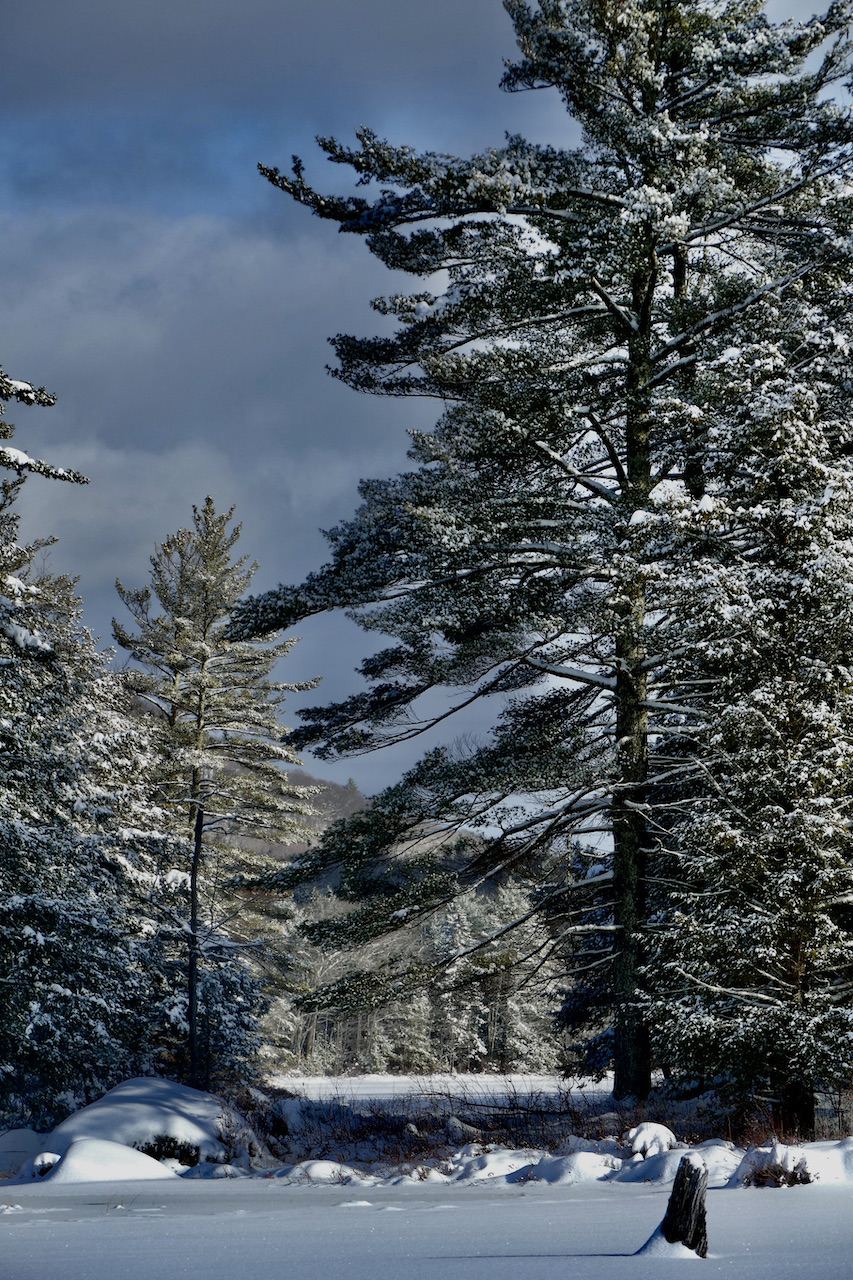
Thus is our now especially slow-footed river laid up not merely on the meadows, but on the twigs and leaves of the trees, on the needles of the pines. The pines thus weighed down are sharp-pointed at top and remind me of firs and even hemlocks, their drooping boughs being wrapped about them like the folds of a cloak or a shawl.
The crust is already strewn with bits of the green needles which have been broken off. Frequently the whole top stands up bare, while the middle and lower branches are drooping and massed together, resting on one another.
But the low and spreading weeds in the fields and the wood-paths are the most interesting. Here are asters, savory-leaved, whose flat imbricated calyxes, three quarters of an inch over, are surmounted and inclosed in a perfectly transparent ice button, like a glass knob, through which you see the reflections of the brown calyx. These are very common. Each little blue-curls calyx has a spherical button like those brass ones on little boys’ jackets, —little sprigs on them, —and the pennyroyal has still smaller spheres, more regularly arranged about its stem, chandelier-wise, and still smells through the ice. The finest grasses support the most wonderful burdens of ice and most branched on their minute threads. These weeds are spread and arched over into the snow again, — countless little arches a few inches high, each cased in ice, which you break with a tinkling crash at each step.
The scarlet fruit of the cockspur lichen, seen glowing through the more opaque whitish or snowy crust of a stump, is, on close inspection, the richest sight of all, for the scarlet is increased and multiplied by reflection through the bubbles and hemispherical surfaces of the crust, as if it covered some vermilion grain thickly strewn. And the brown cup lichens stand in their midst. The whole rough bark, too, is encased.
Already a squirrel has perforated the crust above the mouth of his burrow, here and there by the side of the path, and left some empty acorn shells on the snow. He has shovelled out this morning before the snow was frozen on his door-step.
Now, at 10 a. m., there blows a very strong wind from the northwest, and it grows cold apace.
Particularly are we attracted in the winter by greenness and signs of growth, as the green and white shoots of grass and weeds, pulled or floating on the water, and also by color, as cockspur lichens and crimson birds, etc.
Thorny bushes look more thorny than ever; each thorn is prolonged and exaggerated.
Some boys have come out to a wood-side hill to coast. It must be sport to them, lying on their stomachs, to hear their sled cronching the crystalled weeds when they have reached the more weedy pasture below.
4 p. m. — Up railroad. Since the sun has risen higher and fairly triumphed over the clouds, the ice has glistened with all the prismatic hues. On the trees it is now considerably dissipated, but rather owing to the wind than the sun. The ice is chiefly on the upper and on the storm side of twigs, etc. The whole top of the pine forest, as seen miles off in the horizon, is of sharp points, the leading shoots with a few plumes, even more so than I have drawn on the last page but one.
It has grown cold, and the crust bears. The weeds and grasses, being so thickened by this coat of ice, appear much more numerous in the fields. It is surprising what a bristling crop they are. The sun is gone before five. Just before I looked for rainbow flocks in the west, but saw none, —only some small pink-dun(?)clouds. In the east still larger ones,which after sunset turned to pale slate.
In a true history or biography, of how little consequence those events of which so much is commonly made ! For example, how difficult for a man to remember in what towns or houses he has lived, or when Yet one of the first steps of his biographer will be to establish these facts, and he will thus give an undue importance to many of them. I find in my Journal that the most important events in my life, if recorded at all, are not dated.
Thursday. Via spruce swamp on Conantum to hilltop, returning across river over shrub oak plain to Cliffs.
A wind is now blowing the light snow which fell a day or two ago into drifts, especially on the lee, now the south, side of the walls, the outlines of the drifts corresponding to the chinks in the walls and the eddies of the wind. The snow glides, unperceived for the most part, over the open fields without rising into the air (unless the ground is elevated), until it reaches an opposite wall, which it sifts through and is blown over, blowing off from it like steam when seen in the sun. As it passes through the chinks, it does not drive straight onward, but curves gracefully upwards into fantastic shapes, somewhat like the waves which curve as they break upon the shore; that is, as if the snow that passes through a chink were one connected body, detained by the friction of its lower side. It takes the form of saddles and shells and porringers. It builds up a fantastical alabaster wall behind the first,—a snowy sierra. It is wonderful what sharp turrets it builds up, — builds up, i. e. by accumulation though seemingly by attrition, though the curves upward to a point like the prows of ancient vessels look like sharp carving, or as if the material had been held before the blow pipe. So what was blown up into the air gradually sifts down into the road or field, and forms the slope of the sierra. Astonishingly sharp and thin overhanging eaves it builds, even this dry snow, where it has the least suggestion from a wall or bank, — less than a mason ever springs his brick from. This is the architecture of the snow. On high hills exposed to wind and sun, it curls off like the steam from a damp roof in the morning. Such sharply defined forms it takes as if the core had been the flames of gaslights.
I go forth to see the sunset. Who knows how it will set, even half an hour beforehand? whether it will go down in clouds or a clear sky? I feel that it is late when the mountains in the north and northwest have ceased to reflect the sun. The shadow is not partial but universal.
In a winter day the sun is almost all in all.
I witness a beauty in the form or coloring of the clouds which addresses itself to my imagination, for which you account scientifically to my understanding, but do not so account to my imagination. It is what it suggests and is the symbol of that I care for, and if, by any trick of science, you rob it of its symbolicalness, you do me no service and explain nothing. I, standing twenty miles off, see a crimson cloud in the horizon. You tell me it is a mass of vapor which absorbs all other rays and reflects the red, but that is nothing to the purpose, for this red vision excites me, stirs my blood, makes my thoughts flow, and I have new and indescribable fancies, and you have not touched the secret of that influence. If there is not something mystical in your explanation, something unexplainable to the understanding, some elements of mystery, it is quite insufficient. If there is nothing in it which speaks to my imagination, what boots it? What sort of science is that which enriches the understanding, but robs the imagination? not merely robs Peter to pay Paul, but takes from Peter more than it ever gives to Paul? That is simply the way in which it speaks to the understanding, and that is the account which the understanding gives of it; but that is not the way it speaks to the imagination, and that is not the account which the imagination gives of it. Just as inadequate to a pure mechanic would be a poet’s account of a steam-engine.
If we knew all things thus mechanically merely, should we know anything really?
It would be a truer discipline for the writer to take the least film of thought that floats in the twilight sky of his mind for his theme, about which he has scarcely one idea (that would be teaching his ideas how to shoot), faintest intimations, shadowiest subjects, make a lecture on this, by assiduity and attention get perchance two views of the same, increase a little the stock of knowledge, clear a new field instead of manuring the old; instead of making a lecture out of such obvious truths, hackneyed to the minds of all thinkers. We seek too soon to ally the perceptions of the mind to the experience of the hand, to prove our gossamer truths practical, to show their connection with our everyday life (better show their distance from our everyday life), to relate them to the cider-mill and the banking institution. Ah, give me pure mind, pure thought! Let me not be in haste to detect the universal law; let me see more clearly a particular instance of it! Much finer themes I aspire to, which will yield no satisfaction to the vulgar mind, not one sentence for them. Perchance it may convince such that there are more things in heaven and earth than are dreamed of in their philosophy. Dissolve one nebula, and so destroy the nebular system and hypothesis. Do not seek expressions, seek thoughts to be expressed. By perseverance you get two views of the same rare truth.
That way of viewing things you know of, least insisted on by you, however, least remembered, — take that view, adhere to that, insist on that, see all things from that point of view. Will you let these intimations go unattended to and watch the door-bell or knocker ? That is your text. Do not speak for other men; speak for yourself. They show you as in a vision the kingdoms of the world, and of all the worlds, but you prefer to look in upon a puppet-show. Though you should only speak to one kindred mind in all time, though you should not speak to one, but only utter aloud, that you may the more completely realize and live in the idea which contains the reason of your life, that you may build yourself up to the height of your conceptions, that you may remember your Creator in the days of your youth and justify His ways to man, that the end of life may not be its amusement, speak — though your thought presupposes the non-existence of your hearers — thoughts that transcend life and death. What though mortal ears are not fitted to hear absolute truth! Thoughts that blot out the earth are best conceived in the night, when darkness has already blotted it out from sight.
In walking across the Great Meadows to-day on the snow-crust, I noticed that the fine, dry snow which was blown over the surface of the frozen field, when I looked westward over it or toward the sun, looked precisely like steam curling up from its surface, as sometimes from a wet roof when the sun comes out after a rain.
The snow catches only in the hollows and against the reeds and grass, and never rests there, but when it has formed a broad and shallow drift or a long and narrow one like a winrow on the ice, it blows away again from one extremity, and leaves often a thin, tongue-like projection at one end, some inches above the firm crust.
I observe that there are many dead pine-needles sprinkled over the snow, which had not fallen before. Saw a shrike pecking to pieces a small bird, apparently a snowbird. At length he took him up in his bill, almost half as big as himself, and flew slowly off with his prey dangling from his beak. I find that I had not associated such actions with my idea of birds. It was not birdlike.
It is never so cold but it melts somewhere. Our mason well remarked that he had sometimes known it to be melting and freezing at the same time on a particular side of a house; while it was melting on the roof the icicles [were] forming under the eaves. It is always melting and freezing at the same time when icicles are formed.
Our thoughts are with those among the dead into whose sphere we are rising, or who are now rising into our own. Others we inevitably forget, though they be brothers and sisters.
Thus the departed may be nearer to us than when they were present. At death our friends and relations either draw nearer to us and are found out, or depart further from us and are forgotten. Friends are as often brought nearer together as separated by death.
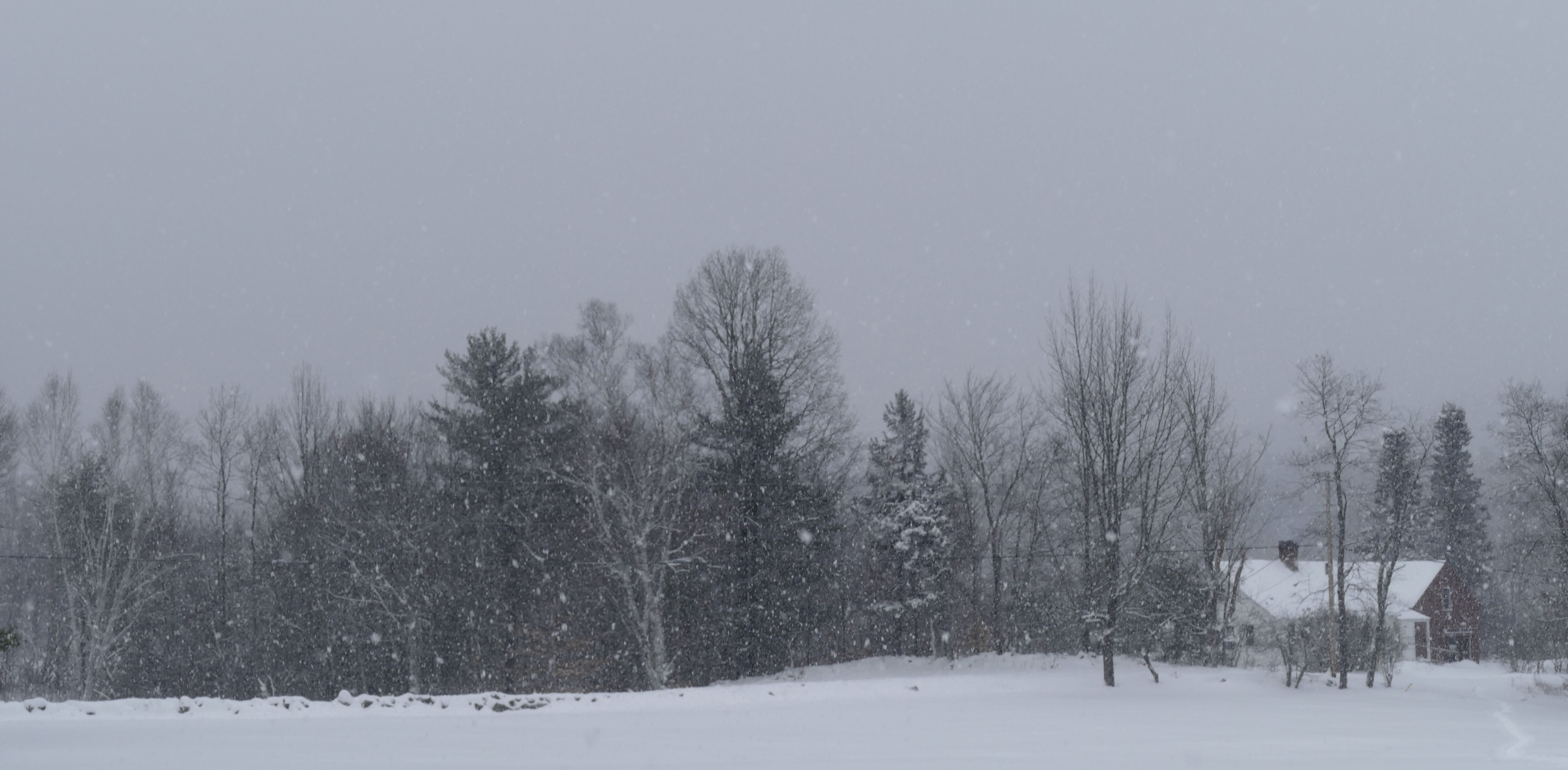
Here is an old-fashioned snow-storm– There is not much passing on railroads. The engineer says it is 3 feet deep above. Walden is frozen, one third of it, though I thought it was all frozen as I stood on the shore on one side only. There is no track on the Walden road. A traveller might cross it in the woods and not be sure it was a road. As I pass the farmers’ houses I observe the cop of the sled propped up with a stick to prevent its freezing into the snow. The needles of the pines are drooping like cockerels’ feathers after a rain, and frozen together by the sleety snow. The pitch pines now bear their snowy fruit.
I can discern a faint foot or sled path sooner when the ground is covered with snow than when it is bare. The depression caused by the feet or the wheels is more obvious; perhaps the light and shade betray it, but I think it is mainly because the grass and weeds rise above it on each side and leave it blank, and a blank space of snow contrasts more strongly with the woods or grass than bare or beaten ground.
Even the surface of the snow is wont to be in waves like billows of the ocean.
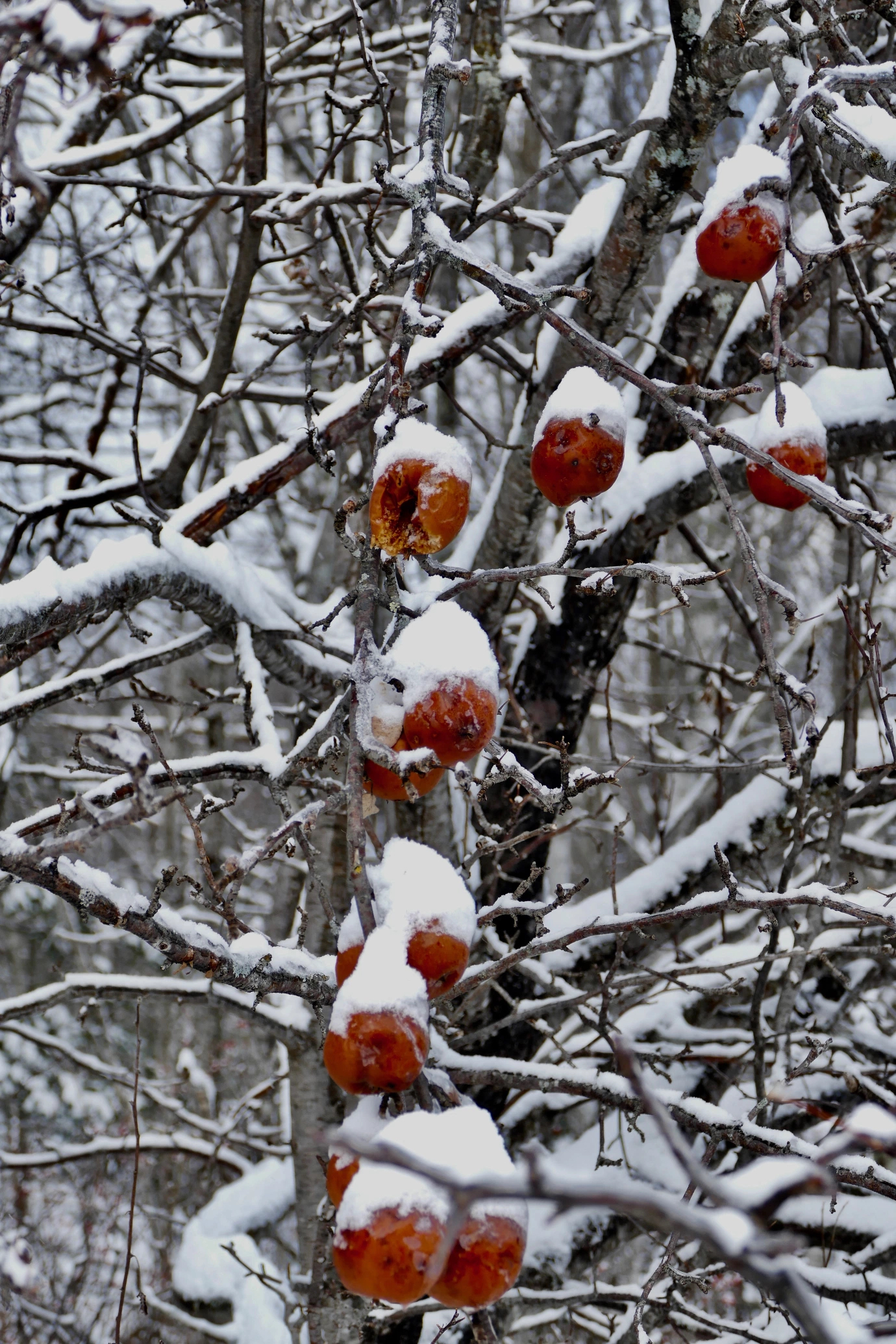
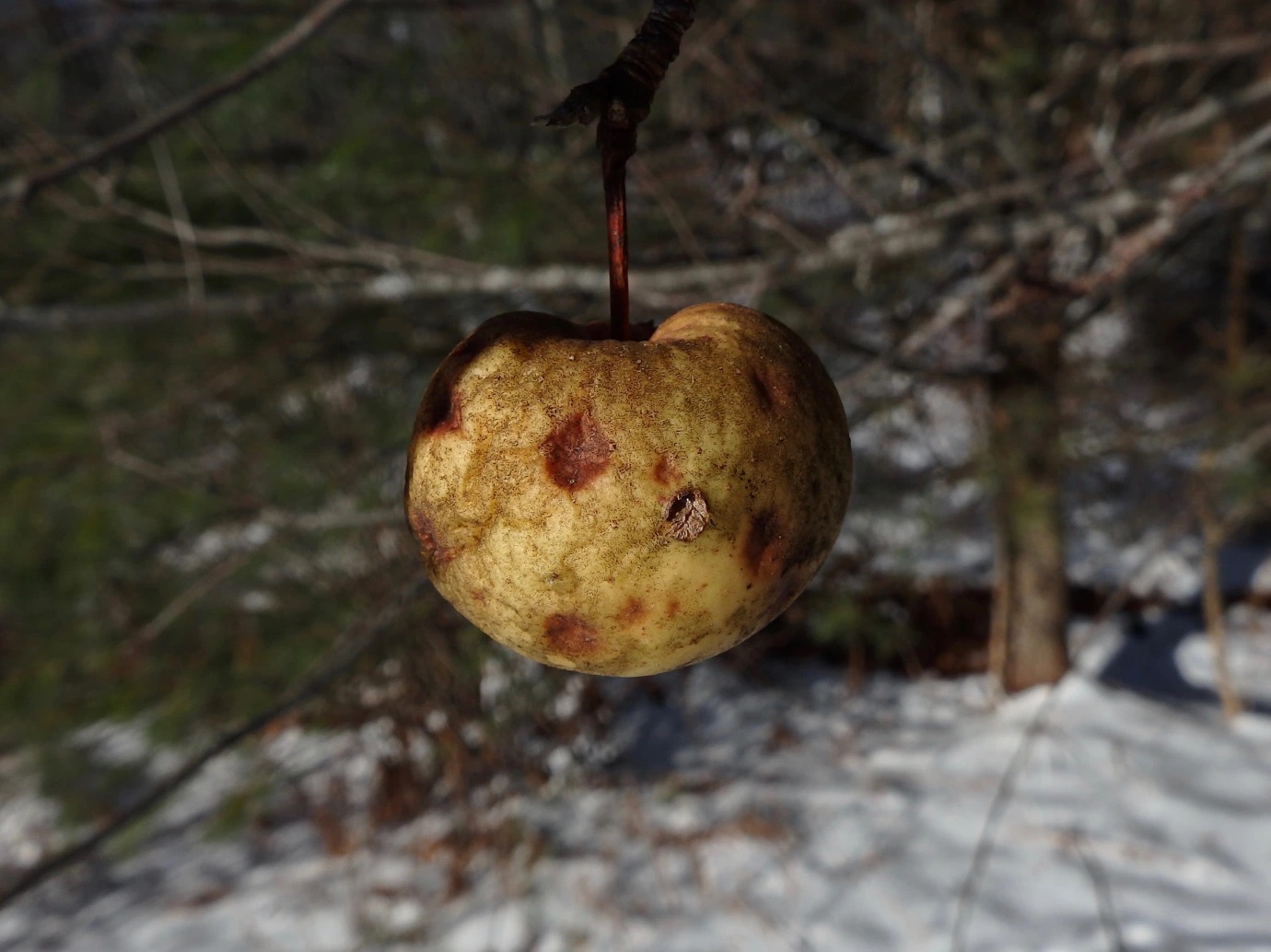
The apples are now thawed. This is their first thawing. Those which a month ago were sour, crabbed, and uneatable are now filled with a rich, sweet cider which I am better acquainted with than with wine. And others, which have more substance, are a sweet and luscious food, —in my opinion of more worth than the pineapples which are imported from the torrid zone. Those which a month ago I tasted and repented of it, which the farmer willingly left on the tree, I am now glad to find have the property of hanging on like the leaves of the shrub oak. It is a way to keep cider sweet without boiling. Let the frost come to freeze them first solid as stones, and then the sun or a warm winter day — for it takes but little heat — to thaw them, and they will seem to have borrowed a flavor from heaven through the medium of the air in which they hang. I find when I get home that they have thawed in my pocket and the ice is turned to cider. But I suspect that after the second freezing and thawing they will not be so good. I bend to drink the cup and save my lappets. What are the half-ripe fruits of the torrid south, to this fruit matured by the cold of the frigid north. There are those crabbed apples with which I cheated my companion, and kept a smooth face to tempt him to eat. Now we both greedily fill our pockets with them, and grow more social with their wine. Was there one that hung so high and sheltered by the tangled branches that our sticks could not dislodge it ? It is a fruit never brought to market that I am aware of, — quite distinct from the apple of the markets, as from dried apple and cider. It is not every winter that produces it in perfection.
In winter I can explore the swamps and ponds.
It is a dark-aired winter day— Yet I see the summer plants still peering above the snow. There are but few tracks in all this snow. It is the Yellow Knife River or the Saskatchewan. The large leafy lichens on the white pines, especially on the outside of the wood, look almost a golden yellow in the light reflected from the snow, while deeper in the wood they are ash-colored. In the swamps the dry, yellowish-colored fruit of the poison dogwood hangs like jewellry on long, drooping stems. It is pleasant to meet it, it has so much character relatively to man. Here is a stump on which a squirrel has sat and stripped the pine cones of a neighboring tree. Their cores and scales be all around. He knew that they contained an almond before the naturalist did. He has long been a close observer of Nature; and opens her caskets.
I feel sometimes as if I could say to my friends— My friends I am aware how I have outraged you how I have seemingly preferred hate to love—seemingly treated others kindly & you unkindly—sedulously concealed my love—& sooner or later expressed all and more than all my hate— I can imagine how I might utter something like this in some moment never to be realized— But let me say frankly that at the same time I feel it may be with too little regret — That I am under an awful necessity to be what I am. If the truth were down, which I do not know, I have no concern with those friends whom I misunderstood or who misunderstood me….
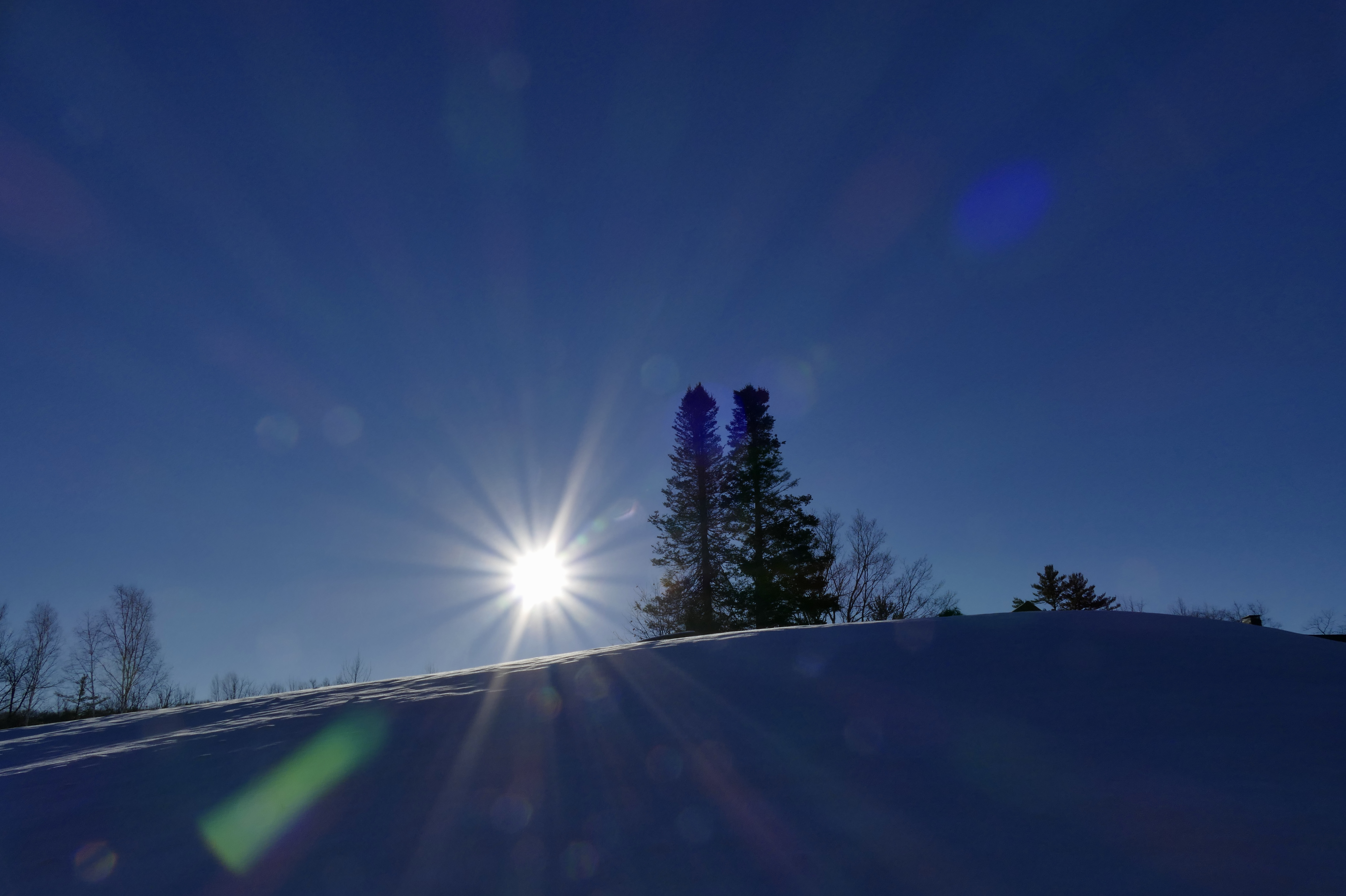
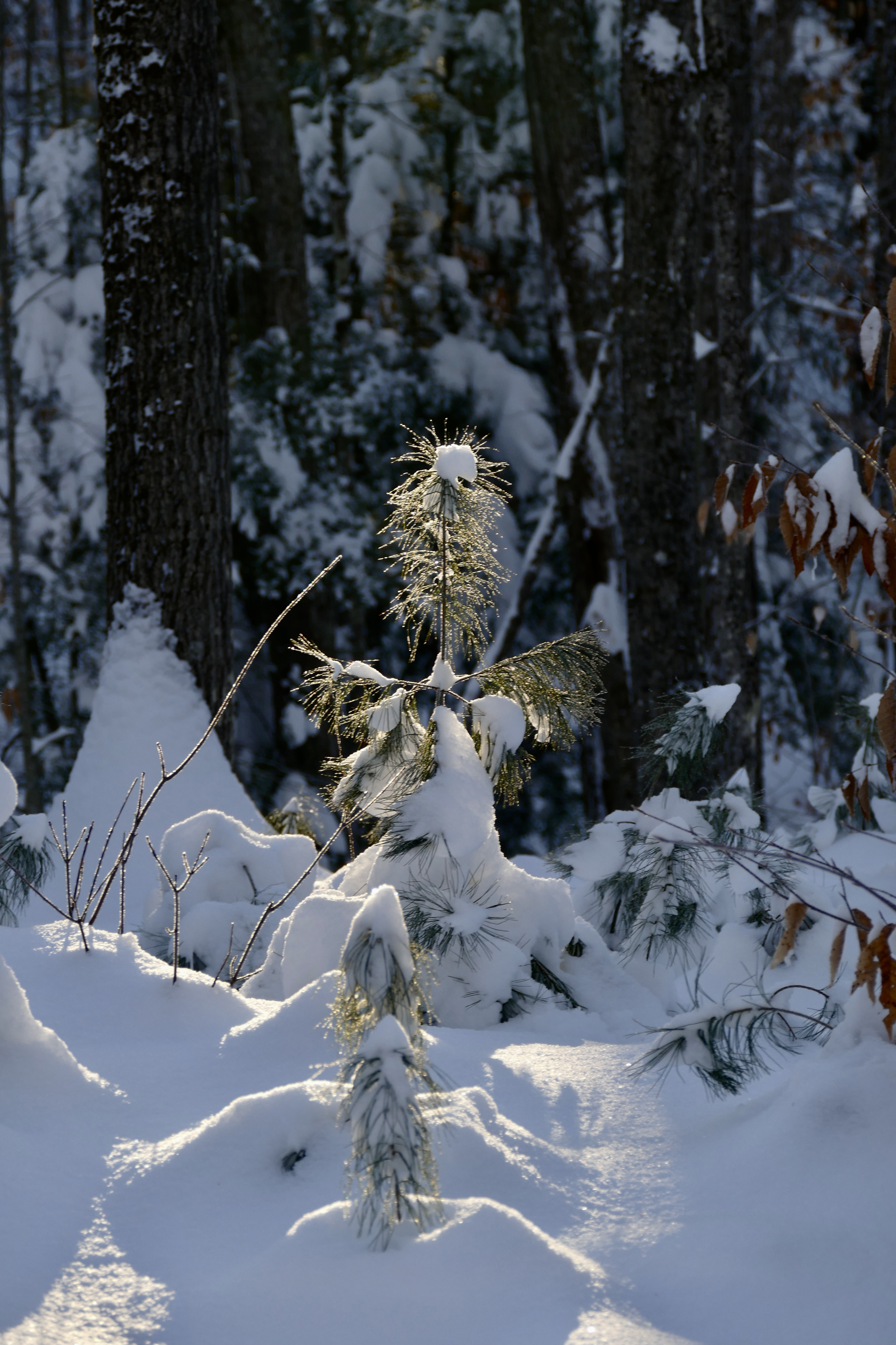
Sunlight on pine needles is an event of a winter day.
Nature and human life are as various to our several experiences as our constitutions are various— Who shall say what prospect life offers to another? Could a greater miracle take place than if we should look through each other’s eyes for an instant. What I have read of Rhapodists—of the primitive poets—Argonautic expeditions—the life of demigods & heroes—Eleusinian mysteries—&c—suggests nothing so ineffably grand and informing as this would be.
We know not what it is to live in the open air—our lives are domestic in more senses than we had thought. From the hearth to the field is a great distance. A man should always speak as if there were no obstruction not even a mote or a shadow between him & the celestial bodies.
The voices of men sound hoarse and cavernous—tinkling as from out of the recesses of caves—enough to frighten bats & toads—not like bells—not like the music of birds, not a natural melody.
Of all the Inhabitants of Concord I now not one that dwells in nature.— If one were to inhabit her forever he would never meet a man. This country is not settled nor discovered yet.
Minott tells how he used to love to walk through swamps where great white pines grew and hear the wind sough in their tops. He recalls this now as he crouches over his stove, but he adds that it was dangerous, for even a small dead limb broken off by the wind and falling from such a height would kill a man at once.
I noticed when the snow first came that the days were very sensibly lengthened by the light being reflected from the snow. Any work which required light could be pursued about half an hour longer.
So that we may well pray that the ground may not be laid bare by a thaw in these short winter days.
AM —to Cambridge—where I read in Gerard’s Herbal— His admirable though quaint descriptions are, to my mind, more greatly superior to the modern scientific ones. He describes not according to rule but to his natural delight in the plants. He brings them vividly before you as one who has seen & delighted in them. It is almost as good as to see the plants themselves. It suggests that we cannot too often get rid of the barren assumption that is in our science. His leaves are leaves—his flowers flowers, his fruit fruit. They are green & colored & fragrant. It is a man’s knowledge added to a child’s delight. Modern botanical descriptions approach ever nearer to the dryness of an algebraic formula–as if X+Y were = to a love-letter. It is the keen joy & discrimination of the child who has just seen a flower for the first time & comes running in with it to its friends– How much better to describe your objects in fresh English words–rather than in these conventional Latinisms! He has really seen & smelt & tasted–& reports his sensations.
Bought a book at Little & Brown’s paying a ninepence more on a volume than it was offered me for elsewhere–The customer thus pays for the more elegant style of the store.
I seem to see somewhat more of my own kith and kin in the lichens on the rocks than in any books. It does seem as if mine were a peculiarly wild nature, which so yearns toward all wildness. I know of no redeeming qualities in me but a sincere love for some things, and when I am reproved I have to fall back on to this ground. This is my argument in reserve for all cases. My love is invulnerable. Meet me on that ground, and you will find me strong. When I am condemned, and condemn myself utterly, I think straightaway, “But I rely on my love for some things.” Therein I am whole and entire. Therein I am God-propped.
Man lays down his body in the field and thinks from it as a stepping stone to vault at once into heaven, as if he could establish a better claim there when he had left such a witness behind him on the plain. Our true epitaphs are those which the sun and wind write upon the atmosphere around our graves so conclusively that the traveller does not draw near to read the lie on our tombstones. Shall we not be judged rather by what we leave behind us, than what we bring into the world? The guest is known by his leavings. When we have become intolerable to ourselves shall we be tolerable to heaven?

















You must be logged in to post a comment.