in Thoreau’s Journal:
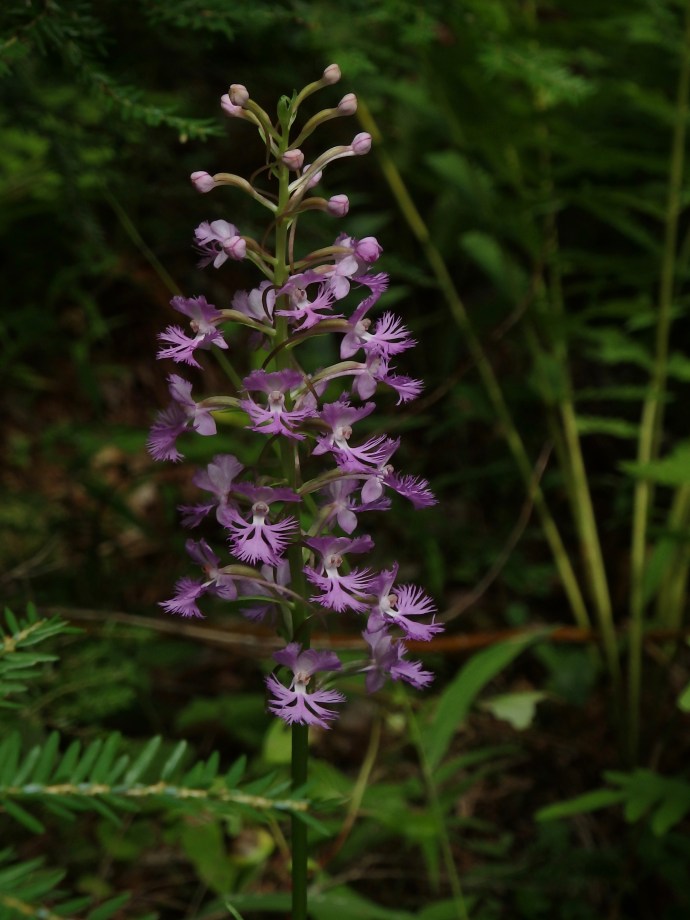
Found a long dense spike of the Orchis psycodes–- Much later this, than the great orchis —the same only smaller & denser—not highly colored enough
in Thoreau’s Journal:
Found a long dense spike of the Orchis psycodes–- Much later this, than the great orchis —the same only smaller & denser—not highly colored enough
in Thoreau’s Journal:
There is more shadow under the edges of woods & copses now— The foliage appears to have increased so that the shadows are heavier & perhaps it is this that makes it cooler especially morning and evening though it may be as warm as ever at noon.

in Thoreau’s Journal:
In every meadow you see far or near the lumbering hay-cart with its mountainous load––& the rakers & mowers in white shirts–– The bittern hardly knows where to lay its legs. By the way I have heard no stake driver for some time. If the meadows were untouched I should no doubt see many more of the rare white & the beautiful smaller purple orchis there as I now see a few—along the shaded brooks & meadow’s edge.

July 29, 1853 in Thoreau’s Journal:
Most fields are so completely shorn now that the walls & fence sides where plants are protected appear unusually rich. I know not what aspect the flowers would present if our fields & meadows were untouched for a year––if the mower were not permitted to swing his scythe there. No doubt some plants contended long in vain with these vandals & at length withdrew from the contest. About these times some hundreds of men with freshly sharpened scythes make an irruption into my garden when in its rankest condition & clip my herbs all as close as they can––& I am restricted to the rough hedges & worn out fields which had little to attract them to the most barren & worthless pastures— I know how some fields of Johnswort & golden rod look left in the natural state —but not much about our richest fields & meadows—

July 29, 1857 in Thoreau’s Journal
I am interested in an indistinct prospect, a distant view, a mere suggestion often, revealing an almost wholly new world to me.

I rejoice to get, and am apt to present, a new view.
in Thoreau’s Journal:
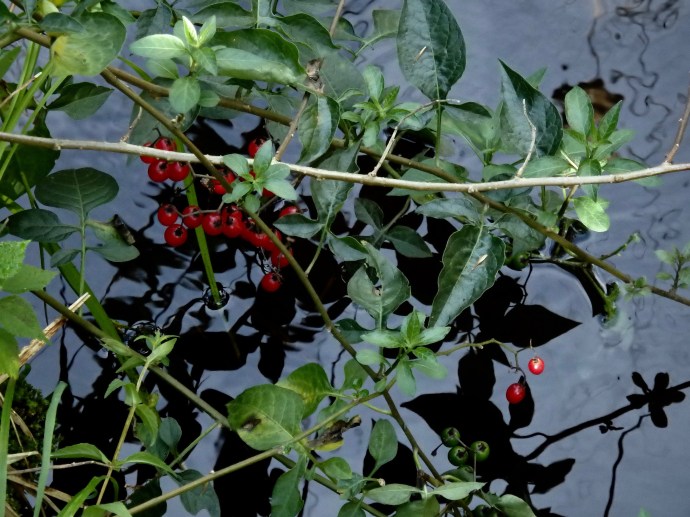
Night shade berries begin to ripen. to be red.
in Thoreau’s Journal:
It is pleasing to behold at this season contrasted shade and sunshine on the side of neighboring hills.
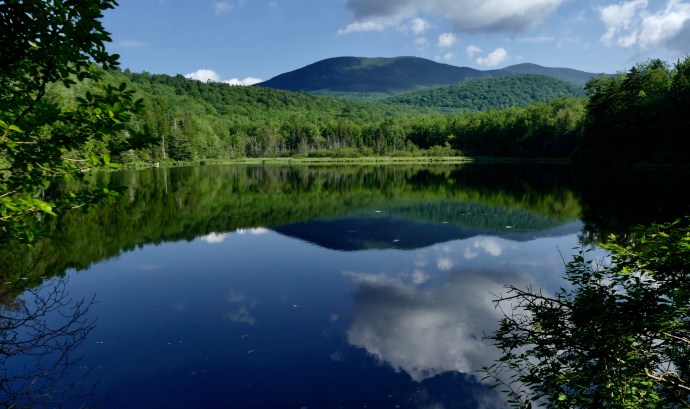
They are not so attractive to the eye when all in the shadow of a cloud or wholly open to the sunshine. Each must enhance the other.
in Thoreau’s Journal:
I mark again the sound of the crickets or locusts about alders &c about this time when the first asters open––which makes you fruitfully meditative–– Helps condense your thoughts–like meldews in the afternoon– This the afternoon of the year. How apt we are to be reminded of lateness–even before the year is half spent. Such little objects check the diffuse tide of our thoughts & bring it to a head–which thrills us– They are such fruits as music, poetry, love which humanity bears. Saw one of the common wild roses R. lucida (?) The swamp-black berry ripe X in open ground. The rhus copallina is not yet quite out, though the glabra is in fruit. The smaller purple-fringed orchis has not quite filled out its spike– What a surprise to detect under the dark damp cavernous copes––where some wild beast might fitly prowl this splendid flower silently standing with all its eyes on you. It has a rich fragrance withal. Rain in the evening.

in Thoreau’s Journal:
It is a rare music the earliest bee’s hum amid the flowers––revisiting the flower bells just after sunrise.

in Thoreau’s Journal:
The Cardinal flower probably open today.

July 22, 2017
in Thoreau’s Journal:
A comfortable breeze blowing. Methinks I can write better in the afternoon, for the novelty of it— if I should go abroad this morning— My genius makes distinctions which my understanding cannot— and which my senses do not report. If I should reverse the usual— go forth & saunter in the fields all the forenoon then sit down in my chamber in the afternoon, which it is so unusual for me to do—it would be like a new season to me & the novelty of it inspire me. The wind has fairly blown me out doors—the elements were so lively & active— & I so sympathized with them that I could not sit while the wind went by. And I am reminded that we should especially improve the summer to live out of doors— When we may so easily it behoves us to break up this custom of sitting in the house. for it is but a custom—and I am not sure that it has the sanction of common sense. A man no sooner gets up than he sits down again….Is the literary man to live always or chiefly sitting in a chamber—through which Nature enters by a window only? What is the use of the summer?

….but here outdoors is the place to store up influences.
in Thoreau’s Journal:
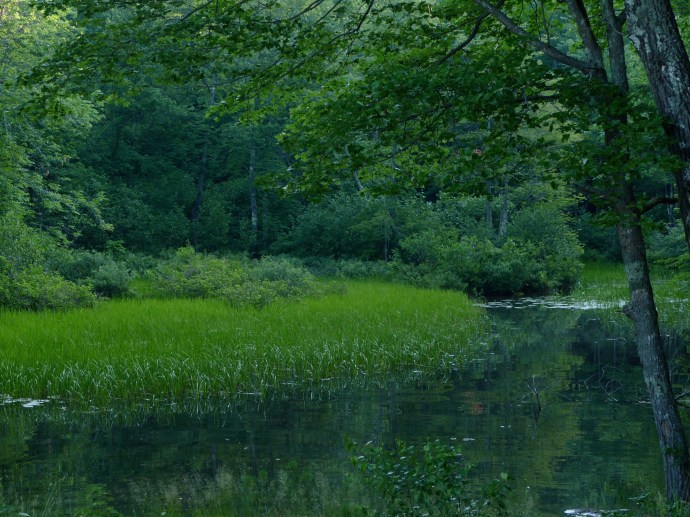
All things –– grass, etc. –– are peculiarly fresh this season on account of the copious rains.
in Thoreau’s Journal:
Nature is beautiful only as a place where a life is to be lived. It is not beautiful to him who has not resolved on a beautiful life.
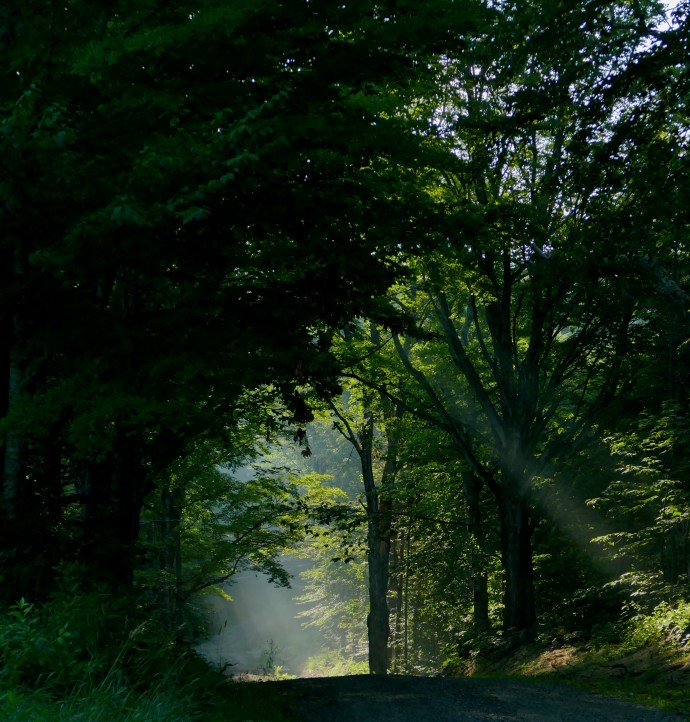
July 20, 2017
in Thoreau’s Journal:
A muttering thunder cloud in NW––gradually rising ––& with its advanced guard hiding the sun–– & now & then darting forked lightning–– The wind rising ominously also drives me home again.
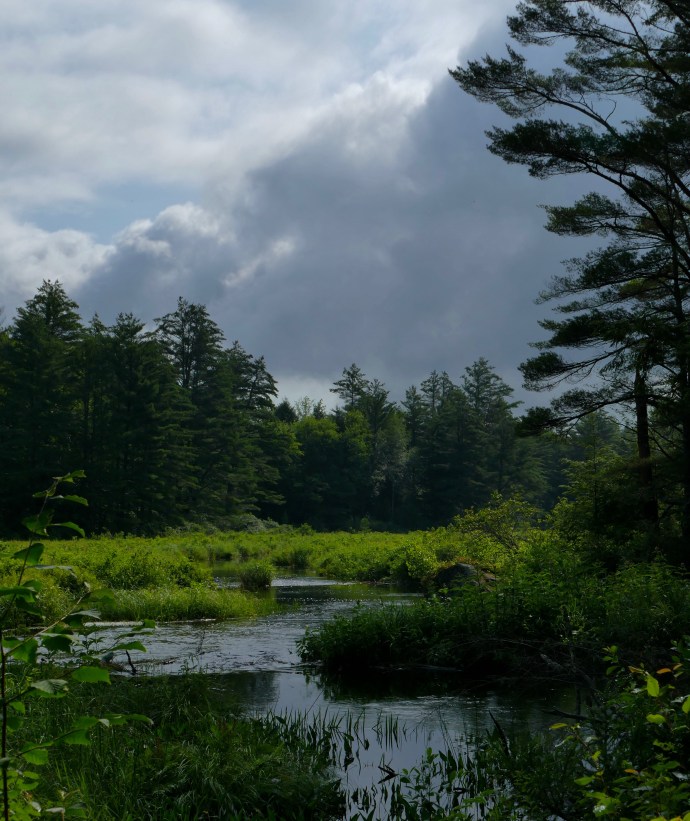
At length down it comes upon the thirsty herbage beating down the leaves with grateful tender violence. & slightly cooling the air.
in Thoreau’s Journal:
In the maple swamp at Hubbards Close the great cinnamon ferns are very handsome…

Clintonia berries in a day or 2.

in Thoreau’s Journal:
Methinks the asters & golden rods begin–like the early ripening leaves, with mid-summer heats.

Now look out for these children of the sun. When already the fall of some of the very earliest spring flowers has commenced.
in Thoreau’s Journal:

A thick fog began last night & lasts till late this morning, first of the kind methinks…
in Thoreau’s Journal:
I go to observe the lilies.

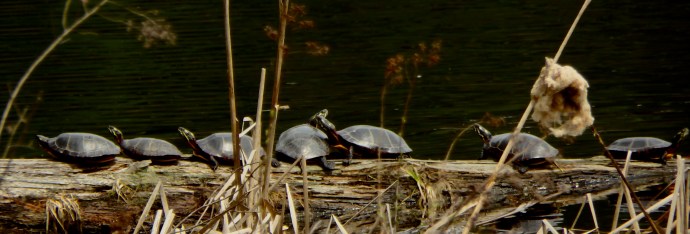
I see a rail lodged in the weeds with 7 tortoises on it––and another with 10––another with 11 all in a row sunning now at midday hot as it is. ––They are mostly the painted tortoise. Apparently no weather is too hot for them thus to bask in the sun.
The pontederia is in its prime alive with butterflies yellow & others– I See its tall blue spikes reflected beneath the edge of the pads on each side–pointing down to a heaven beneath as well as above–

in Thoreau’s Journal:
Rained still in forenoon, now cloudy
Fields comparatively deserted today & yesterday –hay stands cocked in them on all sides––Some being shorn are clear for the walker. It is but a short time that he has to dodge the haymakers– This cooler-–still cloudy weather after the rain is very autumnal & restorative to our spirits– The robin sings–still–but the goldfinch twitters over oftener–& I hear the link link of the bobolink (one perfect strain!) and the crickets creak more as in the fall– All these sounds dispose our minds to serenity– Perhaps the mosquitoes are most troublesome such days in the woods if it is warm enough. We seem to be passing or to have passed a dividing line between spring & autumn–& begin to descend the long slope toward winter….
….the meadow is the broad dark green rank of pickerel weeds &c &c (polygonum &c) then the light reflecting edging of pads–& then the smooth still cloud reflecting water. My thoughts are driven inward–even as clouds and trees are reflected in the still smooth water– There is an inwardness even in the mosquitoes hum–while I am picking blueberries in the dank wood.
Rhexia near the R. Copallina [winged sumac]–ap yesterday XXX….

Rexia virginica
in Thoreau’s Journal:
awake to a day of gentle rain––very much needed—none to speak of for nearly a month methinks. The cooler & stiller day has a valuable effect on my spirits….It holds up from time & then a fine misty rain falls. It lies on the fine reddish tops of some grasses thick & whitish like morning cobwebs. The stillness is very soothing. This is a summer rain. The earth is being bedewed. There is no storm or violence to it.

Health is a sound relation to nature.
in Thoreau’s Journal:
A Journal.–– a book that shall contain a record of all your joy––your extacy….
The dark purple amelanchier are the sweetest berries I have tasted yet.

One who walks the woods & hills daily—expecting to see the first berry that turns—will be surprised at last to find them ripe & thick before he is aware of it—ripened he cannot tell how long before—in some favorable situation. It is impossible to say what day almost what week the huckleberries begin to be ripe unless you are acquainted with & daily visit every huckleberry bush in the town—at least every place where they grow.


You must be logged in to post a comment.