The autumnal tints have not been so bright as usual this year, but why it is hard to say. The summer has been peculiarly cool, as well as wet, and it may be that the leaves have been the more inclined to decay before coming to maturity. Also, apparently, many leaves are killed by the mere frosts before ripening, the locust for instance, —and the frost came early this year, —just as melons and squashes before they have turned yellow; i.e., the leaves fall while they are still green.
How agreeable to the eye at this season the color of new fallen leaves….sere & crisp. When freshly fallen with their forms & their veins still distinct they have a certain life in them still….
You make a great noise now walking in the woods on account of the dry leaves—especially chestnut & oak—& maples that cover the ground….
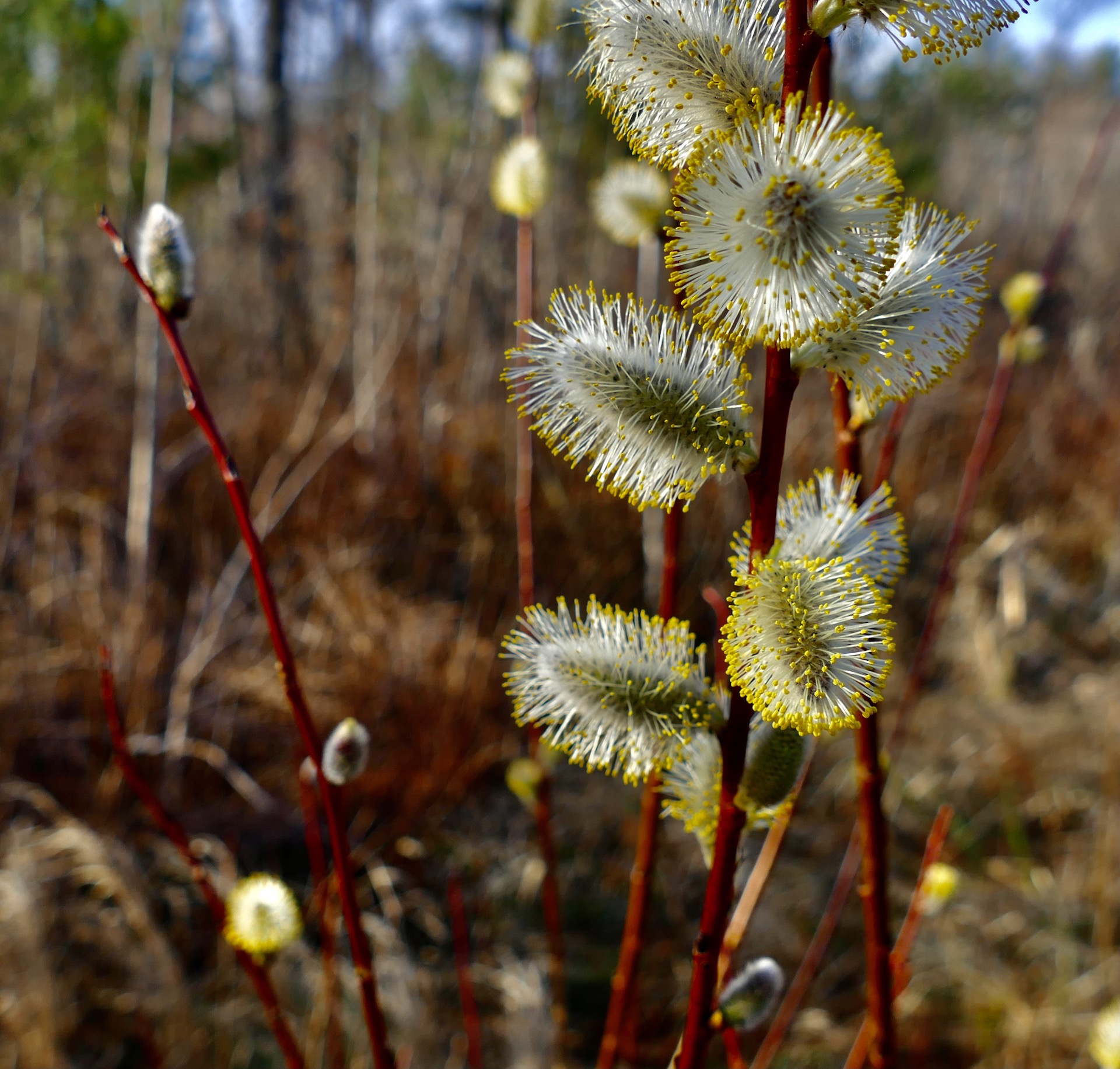
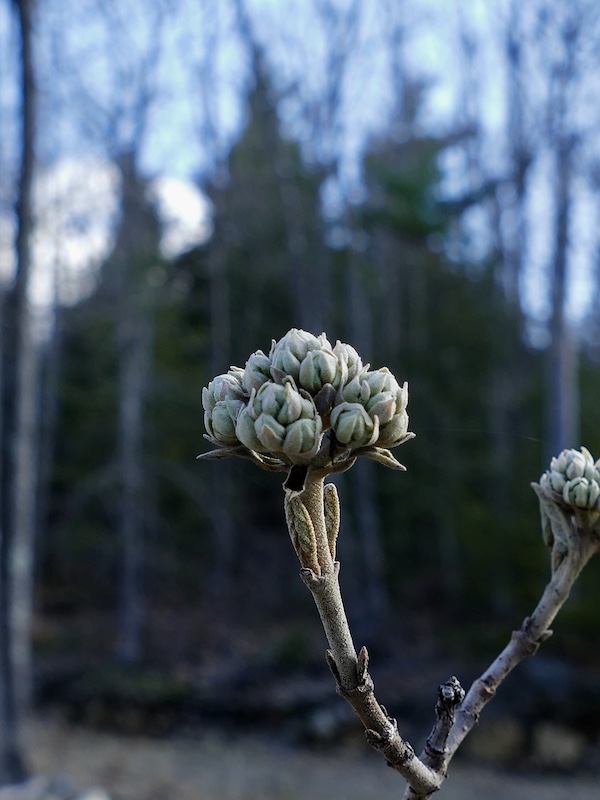
The witch hazel here is in full blossom on this magical hill-side—while its broad yellow leaves are falling—some bushes are completely bare of leaves, and leather-colored they strew the ground. It is an extremely interesting plant—October & November’s child—and yet reminds me of the very earliest spring— Its blossoms smell like the spring—like the willow catkins—by their color as well as fragrance they belong to the saffron dawn of the year.— Suggesting amid all these signs of Autumn—falling leaves & frost—that the life of nature—by which she eternally flourishes, is untouched.
It stands here in the shadow on the side of the hill while the sunlight from over the top of the hill lights up its topmost sprays & yellow blossoms. Its spray so jointed and angular is not to be mistaken for any other. I lie on my back with joy under its boughs. While its leaves fall—its blossoms spring. The autumn then is indeed a spring. All the year is a spring. I see two blackbirds high over head going south, but I am going north in my thoughts with these hazel blossoms.
It has come to this, — that the lover of art is one, and the lover of nature another, though true art is but the expression of our love of nature. It is monstrous when one cares but little about trees but much about Corinthian columns, and yet this is exceedingly common.
When I turn round halfway up Fair Haven Hill, by the orchard wall, and look northwest, I am surprised for the thousandth time by the beauty of the landscape and sit down to behold it in my leisure…..
I do not know how to entertain those who cannot take long walks….I give up my forenoon to them, and get along pretty well, the very elasticity of the air and promise of the day abetting me, but they are as heavy as dumplings by mid-afternoon. If they can’t walk, why won’t they take an honest nap in the afternoon and let me go?
There is not now that profusion, and consequent confusion, of events which belongs to a summer walk. There are few flowers, birds, insects, or fruits now, and hence what does occur affects us as more simple and significant, as the cawing of a crow or the scream of a jay. The latter seems to scream more fitly and with more freedom through the vacancies occasioned by fallen maple leaves.
Surveying in Lincoln. A severer frost last night. The young & tender trees begin to assume the autumnal tints more generally—plainly in consequence of the frost the last 2 mornings. The sides of the bushy hills present a rich variety of colors like rug work—but the forest generally is not yet changed.
The intense brilliancy of the red-ripe maples scattered here and there in the midst of the green oaks & hickories on its hilly shore is quite charming. They are unexpectedly & incredibly brilliant –especially on the western shore & close to the waters edge, where alternating with yellow birches & poplars & green oaks—they remind me of a line of soldiers red coats & riflemen in green mixed together.
The gentian (Andrewsii) now generally in prime, on low, moist, shady banks. Its transcendent blue shows best in the shade and suggests coolness; contrasts there with the fresh green; a splendid blue, light in the shade, turning to purple with age. They are particularly abundant under the north side of the willow row in Merrick’s pasture. I count fifteen in a single cluster there, and afterward twenty in Gentian Lane near Flint’s Bridge, and there were other clusters below; bluer than the bluest sky they lurk in the moist and shady recesses of the banks.
It is a very fine afternoon to be on the water, somewhat Indian-summer-like. I do not know what constitutes the peculiarity and charm of this weather; the broad water so smooth, notwithstanding the slight wind, as if, owing to some oiliness, the wind slid over without ruffling it. There is a slight coolness in the air, yet the sun is occasionally very warm. I am tempted to say that the air is singularly clear, yet I see it is quite hazy. Perhaps it is that transparency it is said to possess when full of moisture and before or after rain. Through this I see the colors of trees and shrubs beginning to put on their October dress, and the creak of the mole cricket sounds late along the shore.
The increasing scarlet & yellow tints around the meadows & river remind me of the opening of a vast flower bud—they are the petals of its corolla—which is of the width of the valleys—
It is the flower of autumn whose expanding bud just begins to blush.
At Clematis Brook I perceive that the pods or follicles of the Asclepias Syriaca point upward––(did they before all point down?)
They are already bursting. I release some seeds with the long fine silk attached––the fine threads fly apart open with a spring as soon as released––& then ray themselves out into a hemispherical form, each thread freeing itself from its neighbor & all reflecting prismatic tints.
The seeds besides are winged, I let one go and it rises slowly & uncertainly at first now driven this way then that, by airs which I can not perceive––& I fear it will make shipwreck against the neighboring wood––but no, as it approaches it––it surely rises above it & then feeling the strong north wind it is borne off rapidly in the opposite direction––ever rising higher & higher––& tossing & heaved about with every commotion––till at a hundred feet in the air & 50 rods off steering south I loose sight of it. How many myriads go sailing away at this season over hill & meadow & river––to plant their race in new localities––on various tacks until the wind lulls––who can tell how many miles. And for this end these silken streamers have been perfecting all summer, snugly packed in this light chest––a perfect adaptation to this end––a prophecy of the fall & of future openings. Who could believe in the prophecies of Daniel or of Miller that the world would end this summer while one Milkweed with faith matured its seeds!
The woods generally may now be said to be fairly beginning to turn (this with the first noticeable frost). The red maples, especially at a distance, begin to light their fires, some turning yellow, and within the woods many oak, e. g. scarlet and black and chestnut, and other leaves begin to show their colors. Those leaves of the young white oaks which have changed dull-salmon, crimson, scarlet (many incline to crimson) are mostly within the tree and partially concealed by the green leaves. They are handsomest looking up from below, the light through them.
You must be logged in to post a comment.