There was also the columbine, its leaves still alive and green; and I was pleased to smell the pennyroyal which I had bruised, though this dried up long ago. Each season is thus drawn out and lingers in certain localities, as the birds and insects know very well.
If you penetrate to some warm recess under a cliff in the woods, you will be astonished at the amount of summer life that still flourishes there. No doubt more of the summer’s life than we are aware thus slips by and outmanoeuvres the winter, gliding from fence to fence.
I look S from the Cliff— The westering sun just out of sight behind the hill. Its rays from those bare twigs across the pond are bread & cheese to me. So many oak leaves have fallen that the white birch stems are more distinct amid the young oaks— I see to the bone. See those bare birches prepared to stand the winter through on the hill sides— They never owing what is this dull town to me? The maples skirting the meadows— in dense phalanxes — look like light infantry advanced for a swamp flight. Ah Dear November ye must be sacred to the Nine surely. The only willow catkins already peep out 1/4 of an inch. Early crowfoot is reddened at Lee’s.
The very sunlight on the pale-brown-bleached fields is an interesting object these cold days. I naturally look toward it as a wood fire. Not only different objects are presented to our attention at different seasons of the year, but we are in a frame of body and mind to appreciate different objects at different seasons. I see one thing when it is cold and another when it is warm.
We are interested at this season by the manifold ways in which light is reflected to us. Ascending a little knoll covered with sweet fern, the sun appearing but a little above the sweet fern, its light was reflected from a dense mass of the bare, downy twigs of this plant in a surprising manner which would not be believed, if described. It was quite like the sunlight reflected from grass and weeds covered with hoar frost. Yet in an ordinary light, these are but dark or dusky-looking with scarcely a noticeable downiness. But as I saw them, there was a perfect halo of light resting on the knoll. I moved to right or left. A myriad of surfaces are now prepared to reflect the light. This is one of the hundred silvery lights of November. The setting sun too, is reflected from windows more brightly than at any other season. “November Lights” would be a theme for me.
Nature is moderate, and loves degrees. Winter is not all white and sere. Some trees are evergreen to cheer us, and on the forest floor our eyes do not fall on sere brown leaves alone, but some evergreen shrubs are placed there to relieve the eye. Mountain laurel, lamb kill, checkerberry, interfere, etc., keep up the semblance of summer still.
I found three good arrowheads today behind Dennis’s. The season for them began some time ago, as soon as the farmers had sown their winter rye, but the spring, after the melting of the snow, is still better.
I am accustomed to regard the smallest brook with as much interest for the time being as if it were the Orinoco or Mississippi. What is the difference, I would like to know, but mere size? And when a tributary rill empties in, it is like the confluence of famous rivers I have read of. When I cross one on a fence, I love to pause in mid-passage and look down into the water, and study its bottom, its little mystery.
There is none so small but you may see a pickerel regarding you with a wary eye, or a pygmy trout glance from under the bank, or in spring, perchance, a sucker will have found its way far up its stream. You are sometimes astonished to see a pickerel far up some now shrunken rill, where it is a mere puddle by the roadside. I have stooped to drink at a clear spring no bigger than a bushel basket in a meadow, from which a rill was scarcely seen to dribble away, and seen lurking at its bottom two little pickerel not so big as my finger, sole monarchs of this their ocean, and who probably would never visit a larger water.
In literature it is only the wild that attracts us. Dullness is only another name for tameness. It is the untamed, uncivilized, free, and wild thinking in Hamlet, in the Iliad, and in all the scriptures and mythologies that delights us,— not learned in the schools, refined and polished by art. A truly good book is something as wildly natural and primitive, mysterious and marvellous, ambrosial and fertile, as a fungus or a lichen. Suppose the muskrat or beaver were to turn his views to literature, what fresh views of nature would he present! The fault of our books and other deeds is that they are too humane, I want something speaking in some measure to the condition of muskrats and skunk-cabbage as well as of men, — not merely to a pining and complaining coterie of philanthropists.
I discover again about these times that cranberries are good to eat in small quantities as you are crossing the meadows.
I hear deep amid the birches some row among the birds or the squirrels, where evidently some mystery is being developed to them. The jay is on the alert, mimicking every woodland note. What has happened? Who’s dead? The twitter retreats before you, and you are never let into the secret. Some tragedy surely is being enacted, but murder will out. How many little dramas are enacted in the depth of the woods at which man is not present!
When I am considering which way I will walk, my needle is slow to settle, my compass varies by a few degrees and does not always point due southwest; and there is good authority for these variations in the heavens. It pursues the straighter course for it at last, like the ball which has come out of a rifle, or the quoit that is twirled when cast. Today it is some particular wood or meadow or deserted pasture in that direction that is my southwest.
I love my friends very much, but I find that it is of no use to go to see them. I hate them commonly when I am near them. They belie themselves and deny me continually.
Somebody shut the cat’s tail in the door just now, and she made such a caterwaul as has driven two whole worlds out of my thoughts. I saw unspeakable things in the sky and looming in the horizon of my mind, and now they are all reduced to a cat’s tail. Vast films of thought floated through my brain, like clouds pregnant with rain enough to fertilize and restore a world, and now they are all dissipated.
There is a place whither I should walk to-day. Though oftenest I fail to find, when by accident I ramble into it, great is my delight. I have stood by my door sometimes half an hour, irresolute as to what course I should take.
Apparently all but the evergreens and oaks have lost their leaves now. It is singular that the shrub oaks retain their leaves through the winter. Why do they?
The walnut trees spot the sky with black nuts. Only catkins are seen on the birches.
I saw the other day a dead limb which the wind or some other cause had broken nearly off, which had lost none of its leaves, though all the rest of the tree, which was flourishing, had shed them.
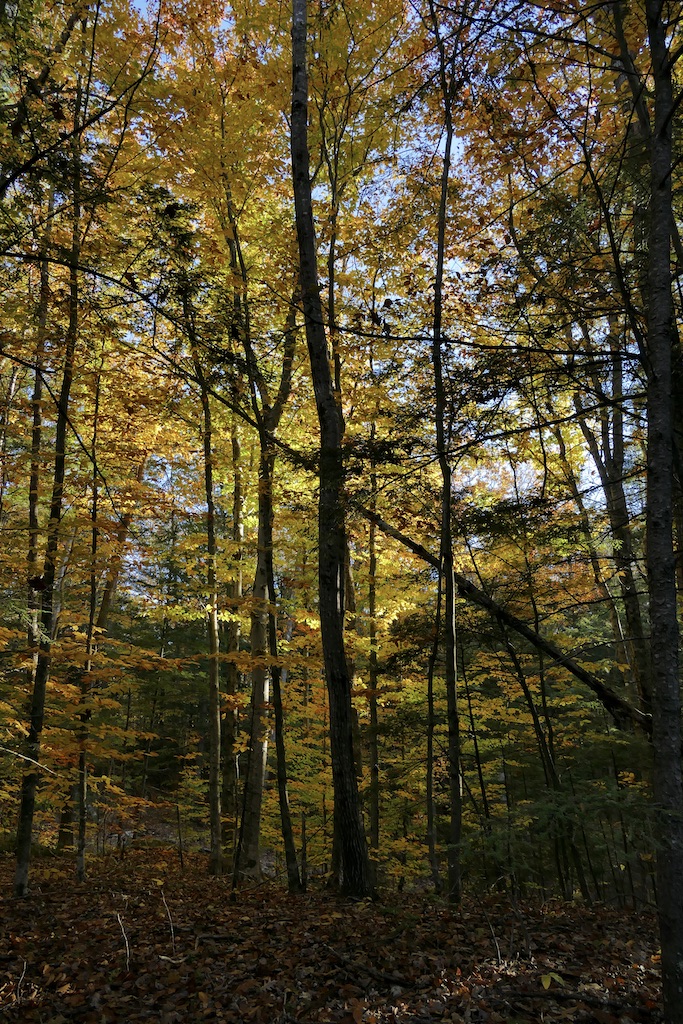
There seems to be in the fall a sort of attempt at a spring, a rejuvenescence, as if the winter were not expected by a part of nature. Violets, dandelions, and some other flowers blossom again, and mulleins and innumerable other plants begin again to spring and are only checked by the increasing cold. There is a slight uncertainty whether there will be any winter this year.
I was pleased today to hear a great noise and trampling in the woods produced by some cows which came running toward their homes, which apparently had been scared by something unusual, as their ancestors might have been by wolves. I have known sheep to be scared in the same [way] and a whole flock to run bleating to me for protection.
What shall we do with a man who is afraid of the woods, their solitude and darkness? What salvation is there for him? God is silent and mysterious.
Some of our richest days are those in which no sun shines outwardly, but so much the more a sun shines inwardly. I love nature, I love the landscape, because it is so sincere. It never cheats me. It never jests. It is cheerfully, musically earnest. I lie and relie on the earth.
Land where the wood has been cut off and is just beginning to come up again is called sprout land.
The sweet-scented life-everlasting has not lost its scent yet, but smells like the balm of the fields.
The partridge-berry leaves checker the ground on the side of moist hillsides in the woods. Are they not properly called checker-berries ?
The era of wild apples will soon be over. I wander through old orchards of great extent, now all gone to decay, all of native fruit which for the most part went to the cider mill. But since the temperance reform and the general introduction of grafted fruit, no wild apples, such as I see everywhere in deserted pastures, and where the woods have grown up among them, are set out. I fear that he who walks over these hills a century hence will not know the pleasure of knocking off wild apples. Ah, poor man! there are many pleasures which he will be debarred from! Notwithstanding the prevalence of the Baldwin and the Porter, I doubt if as extensive orchards are set out to-day in this town as there were a century ago, when these vast straggling cider-orchards were planted. Men stuck in a tree then by every wall-side and let it take its chance. I see nobody planting trees today in such out of the way places, along almost every road and lane and wall-side, and at the bottom of dells in the wood. Now that they have grafted trees and pay a price for them, they collect them into a plot by their houses and fence them in.
My Journal should be the record of my love. I would write in it only of the things I love, my affection for any aspect of the world, what I love to think of. I have no more distinctness or pointedness in my yearnings than an expanding bud, which does indeed point to flower and fruit, to summer and autumn, but is aware of the warm sun and spring influence only. I feel ripe for something, yet do nothing, can’t discover what that thing is. I feel fertile merely. It is seed time with me. I have lain fallow long enough.
Notwithstanding a sense of unworthiness which possesses me, not without reason, notwithstanding that I regard myself as a good deal of a scamp, yet for the most part the spirit of the universe is unaccountably kind to me, and I enjoy perhaps an unusual share of happiness. Yet I question sometimes if there is not some settlement to come.
Pm to Fair Haven Hill & by boat to Witch Hazel bush
Were they not the white in tail birds I saw this afternoon? cricket still. After yesterdays clear, windy weather we have today less wind and much haze— It is Indian summer-like. The river has risen yet higher than last night—so that I cut across Hubbard’s meadow with ease— Took up a witch hazel with still some fresh blossoms.
There is a clear air and a strong northwest wind drying up the washed earth after the heavy rain of yesterday. The road looks smooth and white as if washed and swept. It is surprising how rapidly our sandy soil dries up.
We walk dry-shod the day after a rain which raises the river three feet. I am struck by the dark blue of the agitated river.
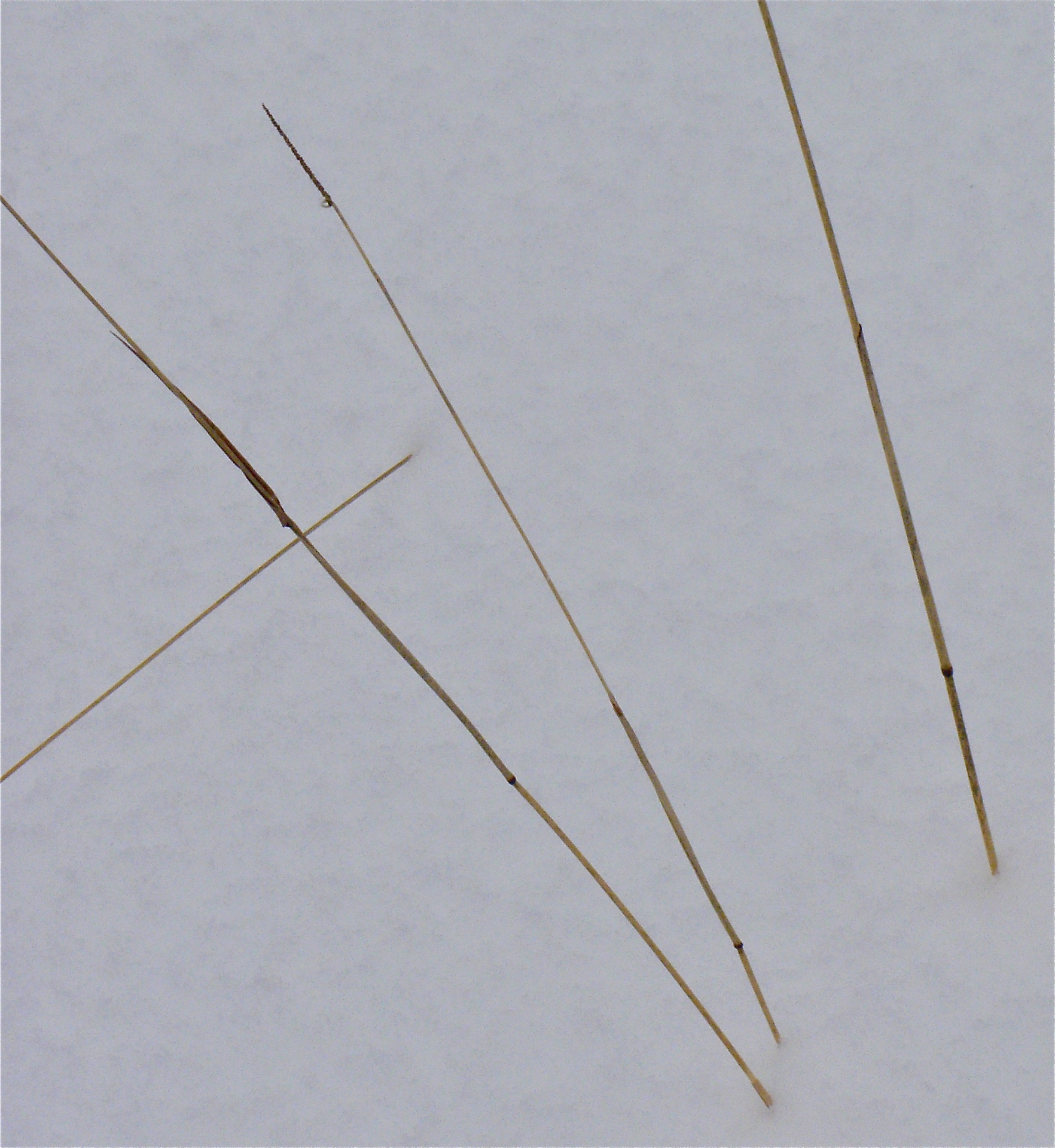
It is wonderful what gradation and harmony there is in nature. The light reflected from bare twigs at this season ––i.e., since they began to be bare, in the latter part of October––is not only like that from gossamer, but like that which will ere long be reflected from the ice that will incrust them. So the bleached herbage of the fields is like frost, and the frost like, snow, and one prepares for the other.
The riverside is skimmed over and presents a wintry aspect, —those great plaits, or folds, as it were, where the crystals have shot, wool-grass frozen in, and the thin white ice where the water has gone down.
Now for a brisk and energetic walk, with a will and a purpose. Have done with sauntering, in the idle sense. You must rush to the assault of winter. Make haste into the outskirts, climb the ramparts of the town, be on the alert and let nothing escape your observation. The army is all van.
The cold alone has brought down a good part of the remaining leaves of abeles and white willows. I see the handsome leaves of the last thickly strewn over the ice and reminding of grain even, half upside down. Pitch pine leaves are about all fallen.
The very common redness of the recent shoots, as white maples, huckleberries, etc., now that the twigs are bare, and on many sides masses of them are run together in a maze, adds to the general russet of nature. The black willow shoots are a very pale brownish yellow.
We are now reduced to browsing on buds and twigs, and methinks, with this diet and this cold, we shall look to the stall-fed thinkers like those unkempt cattle in meadows now, grazing the withered grass.
I am glad of the shelter of the thick pine wood on the Marlboro’ road—on the plain. The roar of the wind over the pines sounds like the surf on countless beaches—an endless shore—& at intervals it sounds like a gong resounding through the halls & entries. How the wind roars among the shrouds of the wood i.e. there is a certain resounding woodiness in the tone— The sky looks mild & fair enough from this shelter.— every withered blade of grass & every dry weed—as well as pine needle—reflects light— The lately dark woods are open & light—the sun shines in upon the stems of trees which it has not shone on since spring — Around the edges of ponds the weeds are dead and there too the light penetrates— The atmosphere is less moist & gross & light is universally dispersed. We are greatly indebted to these transition seasons or states of the atmosphere—which show us thus phenomena which belong not to the summer or the winter of any climate. The brilliancy of the autumn is wonderful—this flashing brilliancy—as if the atmosphere were phosphoric…
No true and absolute account of things, —of the evening and the morning and all the phenomena between them, —but ever a petty reference to man, to society, aye, often to Christianity: What these things are when men are asleep. I come from the funeral of mankind to attend to a natural phenomenon. The so much grander significant of any fact —of sun and moon and stars — when not referred to man and his needs but viewed absolutely! Sounds that are wafted from over the confines of time.
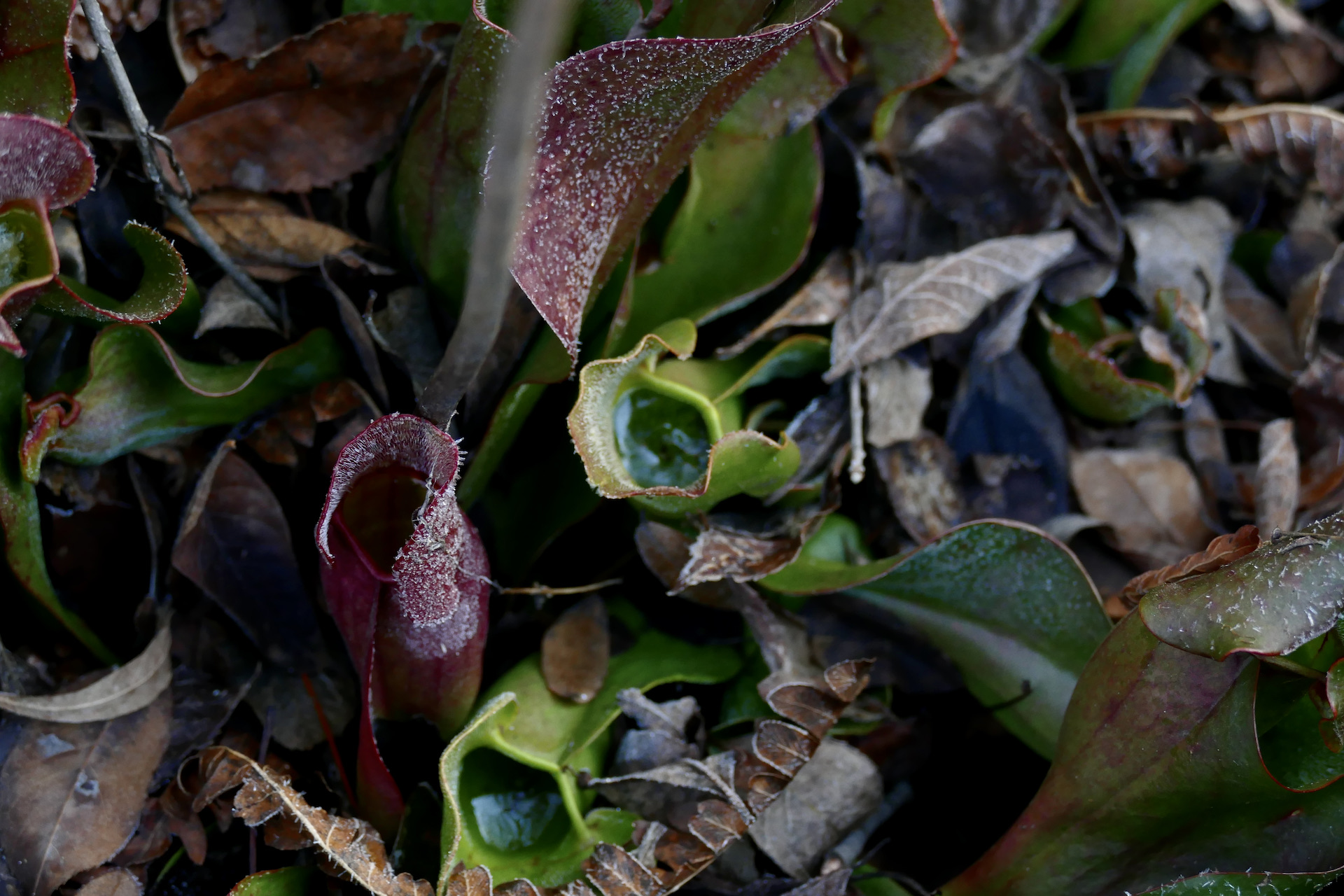
The pitcher-plant, though a little frost-bitten and often cut off by the mower, now stands full of water in the meadows. I never found one that had not an insect in it.
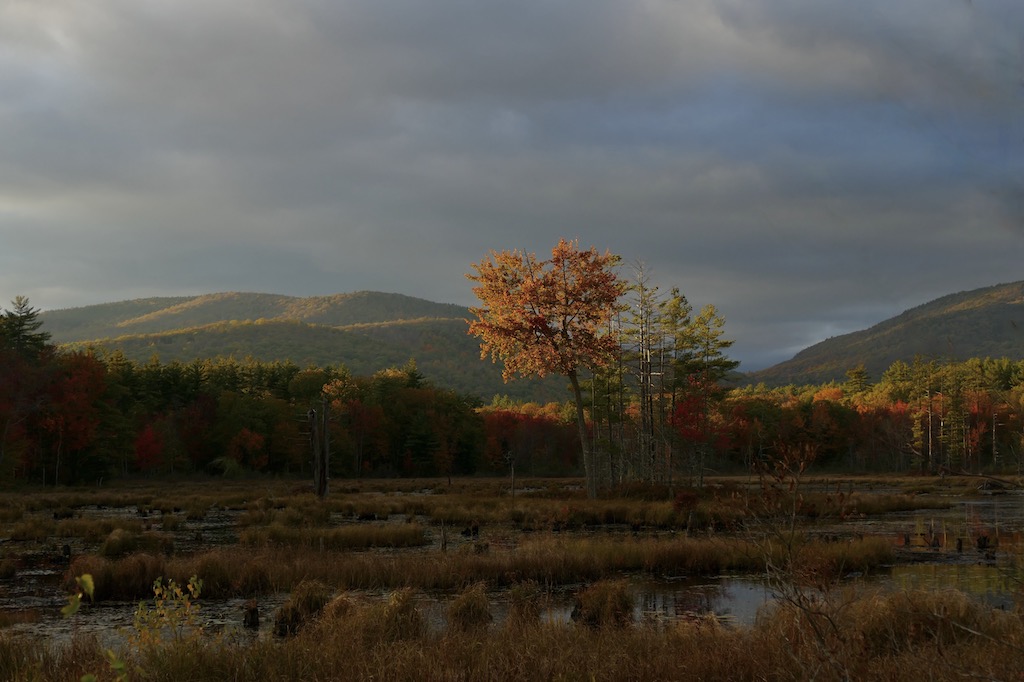
Nature has many scenes to exhibit, and constantly draws a curtain over this part or that. She is constantly repainting the landscape and all surfaces, dressing up some scene for our entertainment. Lately we had a leafy wilderness, now bare twigs begin to prevail, and soon she will surprise us with a mantle of snow….
Each phase of nature, while not invisible, is yet not too distinct and obtrusive. It is there to be found when we look for it, but not demanding our attention. It is like a silent but sympathizing companion in whose company we retain most of the advantages of solitude, with whom we can walk and talk, or be silent, naturally, without the necessity of talking in a strain foreign to the place.
It cleared up this forenoon. I leave my boat opposite the Hemlocks. I see the cold sunlight from some glade between the clouds falling on distant oak woods, now nearly bare, and as I glance up the hill between them seeing the bare but bright hillside beyond, I think, Now we are left to the hemlocks and pines with their silvery light, to the bare trees and withered grass. The very rocks and stones in the rocky roads (that beyond Farmer’s) look white in the clear November light, especially after the rain. We are left to the chickadee’s familiar notes, and the jay for trumpeter. What struck me was a certain emptiness beyond, between the hemlocks and the hill, in the cool, washed air, as if I appreciated even here the absence of insects from it. It suggested agreeably to me a mere space in which to walk briskly. The fields are bleak, and they are, as it were, vacated. The very earth is like a house shut up for the winter, and I go knocking about it in vain.
But just then I heard a chickadee on a hemlock, and was inexpressibly cheered to find that an old acquaintance was yet stirring about the premises, and was, I was assured, to be there all winter. All that is evergreen in me revived at once.
Surveying on Colburn Place — It is suddenly cold. Pools frozen so as to bear–& ground frozen so that it is difficult if not impossible to force down a stake in plowed ground.
The brightness of the foliage generally ceased pretty exactly with October. The still bright leaves which I see as I walk along the river edge of this swamp are birches, clear yellow at top; high blueberry, some very bright scarlet red still; some sallows; Viburnum nudum, fresh dark red; alder sprouts, large green leaves. Swamp-pink buds now begin to show. The late growth of the pyrus is now checked by the frost. The bark of many frostweeds is now cracked or burst off, and curled backward in five or six strips for about an inch, leaving the woody part bare at, or an inch above, the ground, sometimes five or six inches above the ground. I suspect the frost is the dying breath of the weed congealed.
By your few words show how insufficient would be many words. If, after conversation I would reinstate my thought in its primary dignity and authority, I have recourse again to my first simple and concise statement.
In breadth we may be patterns of conciseness, but in depth we may well be prolix.
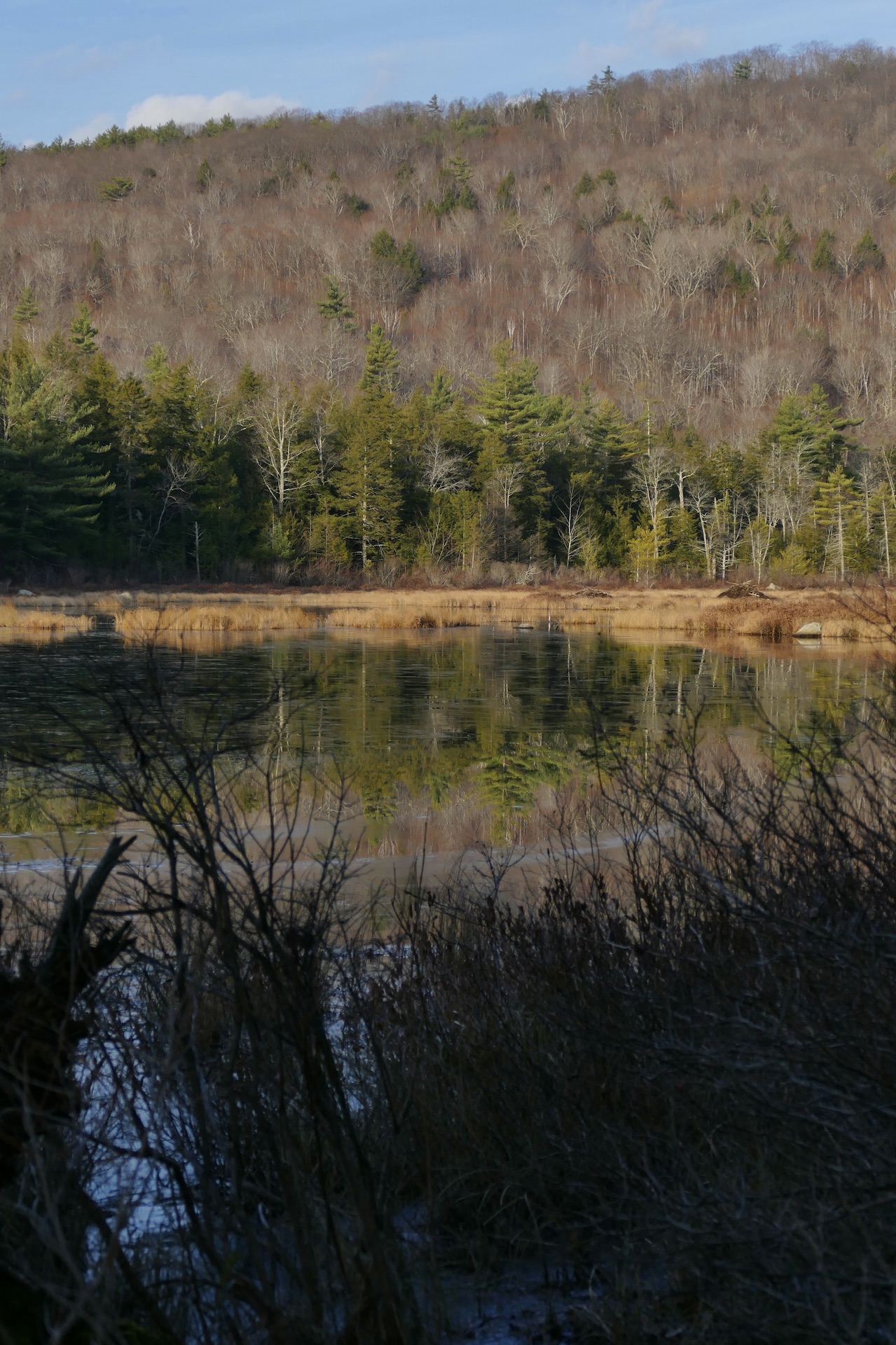
Returning, I see the red oak on R. W. E.’s shore reflected in the bright sky water. In the reflection the tree is black against the clear whitish sky, though as I see it against the opposite woods it is a warm greenish yellow. But the river sees it against the bright sky, and hence the reflection is like ink. The water tells me how it looks to it seen from below. I think that most men, as farmers, hunters, fishers, etc., walk along a river’s bank, or paddle along it stream, without seeing the reflections. Their minds are not abstracted from the surface, from surfaces generally. It is only a reflecting mind that sees reflections. I am aware often that I have been occupied with shallow and commonplace thoughts, looking for something superficial, when I did not see the most glorious reflections, though exactly in the line of my vision. If the fisherman was looking at the reflection, he would not know when he had a nibble! I know from my own experience that he may cast his line right over the most elysian landscape and sky, and not catch the slightest notion of them. You must be in an abstract mood to see reflections however distinct. I was even startled by the sight of that reflected red oak as if it were a black water-spirit. When we are enough abstracted, the opaque earth itself reflects images to us; i. e., we are imaginative, see visions, etc. Such a reflection, this inky, leafy tree, against the white sky, can only be seen at this season.
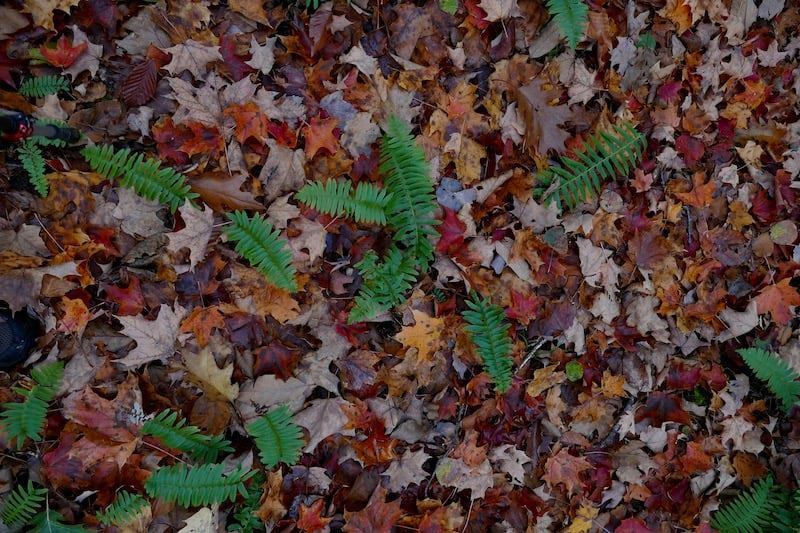
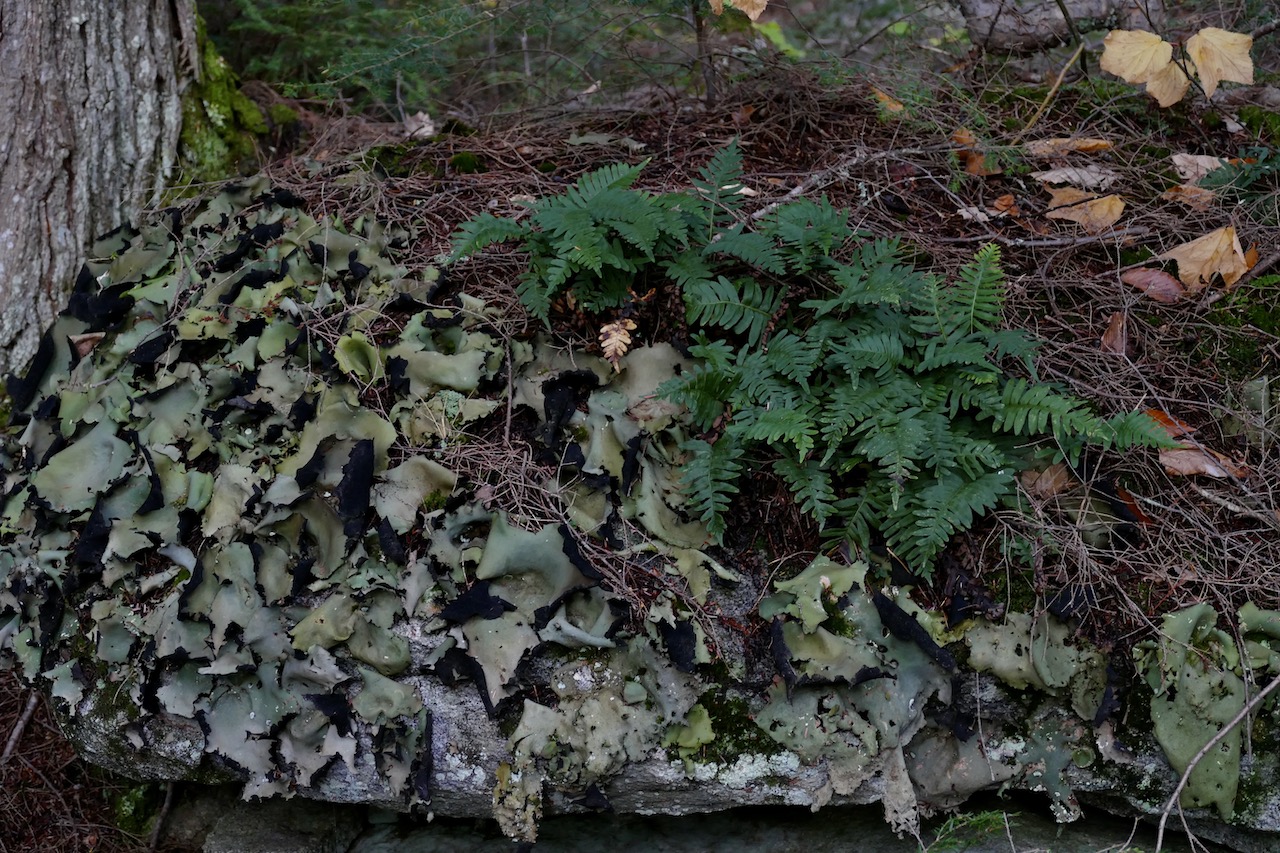
It is very pleasant & cheerful now days—when the brown & withered leaves strew the ground—& almost every plant is fallen or withered—to come upon a patch of polypody (as in abundance on hill side between Calla swamp & Bateman’s P.) on some rocky and still more (same) hillside E of the Callas hill side in the woods— When in the midst of dry & rustling leaves defying frost it stands so freshly green & full of life—The mere green which was not remarkable in the summer—is positively interesting now— My thoughts are with the poly-pody a long time after my body has passed. The brakes—the sarsaparilla—the Solomons seals—the ladies slippers—the osmundas—have long since withered & fallen. — The huckleberries & blueberries too have lost their leaves— The forest floor is covered with a thick coat of moist brown leaves, but what is that perennial & spring like verdure that clothes the rocks—of small green plumes pointing various ways— It is the cheerful community of the polypody. It survives at least as the type of vegetation to remind us of the spring which shall not fail. These are the green pastures where I browse now— Why is not this form copied by our sculptors instead of the foreign acanthus leaves & bays?
The sight of this unwithering green leaf excites me like red at some seasons. Are not wood frogs the philosophers who walk in these groves? —Methinks I imbibe a cool composed frog-like philosophy when I behold them. I don’t care for acanthus leaves— They are far fetched— I do love this form however— & would like to see it whether on your marble or my butter painted or sculptured — How fit for a tuft about the base of a column….
The evergreen ferns & lycopodiums— now have their day—now is the flower of their age—& their greenness is appreciated. They are much the clearest & most liquid green in the woods—more yellow & brown specked in the open places— The form of the polypody is strangely interesting—it is even outlandish. Some forms though common in our midst are thus perennially foreign as the growths of other latitudes—there being a greater interval between us & their kind than usual. We all feel the ferns to be further from us essentially—& sympathetically—than the phaenogamous plants—the roses & weeds for instance— It needs no geology nor botany to assure us of that—we feel it—& told them of it first. The bare outline of the polypody—thrills me strangely—it is a strange type which I cannot read—It only piques me— Simple as it is, it is as strange as an oriental character. It is quite independent of my race & of the Indian— & all mankind. It is a fabulous mythological form—such as prevailed when the earth & air & water were inhabited by those extinct fossil creatures—that we find. It is contemporary with them and affects as the sight of them.
I saw there between the converging boughs of two white pines a rod or two from me on the edge of the rock, and I thought that there was no frame to a landscape equal to this—to see between two near pine boughs whose lichens are distinct, a distant forest & lake—the one frame the other picture.









You must be logged in to post a comment.