
in Thoreau’s Journal:
The willow catkin might be the emblem of Spring. The buds of the lilack look ready to take advantage of the first warm day.
in Thoreau’s Journal:
The willow catkin might be the emblem of Spring. The buds of the lilack look ready to take advantage of the first warm day.
in Thoreau’s Journal:

The most interesting fact perhaps at present is these few tender yellow blossoms these half expanded sterile aments of the willow––seen through the rain & cold signs of the advancing year––pledges of the sun’s return. Anything so delicate both in structure in color & in fragrance contrasts strangely with surrounding nature & feeds the faith of man. The fields are acquiring a greenish tinge…
…As Cawley loved a garden, so I a forest. Observe all kinds of coincidences—as what kinds of birds come with what flowers.
in Thoreau’s Journal:

The scent of the earliest spring flowers! I smelt the willow catkins today. Tender––& innocent––after this rude winter––yet slightly sickening–– –– Yet full of vernal promise. The odor–– How unlike any thing that winter affords––or nature has afforded this 6 months! A mild sweet vernal scent–– Not highly spiced & intoxicating as some erelong––but attractive to bees–– That early yellow smell. The odor of spring––of life developing amid buds––of the earth’s epithalamium–– The first flowers are not the highest scented––as catkins––as the first birds are not the finest singers––as the black-birds & song sparrows &c. The beginnings of the year are humble. But though this fragrance is not rich––it contains & prophecies all others in it.

in Thoreau’s Journal:
The water on the meadows is now quite high––on account of the melting snow & the rain….Would it not be worth the while to describe the different states of our meadows which cover so large a portion of the town. It is not as if we had a few acres only of water surface––

From every side the milk-man rides over long causeways into the village —& carries the vision of much meadow’s surface with him into his dreams.–– They answer to moods of the Concord mind.–– There might be a chapter the Sudbury meadows––the humors of the town–– …I think our overflowing river––far handsomer & more abounding in soft and beautiful contrasts––than a merely broad river would be–– A succession of bays it is––a chain of lakes––an endlessly scalloped shore–– –– rounding wood & field––cultivated field & wood & pasture and house are brought into ever new & unexpected positions & relations to the water. There is just stream enough for a flow of thought––that is all. –– Many a foreigner who has come to this town has worked for years on its banks without discovering which way the river runs.
in Thoreau’s Journal:

Would it not be a fine office to preserve the vert of this forest in which I ramble?
in Thoreau’s Journal:

At this season of the year, we are continually expecting warmer weather than we have.
in Thoreau’s Journal:
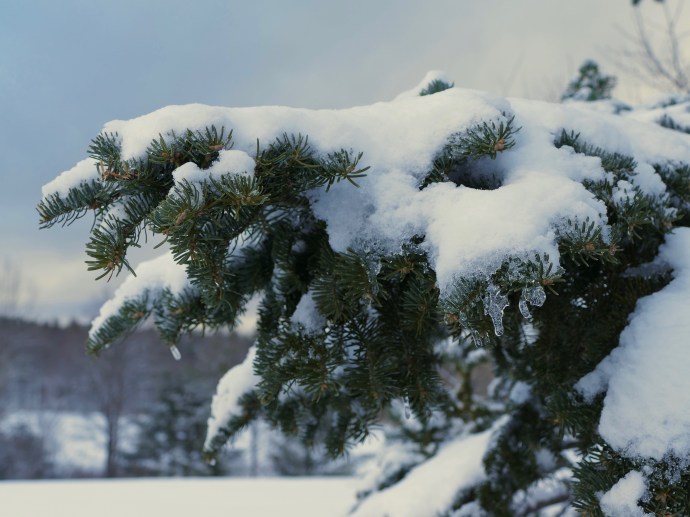
If it were not for the snow it would be a remarkably pleasant as well as warm day…. Can we believe when beholding this landscape––with only a few buds visibly swolen—on the trees & the ground covered 8 inches deep with snow––that the grain was waving in the fields & the apple trees were in blossom April 19, 1775… The snow goes off fast for I hear it melting & the eaves dripping all night as well as all day.

in Thoreau’s Journal:
A driving snow storm in the night & still raging––5 or 6 inches deep on a level at 7 Am. All birds are turned into snow birds. Trees and houses have put on the aspect of winter. The travelers carriage wheels, the farmer’s wagon are converted into white disks of snow through which the spokes hardly appear. But it is good now to stay in the house & read & write. We do not now go wandering all abroad & dissipated––but the imprisoning storm condenses our thoughts–– My life is enriched– I love to hear the wind howl. I have a fancy for sitting with my book or paper––in some mean & apparently unfavorable place––in the kitchen for instance where the work is going on––rather a little cold than comfortable–– –– My thoughts are of more worth in such places than they would be in a well-furnished & warmed studio.
in Thoreau’s Journal:
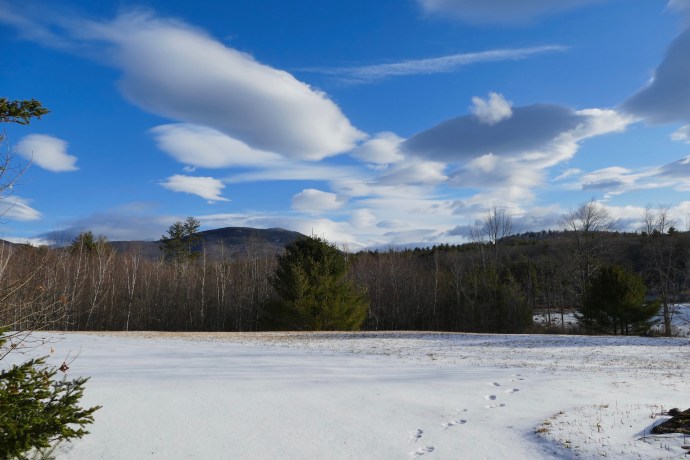
When I look closely I perceive the sward beginning to be green under my feet—very slightly. It rains with sleet & hail yet not enough to color the ground. At this season I can walk in the fields without wetting my feet in grass.
in Thoreau’s Journal:

A pure brook is a very beautiful object to study minutely.

in Thoreau’s Journal:
….maples and birches in front–with pines in the rear—making a low wild shore…The young trees & bushes now making apparent islands on the meadows are there nearly in this proportion I should think i.e. in deep water— Young maples—willows—button bushes—red osier…

in Thoreau’s Journal:
Watching the ripples fall and dart across the surface of low-lying and small woodland lakes is one of the amusements of these windy March and April days.

in Thoreau’s Journal:
The epigaea is not quite out. The earliest peculiarly woodland herbaceous flowers are epigaea, thalictrum, and (by the first of May) Viola pedata. These grow quite in the woods amid dry leaves, nor do they depend so much on water as the very earliest flowers. I am perhaps more surprised by the growth of the Viola pedata leaves by the side of paths amid the shrub oaks, and half covered with oak leaves, than by any other growth, the situation is so dry and the surrounding bushes so apparently lifeless.

in Thoreau’s Journal:
As to which are the earliest flowers, it depends on the character of the season, and ground bare or not, meadows wet or dry, etc., etc., also on the variety of soils and localities within your reach.

in Thoreau’s Journal:
One thing I may depend on, there has been no idling with the flowers. Nature loses not a moment, takes no vacation. They advance as steadily as a clock.

in Thoreaus Journal:
These days when a soft W or SW wind blows & it is truly warm & an outside coat is oppressive––these bring out the butterflies & the frogs––& the marsh hawks which prey on the last. Just so simple is every year. Whatever year it may be….Begin to look off hills & see the landscape again through a slight haze with warm wind on the cheek.

in Thoreau’s Journal:
Rain Rain
To Clematis Brook via Lee’s Bridge. Again I notice that early reddish or purplish grass that lies flat on the pools––like a warm blush suffusing the youthful face of the year. A warm dripping rain heard on ones umbrella as on a snug roof––and on the leaves without suggests comfort–– We go abroad with a slow but sure contentment like turtles under their shells–– We never feel so comfortable as when we are abroad in a storm with satisfaction–– Our comfort is positive then. We are all compact & our thoughts collected. We walk under the clouds & mists as under a roof…. A rainy day is to the walker in solitude and retirement like the night––few travelers are about––& they half hidden under umbrellas and confined to the highways. One’s thoughts run in a different channel than usual–– It is somewhat like the dark day––it is a light night.

in Thoreau’s Journal:
The last two Tribunes I have not looked at- I have no time to read newspapers- If you chance to live & move and have your being in that thin stratum-in which the events which make the news transpire––thinner than the paper on which it is printed––then these things will fill the world for you–but if you soar above or dive below that plain—you cannot remember nor be reminded of them.

in Thoreau’s Journal:
It is evident that it depends on the character of the season whether this flower or that is the most forward; whether there is more or less snow or cold or rain, etc.

in Thoreau’s Journal:
April has begun like itself–– It is warm & showery—while I sail away with a light SW wind toward the Rock–– Sometimes the sun seems just ready to burst out-yet I know it will not–– The meadow is becoming bare It resounds with the sprayey notes of blackbirds — The birds sing this warm and showery day after a fortnight’s cold (yesterday was wet too) with a universal burst & flood of melody.


You must be logged in to post a comment.