in Thoreau’s Journal:
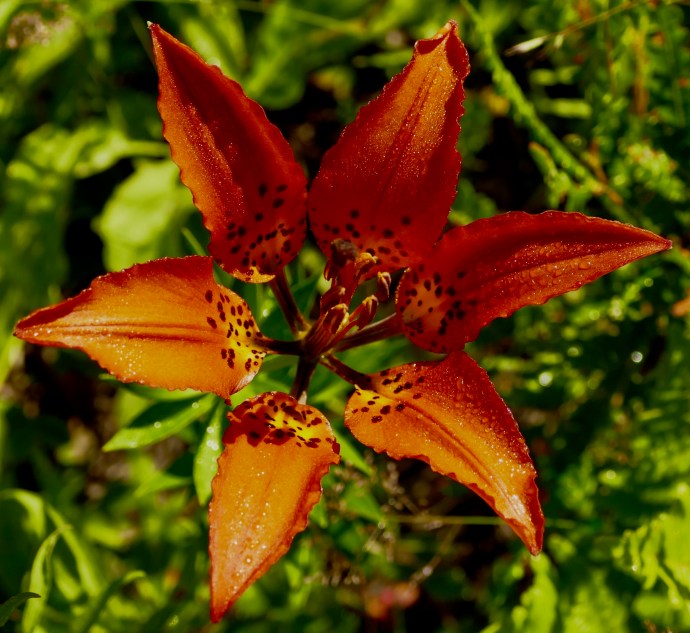
The red lily ilium Philadelphicum– This has very open petals of a dark vermilion color–freckled within & grows in rather dry places–by wood paths &c & is very interesting & handsome–
in Thoreau’s Journal:
The red lily ilium Philadelphicum– This has very open petals of a dark vermilion color–freckled within & grows in rather dry places–by wood paths &c & is very interesting & handsome–
in Thoreau’s Journal:
The progress of the season is indescribable–– It is growing warm again—but the warmth is different from that we have had— We lie in the shade of locust trees–haymakers go by in a hay-rigging–
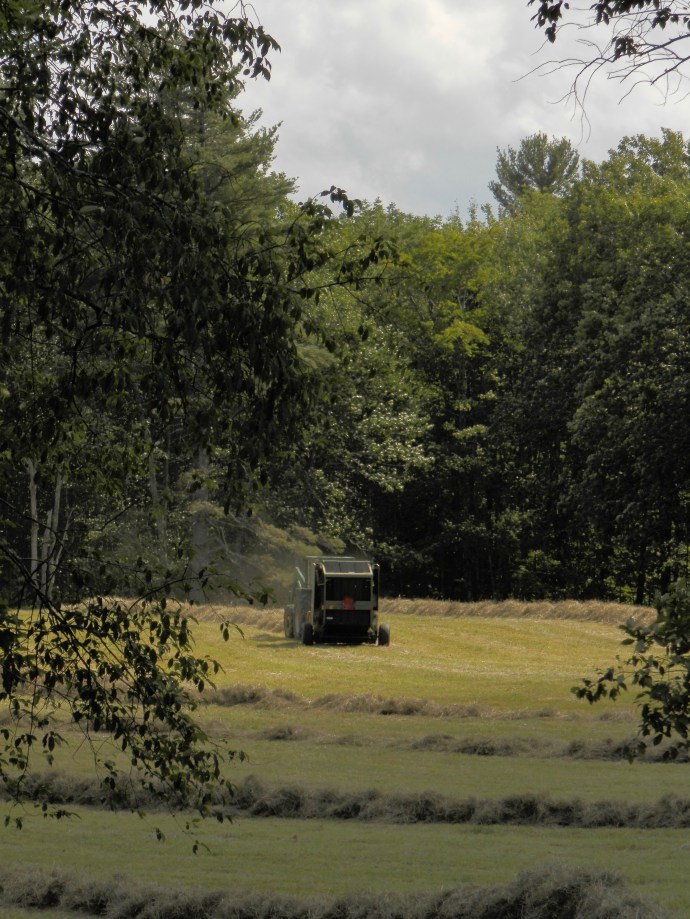
I am reminded of berrying– I scent the sweet fern & the dead or dry pine leaves––cherry-birds alight on a neighboring tree. The warmth is something more normal–& steady-ripening fruits. Campanula Aparinoides slender bell-flower
in Thoreau’s Journal:
To Conantum. –to see the lilies open– I hear an occasional crowing of cocks in distant barns as has been their habit for how many thousand years. It was so when I was young; and it will be so when I am old- I hear the croak of a tree toad as I am crossing the yard– I am surprised to find the dawn so far advanced. There is a yellowish segment of light in the east paling a star–& adding sensibility to the light of the waning & now declining moon. There is very little dew on the uplands. I hear a little twittering & some clear singing from the seringo & the song sparrow– as I go along the Back Road–and now and then the note of the bull frog from the river– The light in the east has acquired a reddish tinge near the horizon Small wisps of cloud are already fuscous & dark seen against the light as in the W at evening. It being Sunday morning I hear no early stirring farmer driving over a bridge– The crickets are not remarkably loud at this season– The sound of a whippoorwill is wafted from the woods– Now on the Corner Road the hedges are alive with twittering sparrows–a blue bird or two &c. The day light now balances the moonlight. How short the nights. The last traces of day have not disappeared much before 10 o’clock or perchance 9 1/2 and before 3 Am you see them again in the East. (probably 2 1/2) leaving about 5 hours of solid night– The sun so soon coming around again. The robins sing–but not so loud & long as in the spring– I have not been awakened by them latterly in the mornings– Is it my fault–ah! those mornings when you are awakened in the dawn by the singing of the Matins of the birds. I hear the dumping sound of frogs now on the causeway. Some small clouds in the east are reddish fuscous. There is no fog on the river nor in the meadows. The king-bird twitters? on the Black willows. Methinks I saw the not yet extinguished lights of one or two fireflies in the darker ruts in the grass in Conant’s meadow. The moon yields to the sun–she pales even in the presence of his dawn. It is chiefly the spring birds that I hear at this hour—& in dawn the spring is thus revived–– The notes of the sparrows & the blue-birds & the robin have a prominence now which they have not by day The light is more & more general & some low bands begin to look bluish as well as reddish. (Elsewhere the sky wholly clear of clouds) The dawn is at this stage far lighter than the brightest moonlight–– I write by it––yet the sun will not rise for some time. Those bars are reddening more above one spot. They grow purplish or lilac rather. White & whiter grows the light in the eastern sky–– (And now descending to the cliff by the river side I cannot see the low horizon & its phenomena) I love to go through these old apple orchards so irregularly set out. Sometimes two trees standing alone together– The rows of grafted fruit will never tempt me to wander amid them like these. A bittern leaves the shore at my approach–– I suppose it is he whose excrement has whitened the rocks–as if a mason had spilled his whitewash–– A night hawk squeaks & booms– before sunrise. The insects shaped like shad flies (some which I see are larger & yellowish) begin to leave their cases (and selves?) on the stems of the grasses & the rushes in the water. I find them so weak they can hardly hold on. I hear the blackbirds carqueree & the king-fisher darts away with his alarum– and outstretched neck. Every lily is shut Sunrise––I see it gilden the top of the hill behind me but the sun itself is concealed by the hills & woods on the E shore…
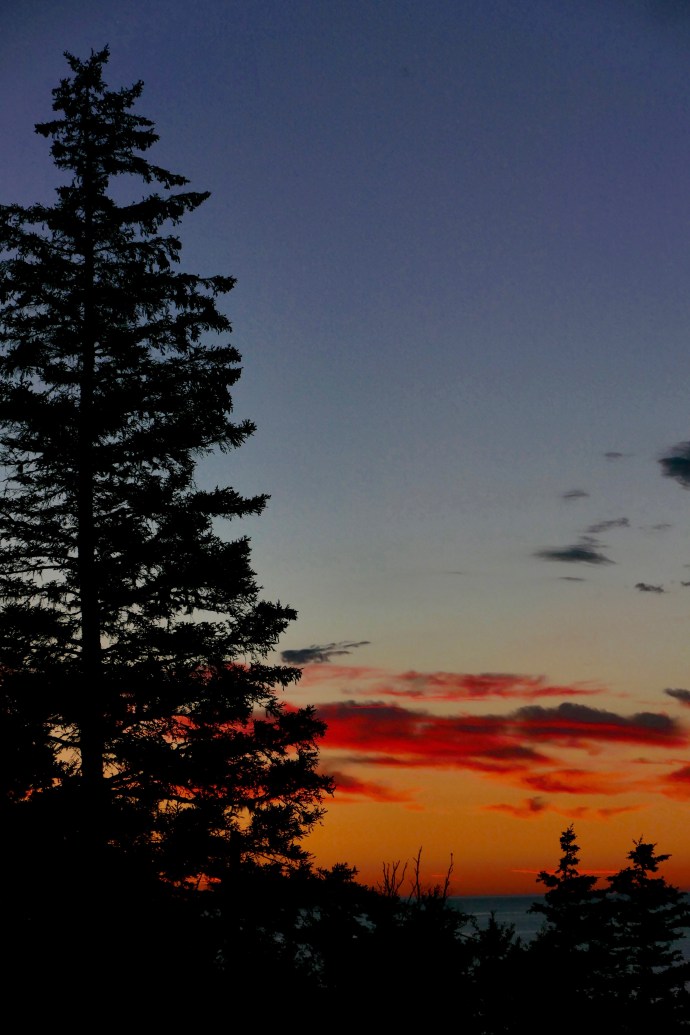
July 4, 2017 Photo
in Thoreau’s Journal:
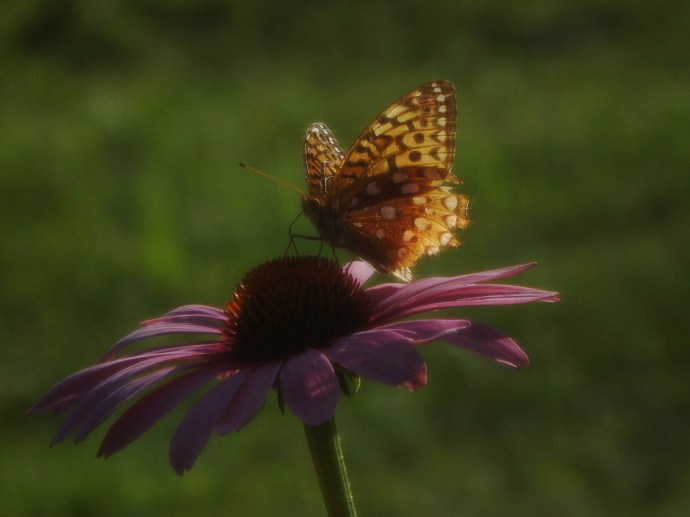
A cone flower–(new plant) Rudbeckia hirta (except that I call its disk not dull brown but dull or dark purple or maroon) in Arethusa meadow)— However Wood calls it dark purple saw one (plucked June 25) —blossomed prob about that time–– Many yesterday in meadows beyond alms house. Prob. introduced lately from west.
in Thoreau’s Journal:
Suddenly I see a broad reach of blue beneath, with its curves and headlands, liberating me from the more terrene earth. What a difference it makes whether I spend my four hours nooning between the hills by yonder roadside, or on the brink of this fair river, within a quarter of a mile of that! Here the earth is fluid to my thought, the sky is reflected from beneath, and around yonder cape is the highway to other continents. This current allies me with the world.
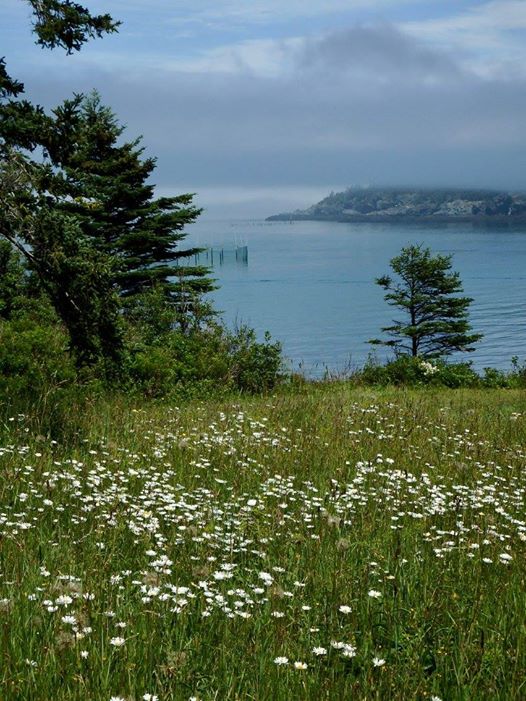
Photo: July 2, 2017
in Thoreau’s Journal:
An abundance of red lilies in an upland dry meadow….low from one to two feet high–up-right flowered––more or less dark shade of red-freckled & sometimes wrinkle edged––must have been some days.

This has come with the intense summer heats– a torrid July heat like a red sunset threatening torrid heat. (Do we not always have a dry time just before the huckleberries turn?-) I think this meadow was burnt over about a year ago. Did that make the red lily grow? The spring now seems far behind–I do not remember the interval.
in Thoreau’s Journal:
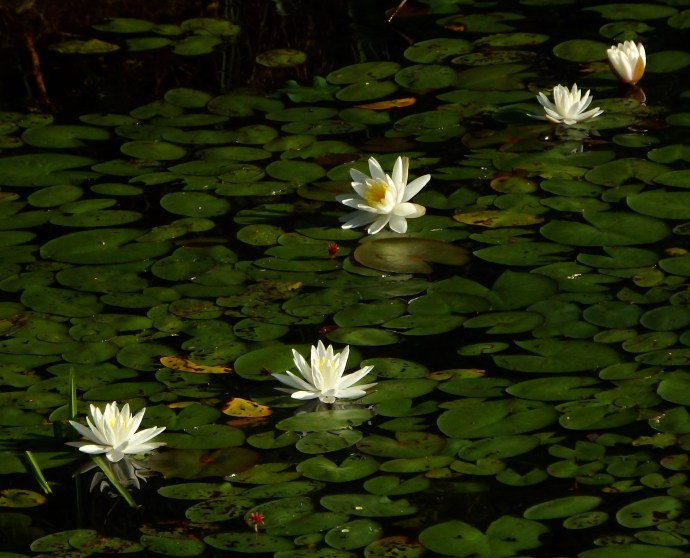
To Sherman’s Bridge by land and water. One object, to see the white lilies in bloom.
in Thoreau’s Journal:
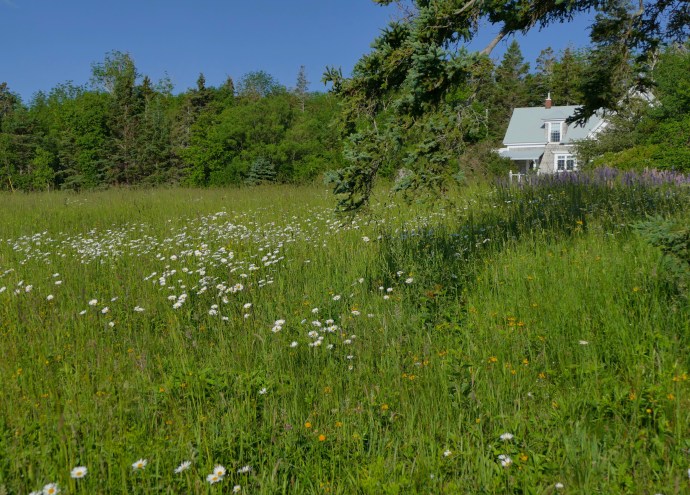
Generally speaking, the fields are not imbrowned yet, but the freshness of the year is preserved. As I stand on the side of Fair Haven Hill, the verdure generally appears at its height, the air clear, and the water sparkling after the rain of yesterday. It is a world of glossy leaves and grassy fields and meads.
in Thoreau’s Journal:
How different is day from day! Yesterday the air was filled with a thick, fog-like haze, so that the sun did not once shine with ardor, and everything was so tempered under this thin veil that it was a luxury merely to be out doors. You were the less out for it. The shadows of the apple trees even early in the afternoon were remarkably distinct. The landscape wore a classic smoothness. Every object was as in a picture with a glass over it. I saw some hills on this side the river looking from Conantum, on which the grass being of a yellow tinge, though the sun did not shine out on them, they had the appearance of being shone upon peculiarly. It was merely an unusual yellow tint of the grass. The mere surface of the water was an object for the eye to linger on.
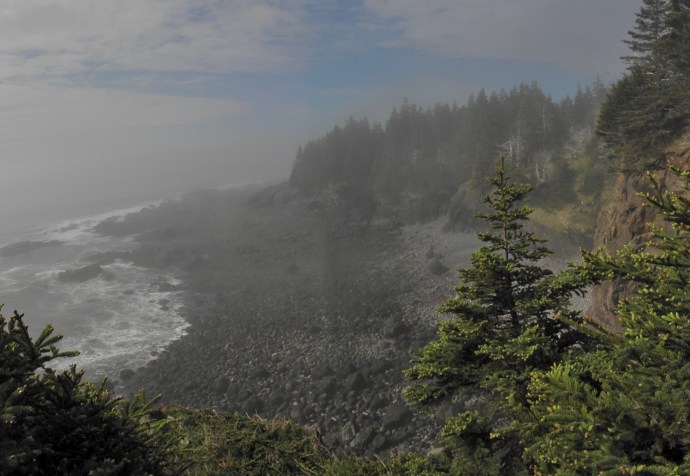
I thought that one peculiarity of my “Week” was its hypaethral character, to use an epithet applied to those Egyptian temples which are open to the heavens above, under the ether. I thought that it had little of the atmosphere of the house about it, but might have been written wholly, as in fact it was to a great extent, out of doors. It was only at a late period in writing it, as it happened, that I used any phrases implying that I lived in a house or led a domestic life. I trust it does not smell so much of the study and library, even of the poet’s attic, as of the fields and woods, that it is a hypaethral or unroofed book, lying open under the ether, and permeated by it, open to all weathers, not easy to be kept on a shelf.

in Thoreau’s Journal:
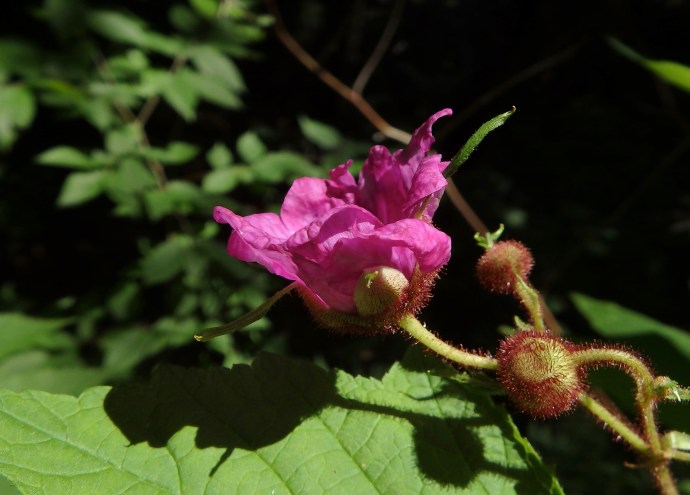
The rubus odoratus purple flowering raspberry in gardens––
in Thoreau’s Journal:

I picked a handful or two of blueberries. These and huckleberries deserve to be celebrated, such simple, wholesome, universal fruits, food for the gods and for aboriginal men. They are so abundant that they concern our race much….

I cannot imagine any country without this kind of berry.
in Thoreau’s Journal:
The Nymphaea odorata, sweet water lily, pond lily, in bloom. A superb flower, our lotus, queen of the waters.

Now is the solstice in still waters. How sweet, innocent, wholesome its fragrance, how pure its white petals, though its root is in the mud.
in Thoreau’s Journal:
Methinks roses oftenest display their bright colors which invariably attract all eyes and betray them, against a dark ground, as the dark green or the shady recesses of other bushes and copes, where they show to best advantage. Their enemies do not spare the open flower for an hour. Hence if for no other reason, their buds are most beautiful. Their promise of perfect and dazzling beauty, when their buds are just beginning to expand, beauty which they can hardly contain, as in most youths, commonly surpasses the fulfillment of their expanded flowers. The color shows fairest and brightest in the bud. The expanded flower has no higher or deeper tint than the swelling bud exposed. This raised a dangerous expectation. The season when wild roses are in bloom should have some preeminence, I think.

in Thoreau’s Journal:
The drifting, white downy clouds are to the landsman what sails on the seas are to him who dwells by the shore, objects of a large, diffusive interest….They are the flitting sails in the ocean whose bounds no man has visited. They are like all great themes, always at hand to be considered, or they float over us unregarded. Far away they float in the serene sky, the most inoffensive of objects, or near and low they smite us with the lightnings and deafen us with their thunder….

What could a man learn by watching the clouds? These objects which go over our head unobserved are vast and indefinite….They are among the most glorious objects in Nature. A sky without clouds is a meadow without flowers, a sea with sails.
in Thoreau’s Journal:

The pretty little Mitchella repens, with its twin flowers spots the ground under the pines, its downy-petaled, cross-shaped flowers, and its purplish buds.
in Thoreau’s Journal:

The birch is the surveyor’s tree– It makes the best stakes to look at through the sights of a compass except when there is snow on the ground. Their white bark was not made in vain. In surveying woodlots I have frequent occasion to say this is what they were made for….
in Thoreau’s Journal:
Nature has looked uncommonly bare & dry to me for a day or two. With our senses applied to the surrounding world we are reading our own physical & corresponding moral revolutions. Nature was so shallow all at once I did not know what had attracted me all my life. I was therefore encouraged when going through a field this evening, I was unexpectedly struck with the beauty of an apple tree –– the perception of beauty is a moral test….

I see the tephrosia out through the dusk––a handsome flower. What rich crops this dry hill side has yielded. First I saw the v. pedata here––& then the Lupines & the Snap-Dragon covered it––& now the Lupines are done & their pods are left––the tephrosia has taken their place. This small dry hill side is thus a natural garden–– I omit the flowers which grow here & name only those which to some extent cover it or possess it. No eighth of an acre in a cultivated garden could be better clothed or with a more pleasing variety from month to month––& while one flower is in bloom you little suspect that which is to succeed & perchance eclipse it. It is a warmly placed dry hill side beneath a wall––very thinly clad with grass. Such spots there are in nature-natural flower gardens. –– Of this succession I hardly know which to admire the most. It would be pleasant to write the history of one hill side for one year. First and last you have the colors of the rain-bow & more––& the various fragrances which it has not. Blackberries––roses––& dogs bane also are now in bloom here–– I hear neither toads not bull frogs at present––they want a warmer night. I hear the sound of distant thunder though no cloud is obvious. muttering like the roar of artillery. This is a phenomena of this season––

in Thoreau’s Journal:

Upland haying begun. or beginning–
in Thoreau’s Journal:

A comfortable breezy June Morning.….Me thinks there are most tall butter-cups now.
in Thoreau’s Journal:
Moon not quite full– Going across Depot Field – The western sky is now a crescent of saffron inclining to salmon–a little dunnish perhaps. The grass is wet with dew–the evening star has come out but no other– There is no wind– I see a night hawk in the twilight flitting near the ground– I hear the hum of a beetle going by– The greenish fires of lightning bugs are already seen on the meadow– I pass through Hubbardston along the side of a field of oats–which wet one leg. I perceive the smell of a burning far off by the river, which I saw smoking 2 days ago. The moon is laboring in a mackerel cloud and my hopes are with her. Why do I hear no bull frogs yet– Do they ever trump as early and as universally as on that their first evening? I hear the whipper wills on different sides – White flowers alone show much at night–white clover–& white-weed It is commonly still at night as now– The day has gone by with its wind like the wind of a cannon ball–and now far in the west it blows–by that dun colored sky you may track it– There is no motion nor sound in the woods (Hubbards Grove) along which I am walking. The trees stand like great screens against the sky.

The distant village sounds, are the barking of dogs, that animal with which man has allied himself, and the rattling of wagons– For the farmers have gone into town shopping this Saturday night– The dog is the tamed wolf–as the villager is the tamed savage But here the crickets are heard in the grass chirping from everlasting to everlasting, a mosquito sings near my ear–and the humming of a dawbug drowns all the noise of the village. So roomy is the universe the moon comes out of the mackerel cloud and the traveller rejoices. How can a man write the same thoughts by the light of the moon–resting his book on a rail by the side of a remote potato field–that he does by the light of the sun, on his study table. The light is but a luminousness– My pencil seems to move through a creamy mystic medium – The moonlight is rich & somewhat opaque like cream but The day light is thin & blue like skimmed milk– I am less conscious than in the presence of the sun–my instincts have more influence…


You must be logged in to post a comment.