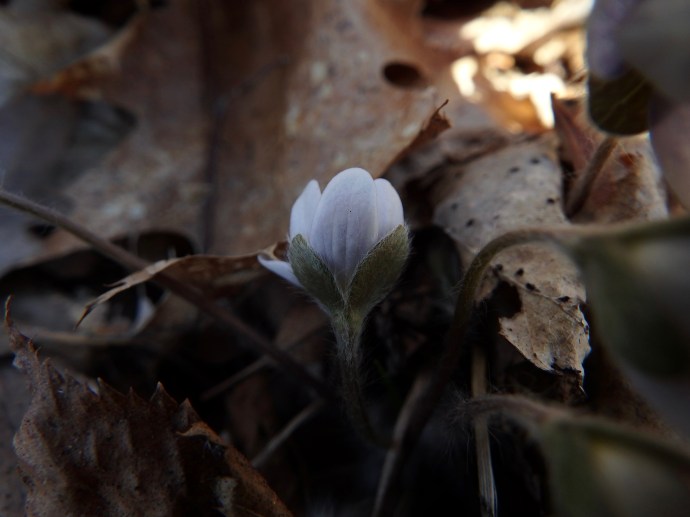
April 25, 1854

in Thoreau’s Journal:

The first partridge drums in one or two places—As if the earth’s pulse now beat audibly with the increased flow of life. It slightly flutters all Nature & makes her heart palpitate— Also, as I stand listening for the wren, & sweltering in my great-coat—I hear the woods filled with the hum of insects—as if my hearing were affected—& thus the summer quire begins—

P4240004.jpg

The silent spaces have begun to be filled with notes of birds and insects & the peep & croak & snore of frogs—even as living green blades are everywhere pushing up amid the sere ones.

April 24, 1852

in Thoreau’s Journal:

P4230007.jpg

The rattlesnake plantain has fresh leaves.
April 23, 2016: Photo

___________________________

April, 24, 1859 in Thoreau’s Journal

There is a season for everything, and we do not notice a given phenomenon except at that season, if indeed it can be called the same phenomenon at any other season. There is a time to watch the ripples on Ripple Lake, to look for arrowheads, to study the rocks and lichens, a time to walk on sandy deserts, and the observor of nature must improve the seasons as much as the farmer his. So boys fly kites and play ball and hawkie at particular times all over the state. We must not be governed by rigid rules, as by the almanac, but let the seasons rule us. The moods and thoughts of man are revolving just as steadily and incessantly as nature’s. Take time by the forelock. Now or never! You must live in the present, launch yourself on every wave, find your eternity in each moment. Fools stand on their island opportunities and look toward another land. There is no other land; there is no other life but this one or the life of this. Where the good husbandman is, there is good soil. Take any other course and life will be a succession of regrets. Let us see vessels sailing prosperously before the wind, and not simply stranded barks. There is no world for penitent and regretful.

April 23, 1854

in Thoreau’s Journal:

The first April showers are even fuller of promise & a certain moist serenity than the sunny days….The tinge of green is gradually increasing in the face of the russet earth…

P4210079.jpg

Now that the very earliest shrubs are beginning to unfold…

April 21, 1854

in Thoreau’s Journal:

….I perceive the faintest possible flower-like scent as from the earth—reminding me of anemones & houstonias. Can it be the budded mouse-ears under my feet? downy-swaddled—they lie along flat to the earth like a child on its mother’s bosom.

P4140042.jpg

I sit on a rock awhile just below the old trough. These are those early times when the rich golden brown tassels of the alder tremble over the brooks—& not a leaf on their twigs.

April 18, 1852

in Thoreau’s Journal:

For the first time I perceive this spring that the year is a circle— I see distinctly the spring arc thus far. It is drawn with a firm line…

Why should just these sights & sounds accompany our life? Why should I hear the chattering of blackbirds—why smell the skunk each year? I would fain explore the mysterious relation between myself & these things. I would at least know what these things unavoidably are- —make a chart of our life & when—know why just this circle of creatures completes the world. Can I not by expectation affect the revolutions of nature—make a day to bring forth something new?

P4140055.jpg

As Cawley loved a garden, so I a forest.

Observe all kinds of coincidences—as what kinds of birds come with what flowers.

An East Wind, I hear the clock strike plainly 10 or 11 PM.

——————

Thought for April 18, 2016:  The 2,000,000 words of his Journal are like a very long hike during which the reader must ask questions (as in the above) in order to keep awake to her/his surroundings. Then, just as we can excerpt from the Journal every day, we can remember those aspects of our hike and assemble them for particular and new purposes.
April 16, 1852

in Thoreau’s Journal:

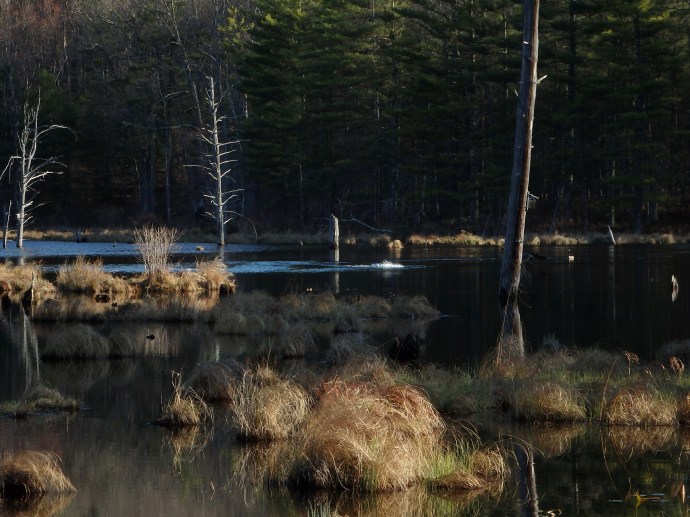
I think our overflowing river—far handsomer & more abounding in soft and beautiful contrasts—than a merely broad river would be- A succession of bays it is-a chain of lakes-an endlessly scalloped shore — — rounding wood & field-cultivated field & wood & pasture and house are brought into ever new & expected positions & relations to the water.

12977206_10209591012193532_8490521442595730282_o.jpg

There is just stream enough for a flow of thought—that is all.

April 13, 1852

in Thoreau’s Journal:

A driving snow storm in the night & still raging…All birds have turned into snow birds. Trees and houses have put on the aspect of winter. The travelers carriage wheels, the farmer’s wagon are converted into white disks of snow through which the spokes hardly appear.

P4130298.jpg

April 13, 2013: Photo

But it is good now to stay in the house & read & write. We do not now go wandering all abroad & dissipated—but the imprisioning storm condenses our thoughts— I can hear the clock tick as not in pleasant weather— My life is enriched— I love to hear the wind howl. I have a fancy for sitting with my book or paper—in some mean & apparently unfavorable place—in the kitchen for instance where the work is going on—rather a little cold than comfortable— — My thoughts are of more worth in such places than they would be in a well-furnished & warmed studio.


April 10 1853

in Thoreau’s Journal:

….maples and birches in front–with pines in the rear—making a low wild shore…The young trees & bushes now making apparent islands on the meadows are there nearly in this proportion I should think i.e. in deep water— Young maples—willows—button bushes—red osier…

P4090043.jpg

April 9, 2016 Photo

April 9, 1853

in Thoreau’s Journal:

The male red maple buds now show 8 or 10 (counting everything) scales alternately crosswise—

P4050005.jpg

& the pairs successively brighter red or scarlet, which will account for the gradual reddening of their tops. They are about ready to open.

April 8, 1859

in Thoreau’s Journal:

The epigaea is not quite out. The earliest peculiarly woodland herbaceous flowers are epigaea, anemone, thalictrum, and (by the first of May) Viola pedata. These grow quite in the woods amid dry leaves, nor do they depend so much on water as the very earliest flowers.

12961334_10209526863469854_5940550783743418815_o.jpg

I am perhaps more surprised by the growth of the Viola pedata leaves by the side of paths amid the shrub oaks, and half covered with oak leaves, than by any other growth, the situation is so dry and the surrounding bushes so apparently lifeless.

April 7, 1853

in Thoreau’s Journal:

Now the sun is low in the west the northeasterly water is of a peculiarly etherial light blue, more beautiful than the sky—

PA290024.jpg

and this broad water with innumerable bays & inlets running up into the land on either side—& often divided by bridge causeways—as if it were the very essence & richness of the heavens distilled and poured upon the earth, contrasting with the clean russet land—& the paler sky from which it has been subtracted—nothing can be more elysian. Is not the blue more etherial when the sun is at this angle— The river is but a long chain of flooded meadows—