December 29, 1856

in Thoreau’s Journal:

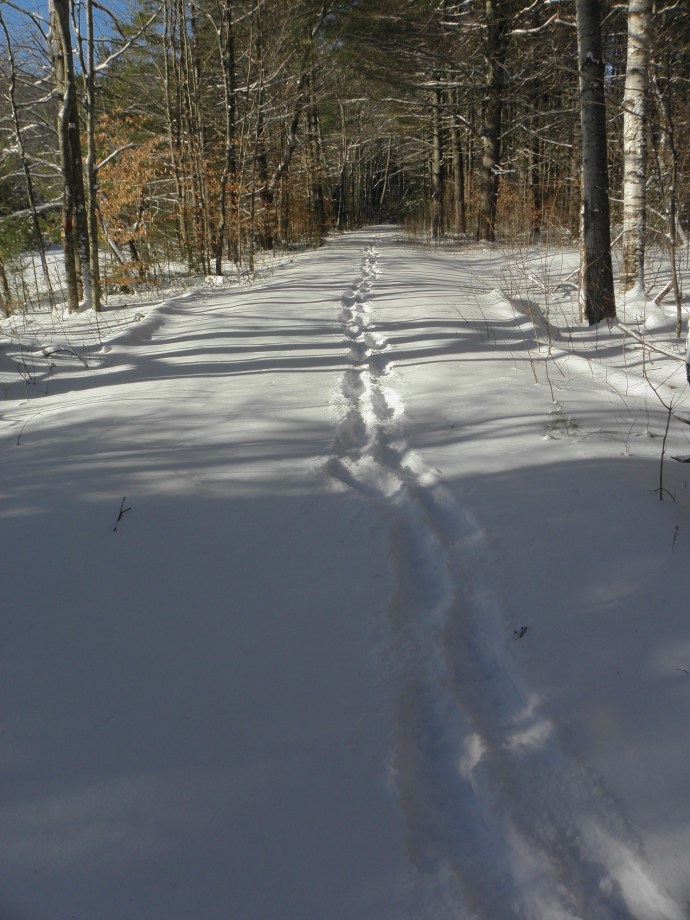
We must go out and re-ally ourselves to Nature every day.
PC287995.jpg

We must make root, sent out some little fibre at least, even every winter day. I am sensible that I am imbibing health when I open my mouth to the wind. Staying in the house breeds a sort of insanity always. Every house is, in this sense, a sort of hospital. A night and a forenoon is as much confinement to those wards as I can stand. I am aware that I recover some sanity, which I had lost, almost the instant that I come abroad.

December 28, 1840

in Thoreau’s Journal:

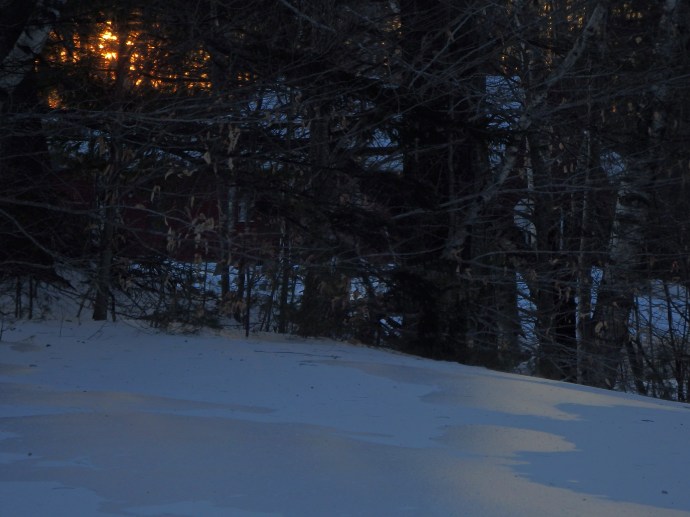
The snow hangs on the trees as the fruit of the season. In those twigs which the wind has preserved naked there is a warmer green for the contrast. The whole tree exhibits a kind of interior and household comfort, a shelter and covert aspect. It has the snug inviting look of a cottage on the moors, buried in snow.

P2190053.jpg

—Our voices ring hollowly through the woods as through a chamber, the twigs crackle under foot with private and household echoes. I have observed on a clear winter’s morning that the woods have their southern window as well as the house, through which the first beams of the sun stream along their aisles and corridors. The sun goes up swiftly behind the limbs of the white pine, as the sashes of a window.

December 27, 1851

in Thoreau’s Journal:

The man is blessed who every day is permitted to behold anything so pure and serene as the western sky at sunset, while revolutions vex the world.

P1080006.jpg

There is no winter necessarily in the sky, though snow covers the earth. The sky is always ready to answer our moods. We can see summer there or winter.

December 23, 1851

in Thoreau’s Journal:

It is a record of the mellow & ripe moments that I would keep.

P1060007.jpg

I would not preserve the husk of life—but the kernel.

When the cup of life is full and flowing over—preserve some drops as a specimen-sample. When the intellect enlightens the heart & the heart warms the intellect.

December 22, 1853

in Thoreau’s Journal:

A slight whitening of snow last evening—the 2nd whitening of the winter—just enough to spoil the skating now 10 days old on the ponds—

PC130022.jpg

Walden skimmed over in the widest part, but some acres still open—will prob. freeze entirely to-night if this weather holds.

December 21, 1853

in Thoreau’s Journal:

PC210020.jpg

We are tempted to call these the finest days of the year. Take Fair Haven Pond, for instance, a perfectly level plain of snow, untrodden as yet by any fisherman, surrounded by snow-clad hills, dark evergreen woods, and reddish oak leaves so pure and still.

December 20, 1851

in Thoreau’s Journal:

A clump of white pines seen far westward over the shrub-oak plain which is now lit up by the setting sun, a soft feathery grove, with their gray stems indistinctly seen, like human beings come to their cabin door, standing expectant on the edge of the plain, inspires me with a mild humanity. The trees indeed have hearts. The sun seems to send its farewell ray far and level over the copes to them, and they silently receive it with gratitude, like a group of settlers with their children.

P1010011.jpg

The pines impress me as human. A slight vaporous cloud floats high over them, while in the west the sun goes down apace behind glowing pines and golden clouds which like mountains skirt the horizon. Nothing stands up more free from blame in this world than a pine-tree.

December 19, 1840

in Thoreau’s Journal:

This plain sheet of snow which covers the ice of the pond is not such a blankness as is unwritten, but such as is unread.

P2076118.jpg

All colors are in white. It is such simple diet to my senses as the grass and the sky. There is nothing fantastic in them. Their simple beauty has sufficed men from the earliest times.— they have never criticized the blue sky and the green grass.

December 18, 1852

in Thoreau’s Journal:

P1070195.jpg

Loring’s Pond beautifully frozen. (This is the first skating.) So polished the surface, I took many parts of it for water. It was waved or watered with a slight dust, nevertheless. Cracked into large squares, like the faces of a reflector, it was so exquisitely polished that the sky and dun-colored scudding clouds, with mother-o’-pearl tints, were reflected in it as in the calmest water. I slid over it with a little misgiving, mistaking the ice before me for water. Still the ruby-crowned birds about.

December 13, 1851

in Thoreau’s Journal:

Surveying today. We had one hour of most Indian-summer weather in the middle of the day. I felt the influence of the sun. It softened my stoniness a little. The pines looked like old friends again. Cutting a path through swamp where was much brittle dogwood, etc, I wanted to know the name of every bush. This varied employment to which my necessities compel me serves instead of foreign travel and the lapse of time. If it makes me forget some things which I ought to remember, it no doubt makes me forget many things which I ought to forget. By stepping aside from my chosen path so often, I see myself better, and am enabled to criticize myself better. It seems an age since I took walks and wrote in my journal, and when shall I revisit the glimpses of the moon? To be able to see ourselves, not merely as others see us, but as we are, that service a variety of absorbing employments does us. (italics, mine)

December 13, 2012:

PC137766.jpg

December 11, 1855

P1175714.jpgin Thoreau’s Journal:

We get only transient and partial glimpses of the beauty of the world. Standing at the right angle, we are dazzled by the colors of the rainbow in colorless ice. From the right point of view, every storm and every drop in it is a rainbow. Beauty and music are not mere traits and exceptions; they are the rule and character. It is the exception that we see and hear.

December 10, 1840

in Thoreau’s Journal:

I discover a strange track in the snow, and learn that some migrating otter has made across from the river to the wood, by my yard and the smith’s shop, in the silence of the night. I cannot but smile at my own wealth when I am thus reminded that every chink and cranny of nature is full to overflowing. Such an incident as this startles me with the assurance that the primeval nature is still working, and makes tracks in the snow. It is my own fault that he must thus skulk across my premises by night. Now I yearn toward him, and heaven to me consists in a complete communion with the otter nature. He travels a more wooded path by watercourses and hedgerows, I by the highways, but though his tracks are now crosswise to mine, our courses are not divergent, but we shall meet at last.

P2066050.jpg