in Thoreau’s Journal:

Health makes the poet—or sympathy with nature—a good appetite for his food which is constantly renewing him—whetting his senses. Pay for your victuals then with poetry—give back life for life.

in Thoreau’s Journal:
Health makes the poet—or sympathy with nature—a good appetite for his food which is constantly renewing him—whetting his senses. Pay for your victuals then with poetry—give back life for life.
in Thoreau’s Journal:
In composition I miss the hue of the mind.

As if we could be satisfied with the dews of the morning and evening—without their colors—or the heavens without their azure.
in Thoreau’s Journal:
Measure your health by your sympathy with morning and spring. If there is no response in you to the awakening of nature, if the prospect of an early morning walk does not banish sleep, if the warble of the first bluebird does not thrill you, know that the morning and spring of your life are past. Thus you may feel your pulse.
in Thoreau’s Journal:
As we grow older, is it not ominous that we have more to write about evening, less about morning? We must associate more with the early hours.
in Thoreau’s Journal:

We have lived, not in proportion to the number of years that we have spent on the earth, but in proportion as we have enjoyed.
in Thoreau’s Journal:
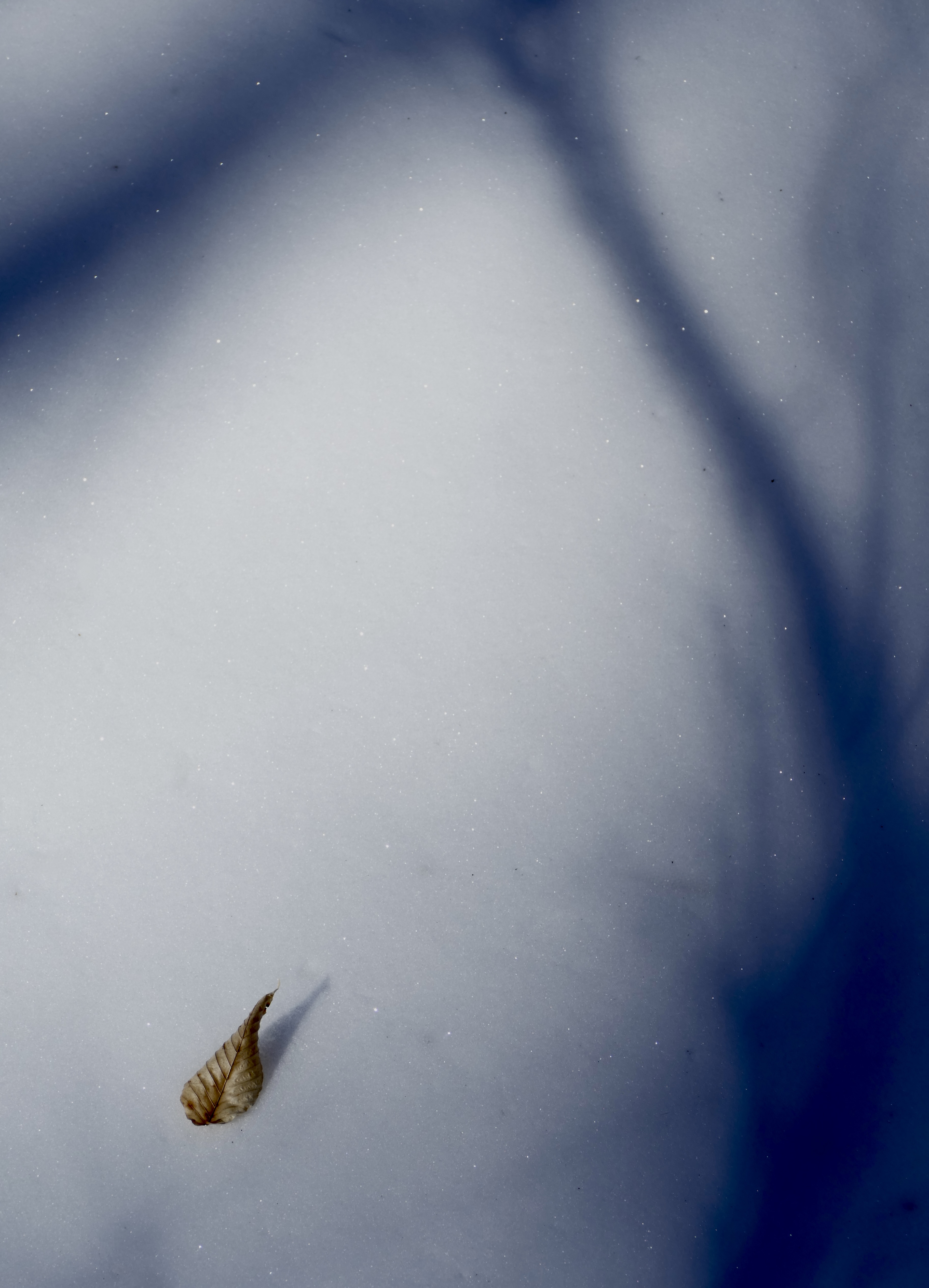
The whole of the day should not be daytime, nor of the night night-time, but some portion be rescued from time to oversee time in. All our hours must not be current; all our time must not lapse. There must be one hour at least which the day did not bring forth, — of ancient parentage and long-established nobility, ––which will be a serene and lofty platform overlooking the rest. We should make our notch every day on our characters, as Robinson Crusoe on his stick. We must be at the helm at least once a day; we must feel the tiller-rope in our hands, and know that if we sail, we steer.
in Thoreau’s Journal:

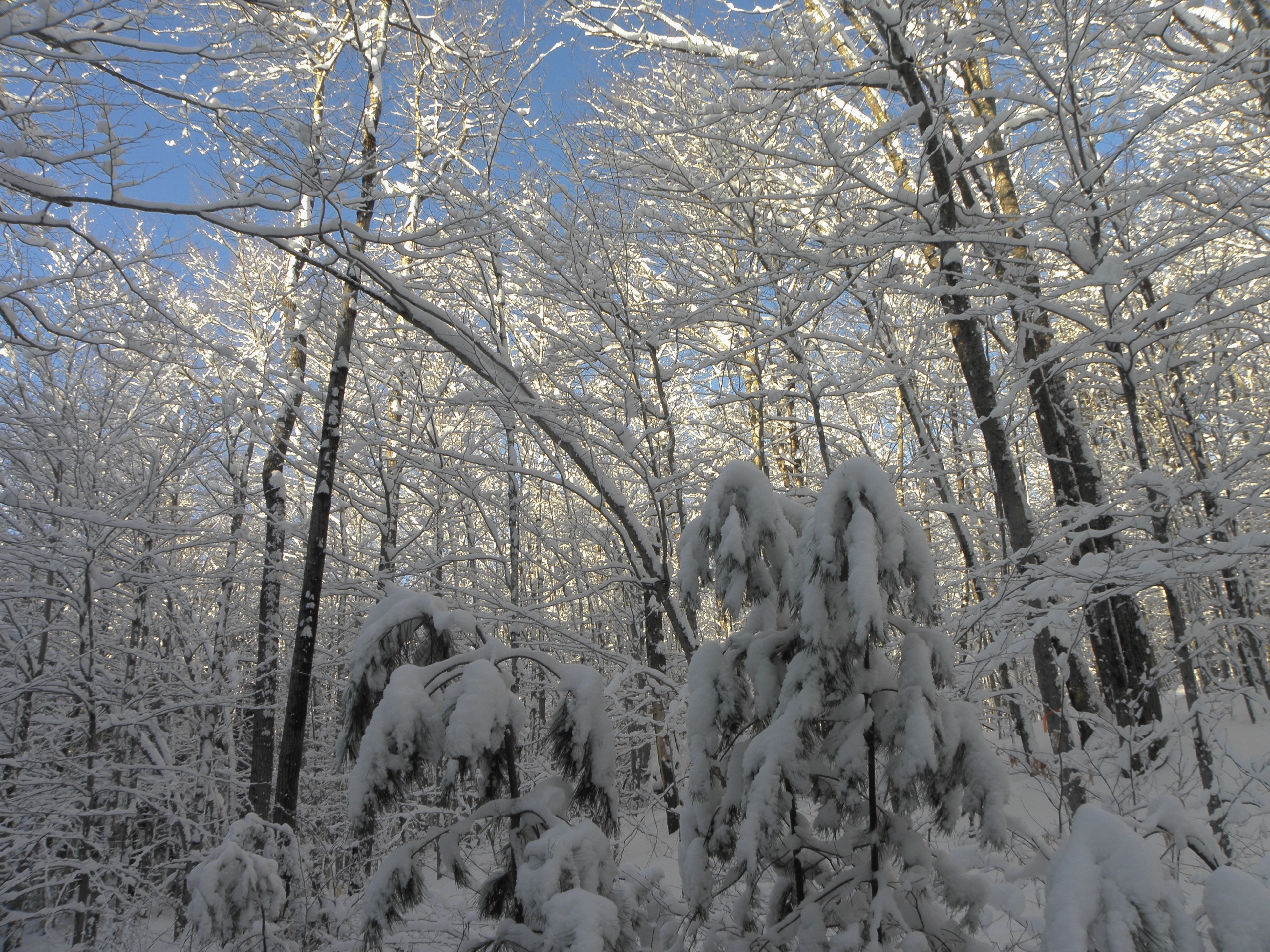
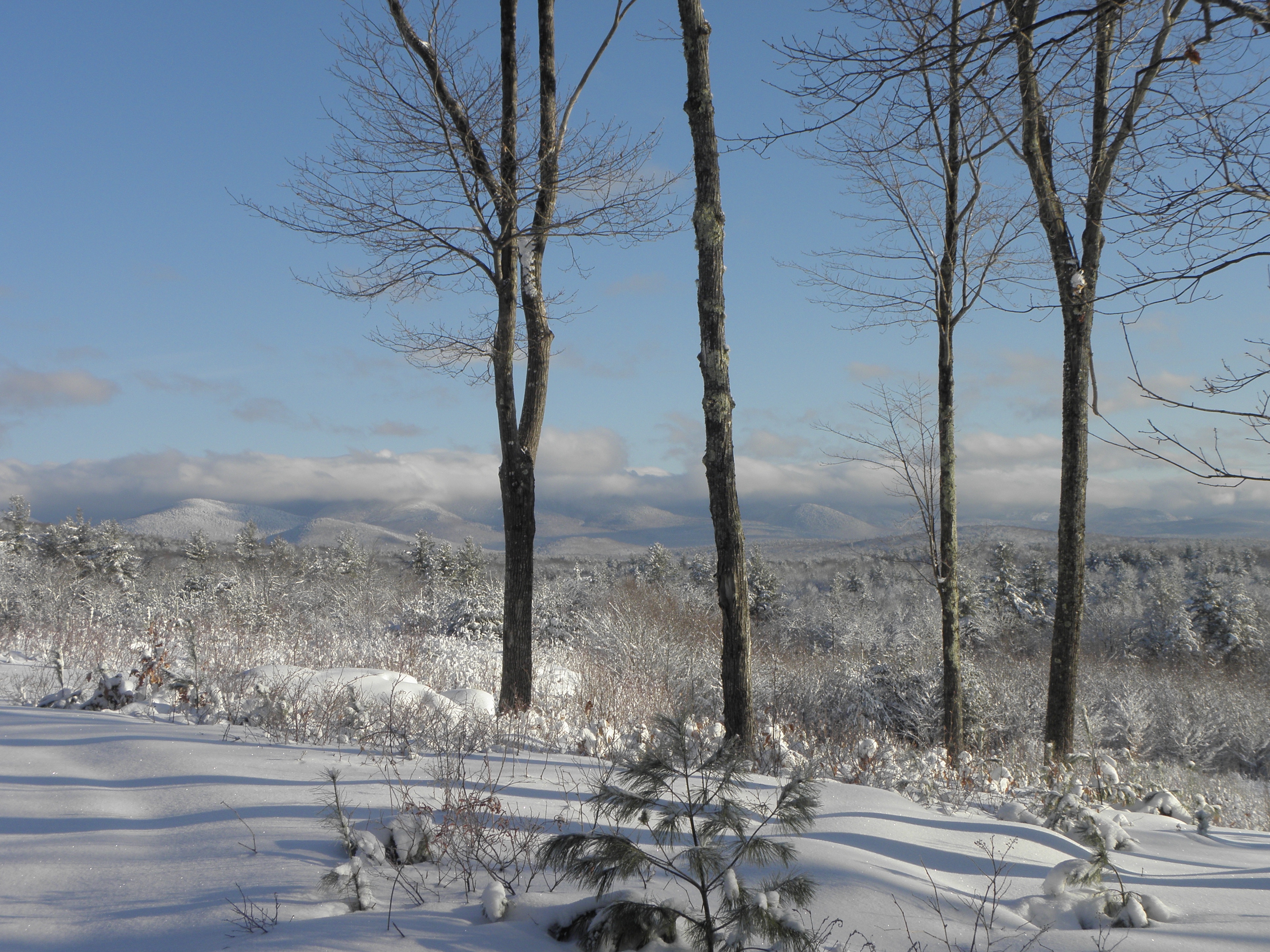
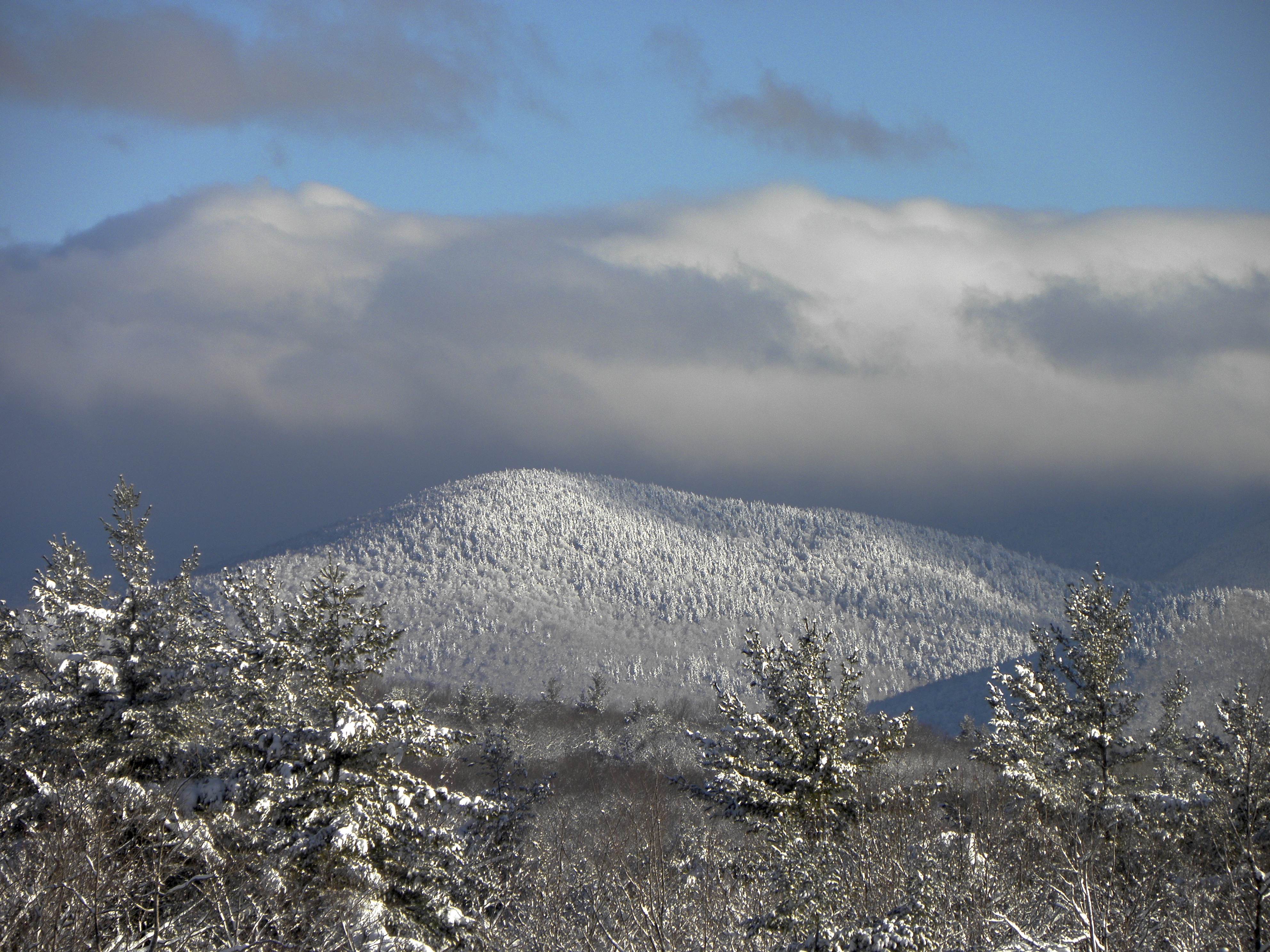
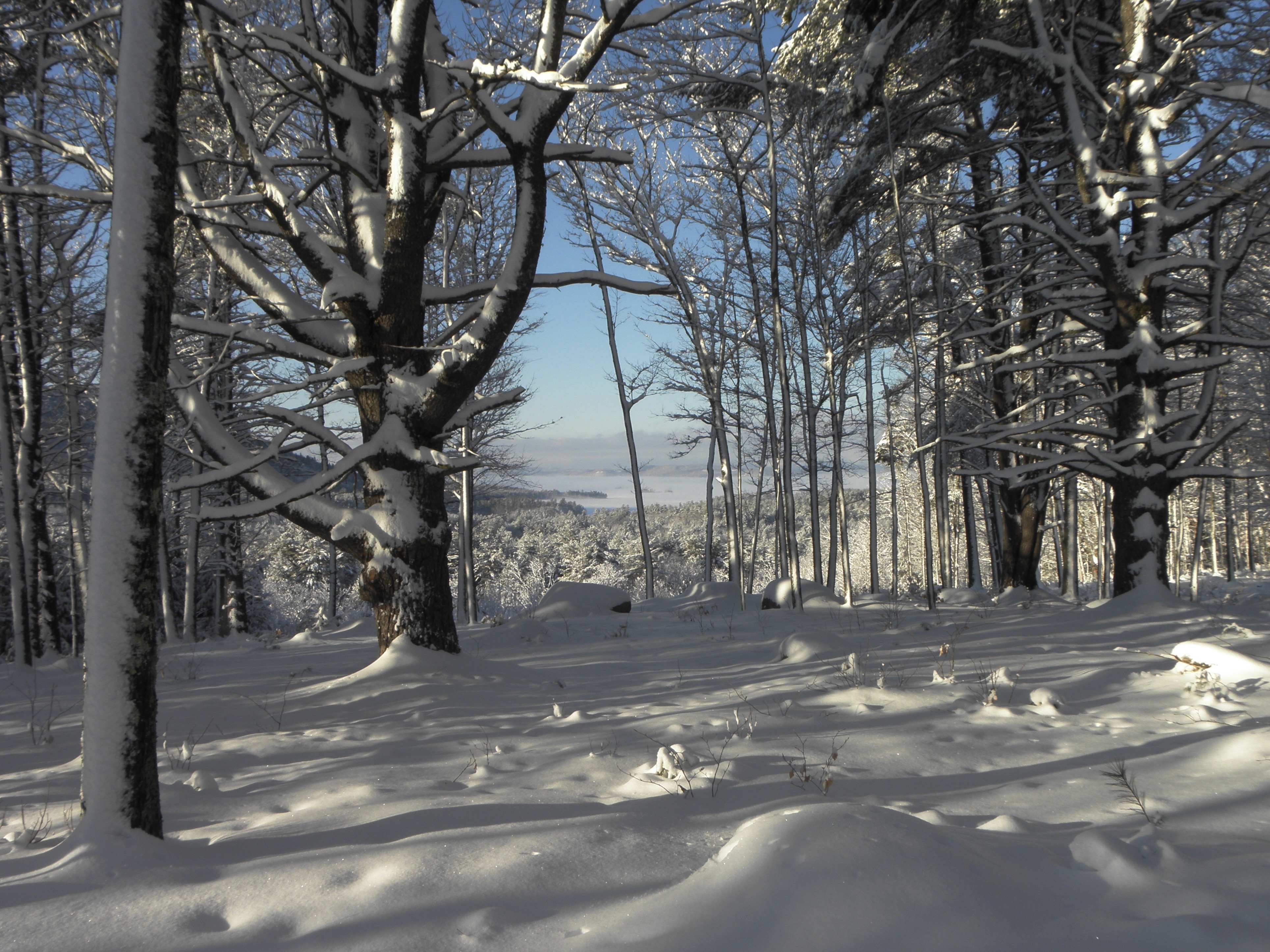
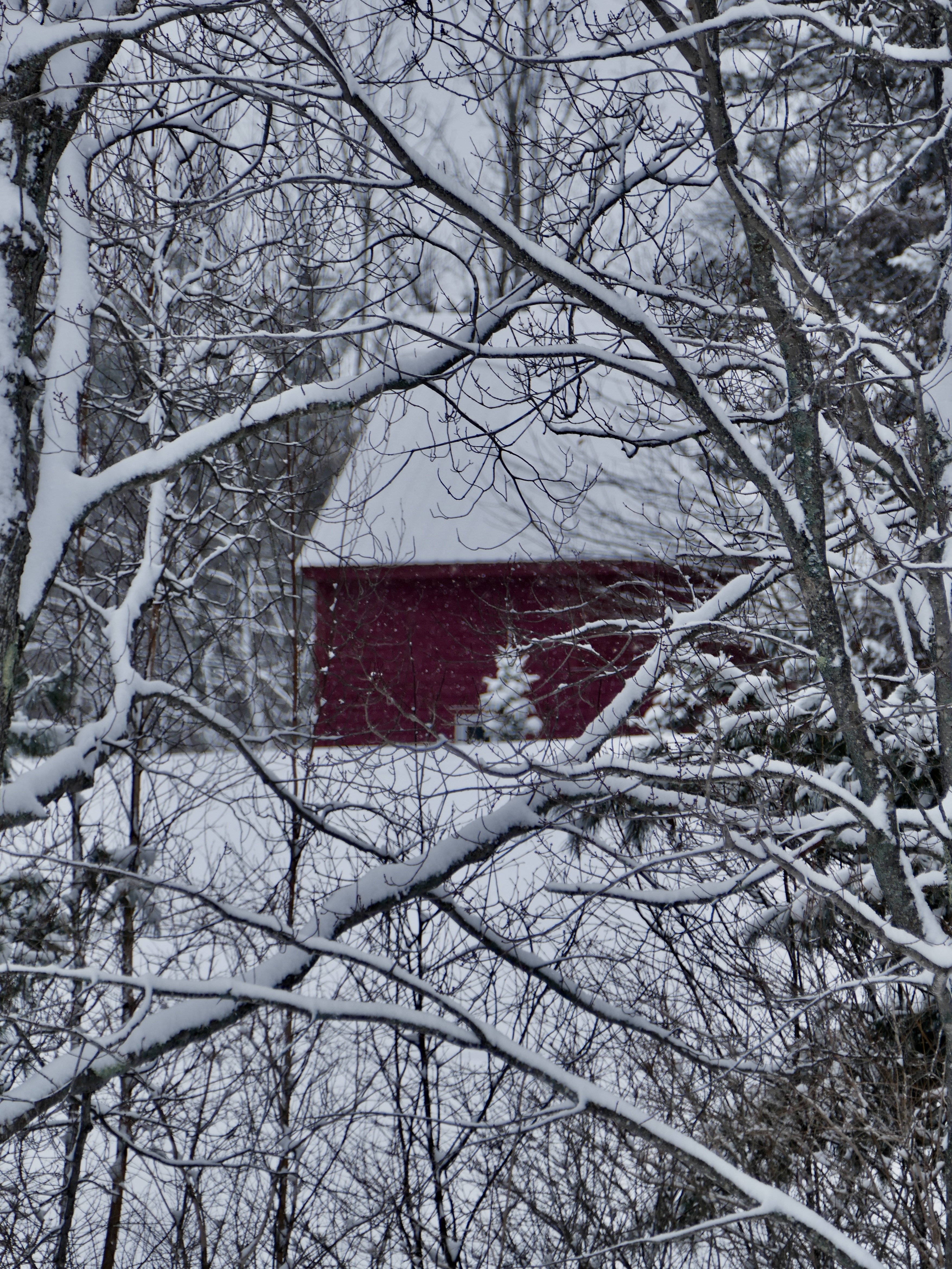
You cannot walk too early in new-fallen snow to get the sense of purity, novelty, and unexploredness. The snow has lodged more or less in perpendicular lines on the northerly sides of trees, so that I am able to tell the points of compass as well as by the sun. I guide myself accordingly.

in Thoreau’s Journal:
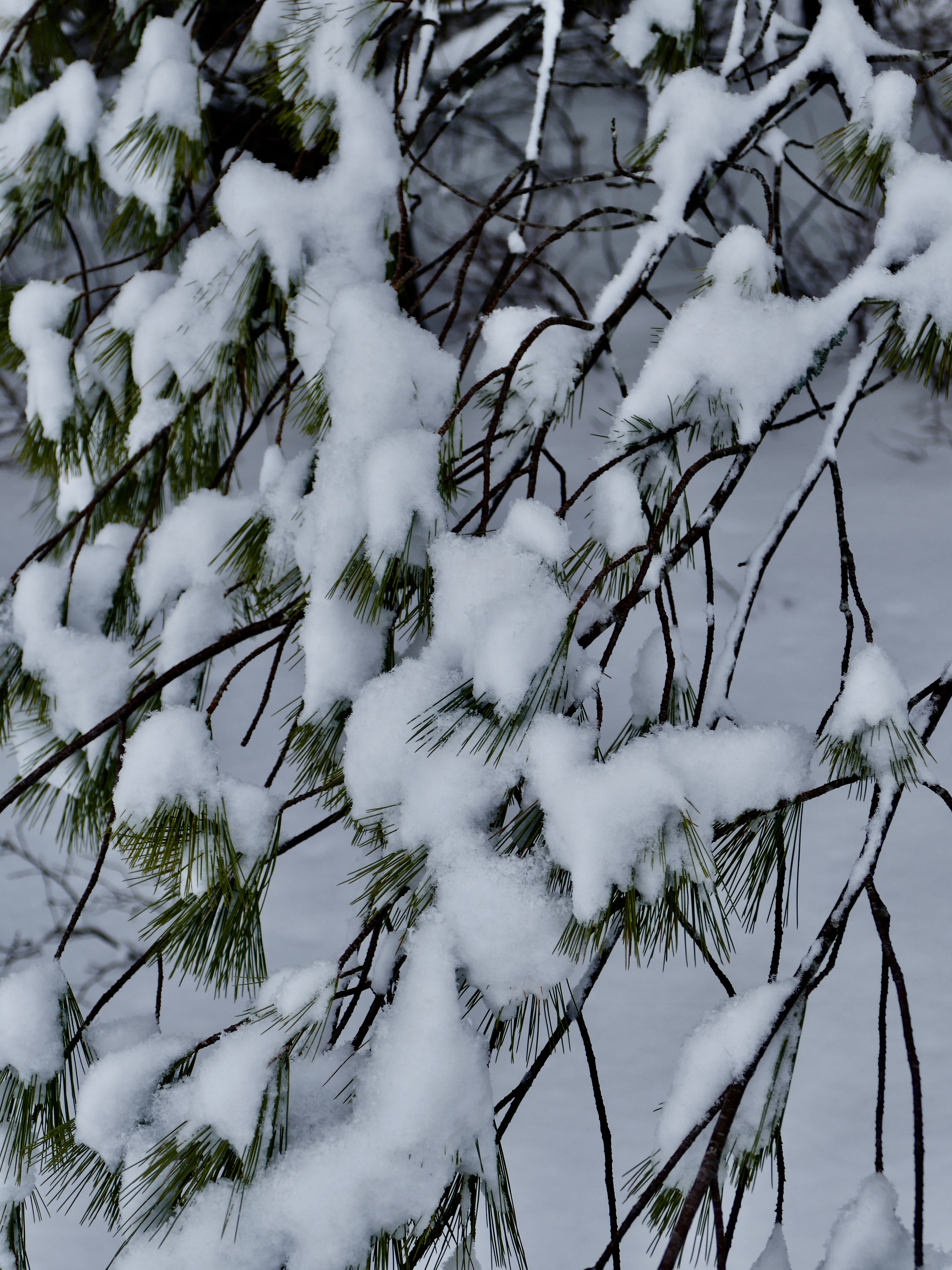
We have had but one & no more this winter (and that I think was the first) of those gentle moist snows which lodge perfectly on the trees—and make perhaps the most beautiful sight of any.

in Thoreau’s Journal:
The sky appears broader now than it did. The day has opened its eyelids wider.
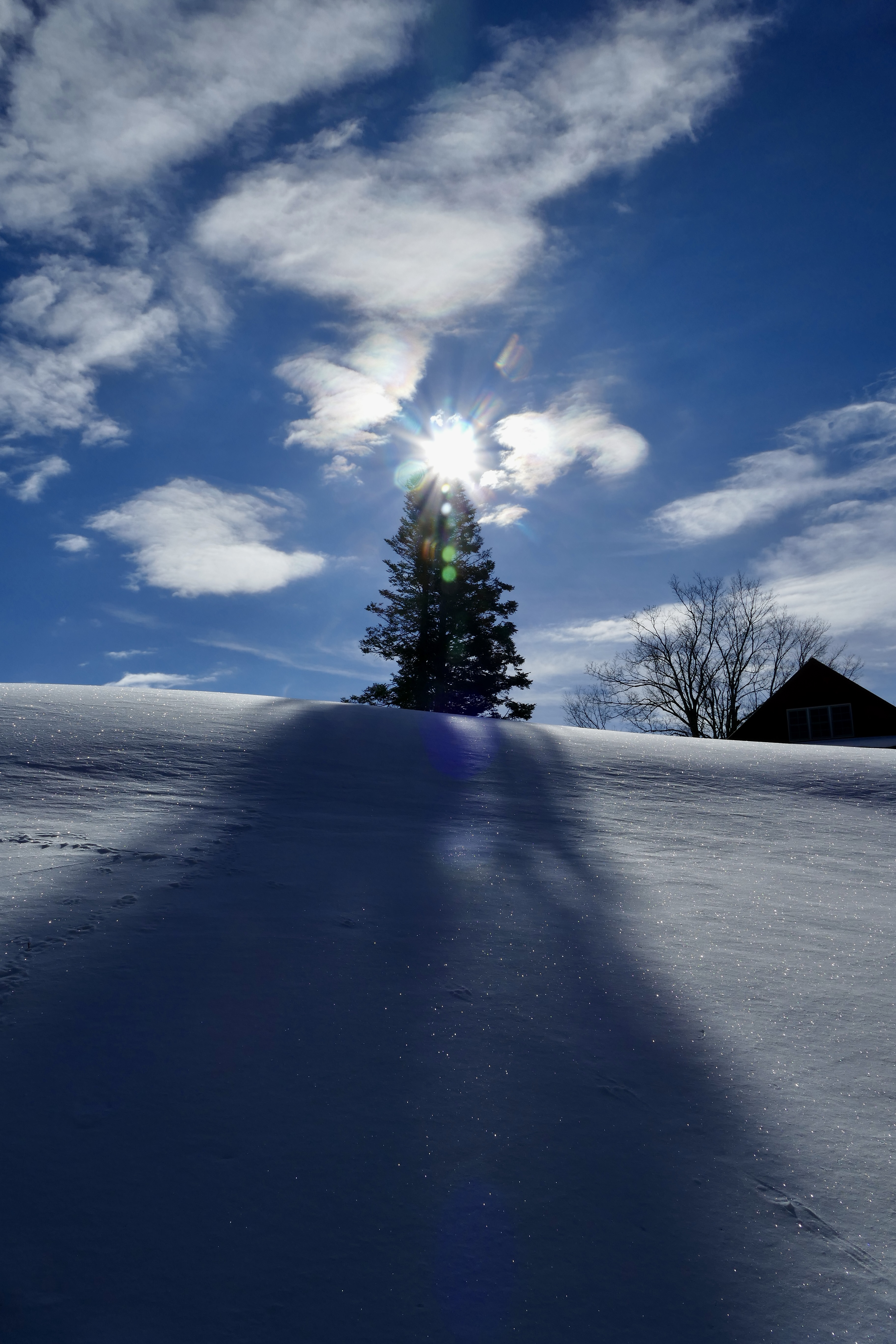
The lengthening of the days, commenced a good while ago, is a kind of forerunner of the spring.
in Thoreau’s Journal:
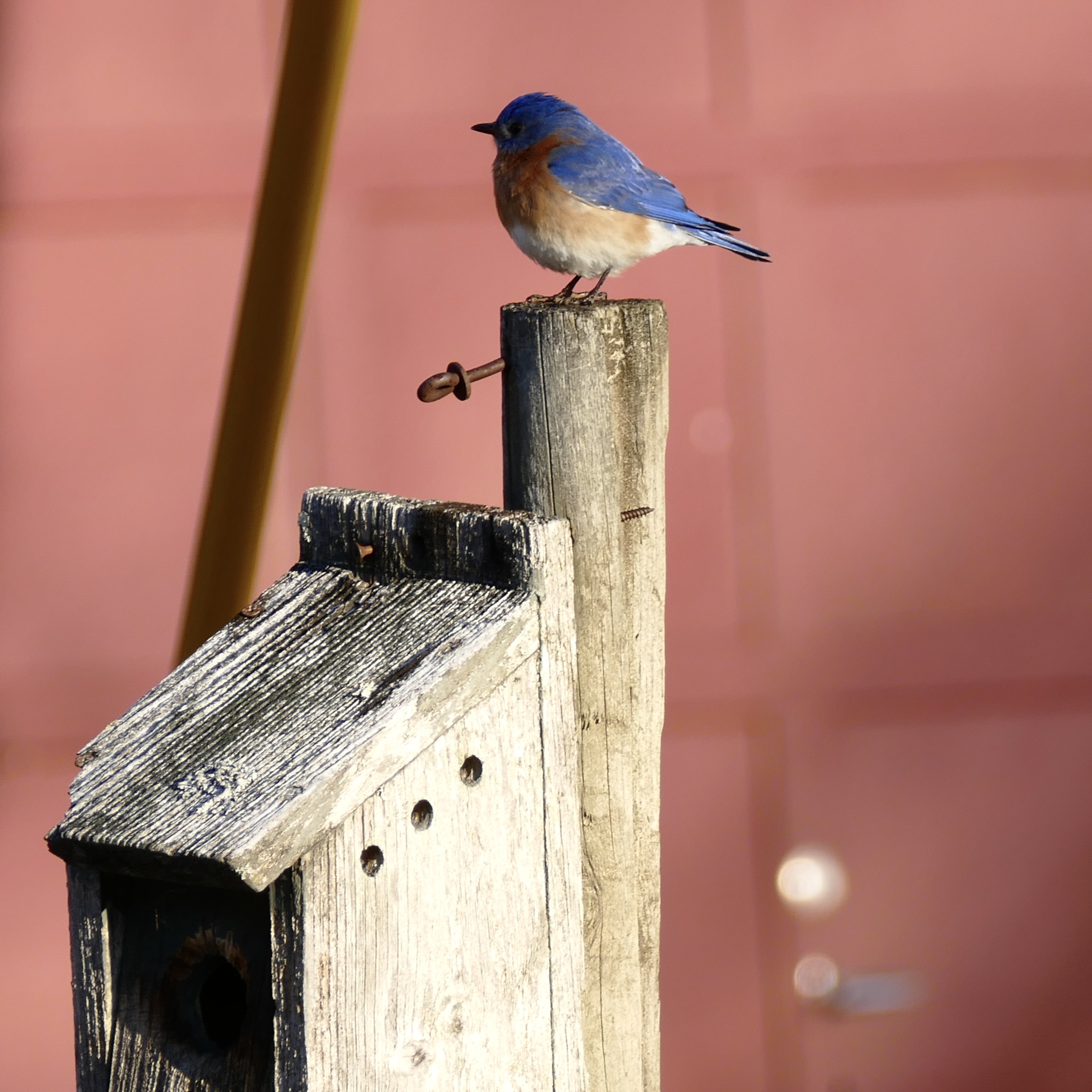
[This post is a fytte or section of Thoreau’s Journal which is a poem.]

in Thoreau’s Journal:
The mice tracks are very amusing. It is surprising how numerous they are—& yet I rarely see one—
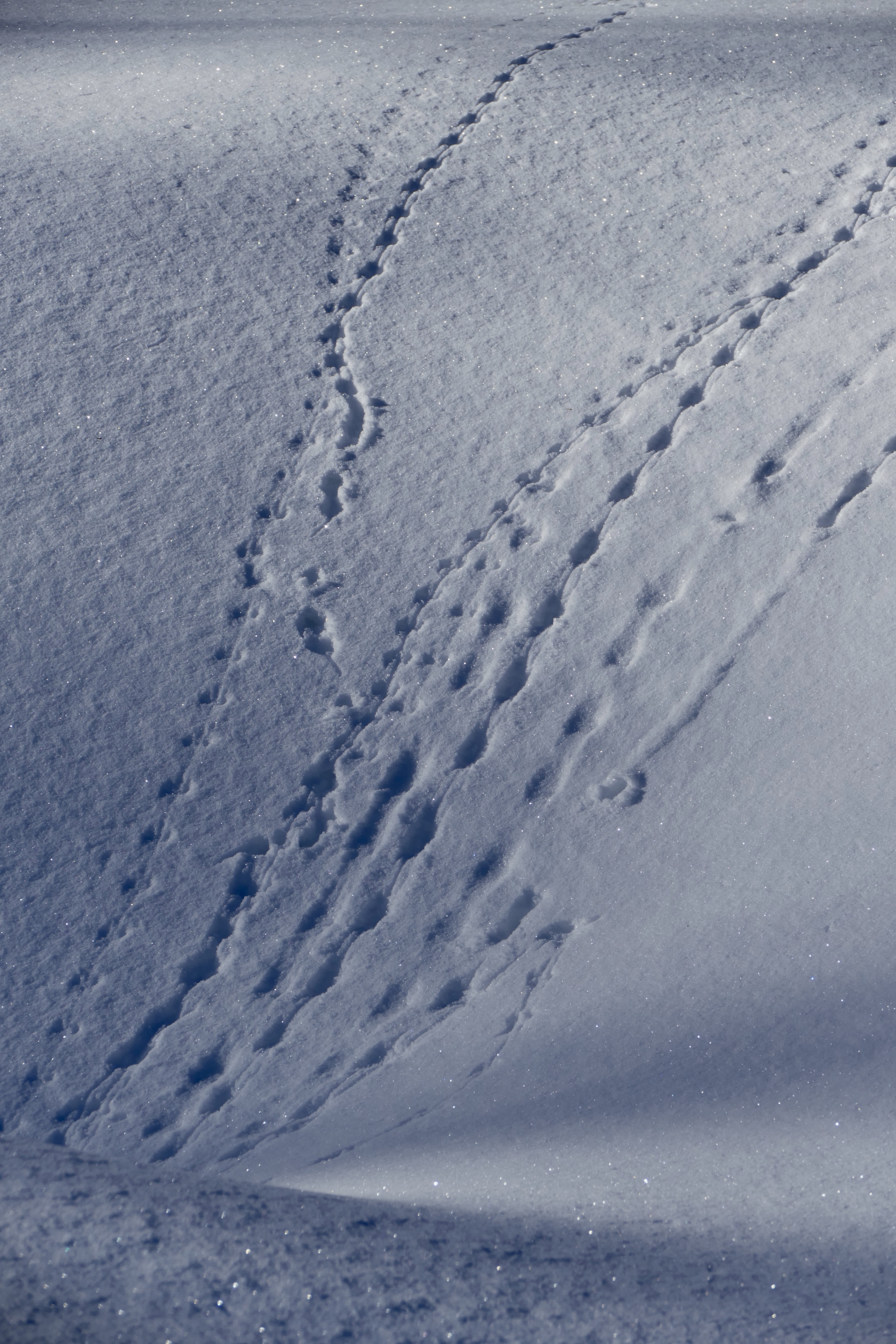
….Any tussocky ground is scored with them— ….You see deep & distinct channels in the snow in some places as if a whole colony had long traveled to & fro in them—a high-way—a well-known trail—but suddenly they will come to an end—& yet they have not dived beneath the snow…
in Thoreau’s Journal:
2 pm To Walden
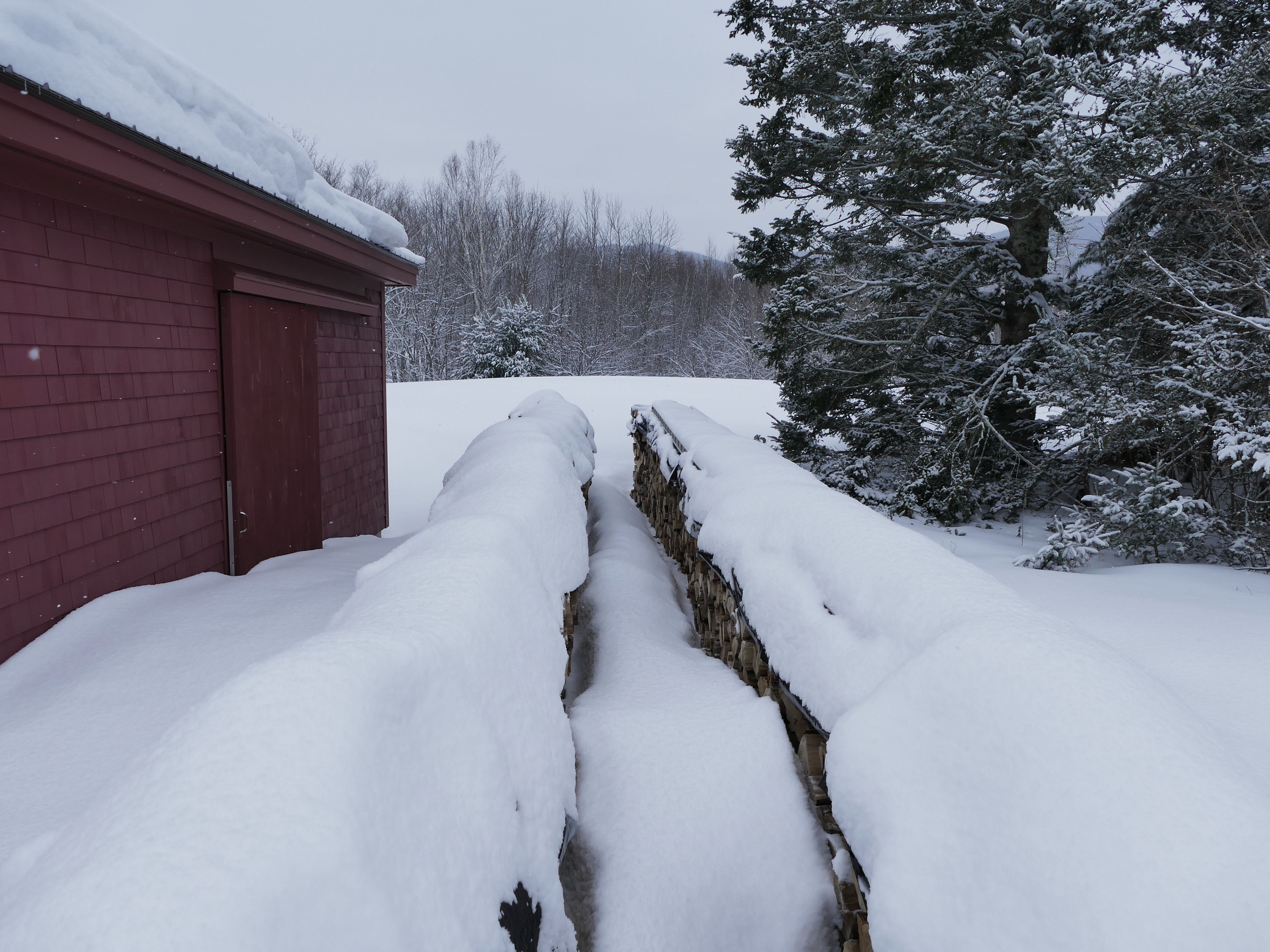

A snow-storm which began in the night –& is now 3 or 4 inches deep– The ground which was more than half bare before–is thus suddenly concealed–& the snow lodges on the trees & fences & sides of houses–& we have a perfect wintry scene again– We hear that it stormed at Philadelphia yesterday morning.
in Thoreau’s Journal:

Why should we not still continue to live with the intensity & rapidity of infants? Is not the world––are not the heavens––as unfathomed as ever? Have we exhausted any joy––any sentiment?

in Thoreau’s Journal:

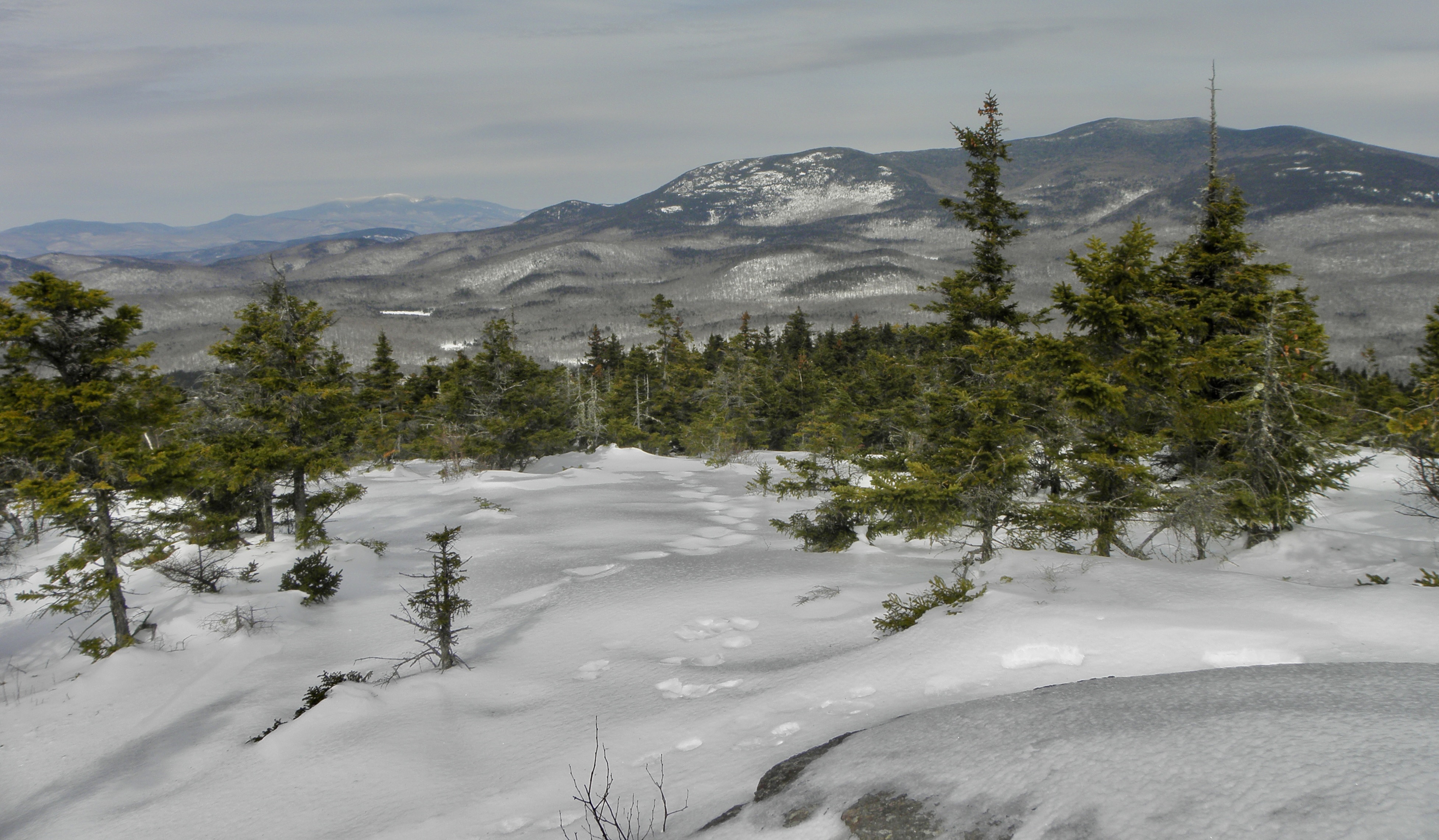
We shall see but little way if we require to understand what we see. How few things can a man measure with the tape of his understanding! How many greater things might he be seeing in the meanwhile!
in Thoreau’s Journal:
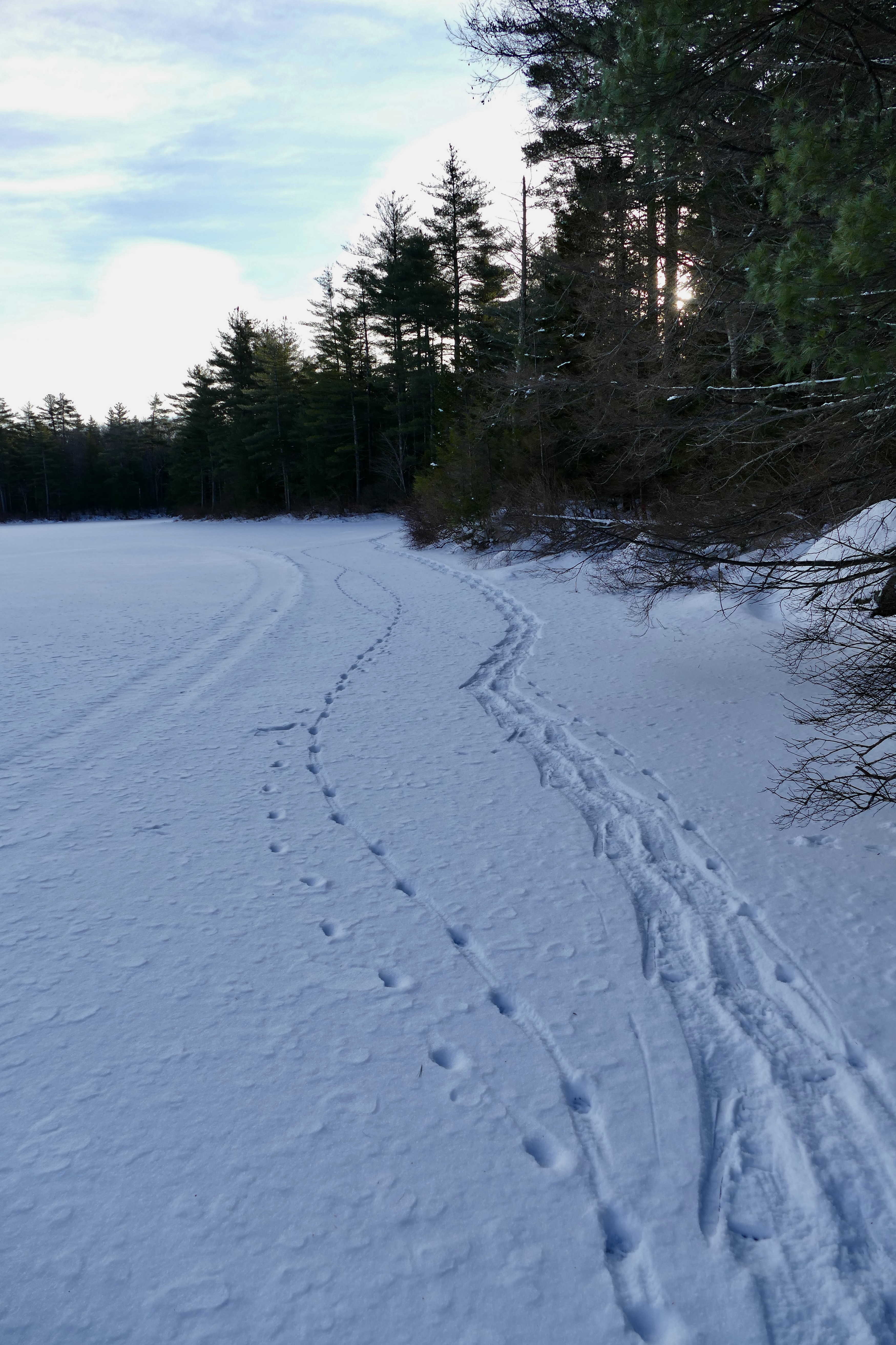
Winter comes to make walking possible where there was no walking in the summer. Not till winter can we take possession of the whole of our territory…The wonderful stillness of a winter day! The sources of sound are, as it were, frozen up…A transient acquaintance with any phenomenon is not sufficient to make it completely the subject of your muse. You must be so conversant with it as to remember it, and be reminded of it long afterward, while it lies remotely fair and elysian in the horizon, approachable only by the imagination.

in Thoreau’s Journal:
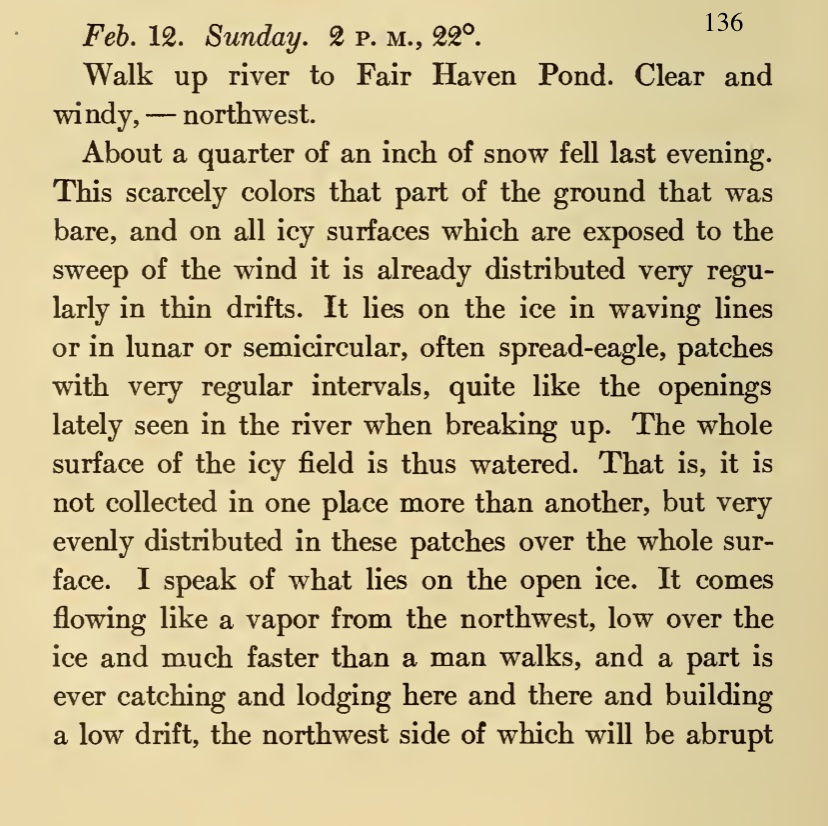
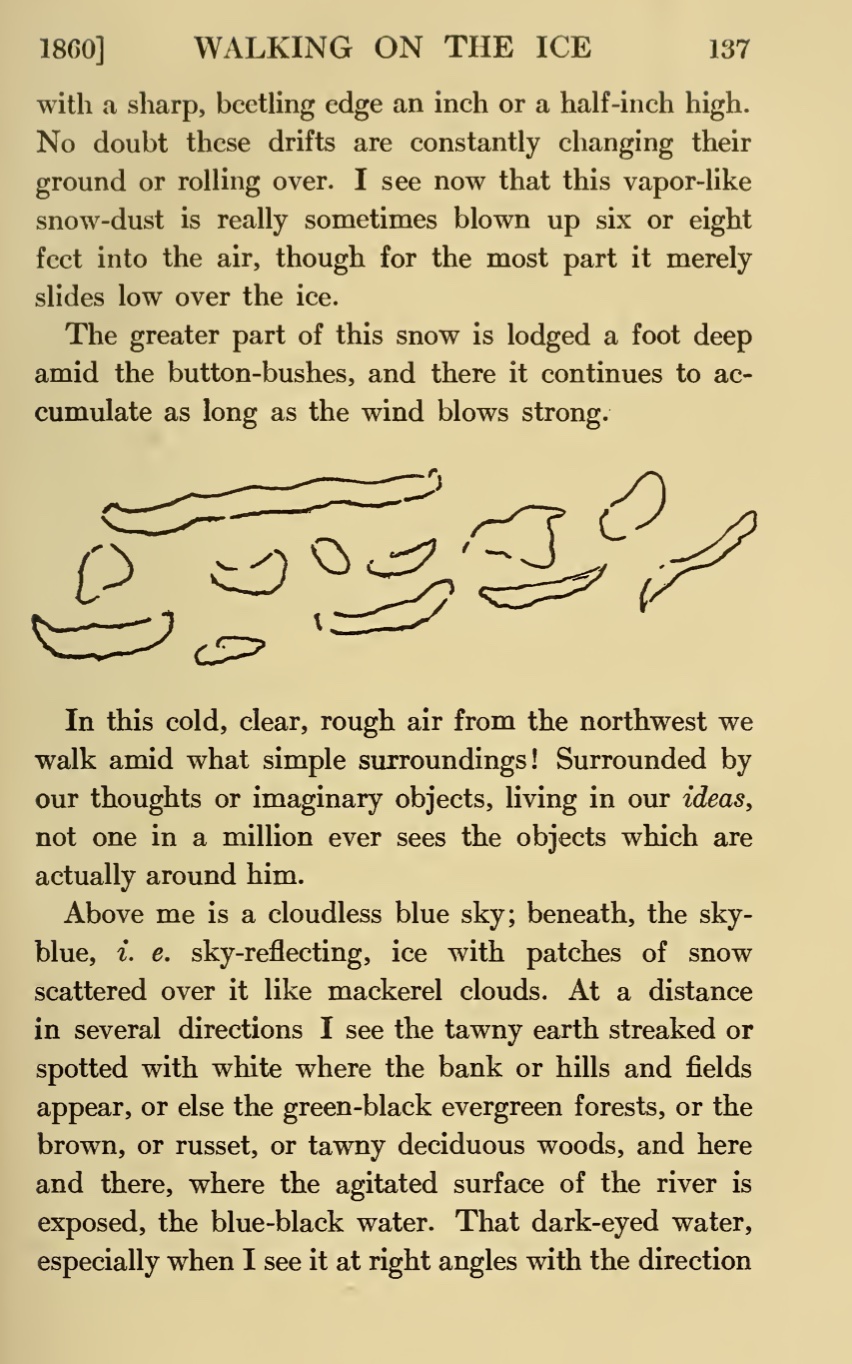
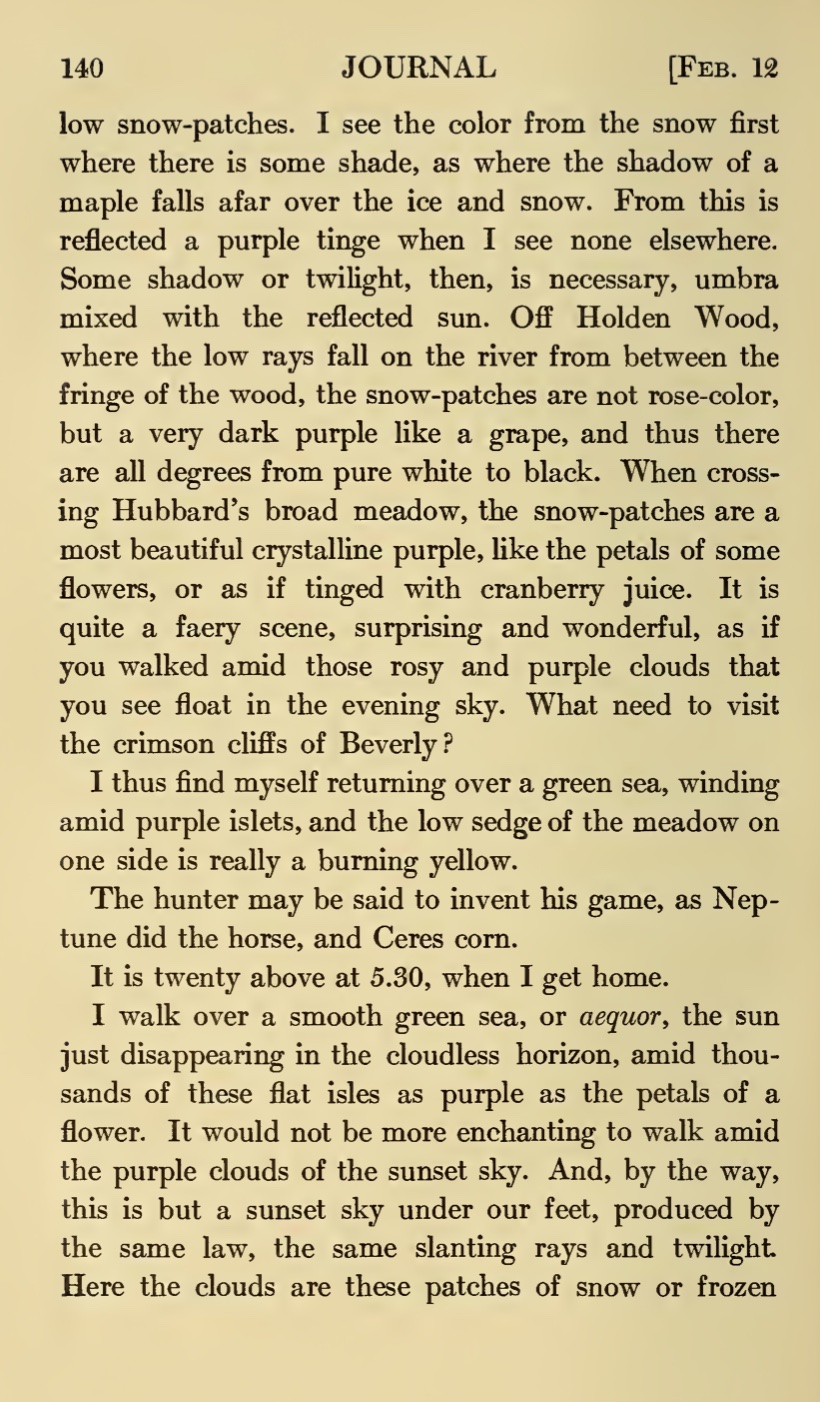
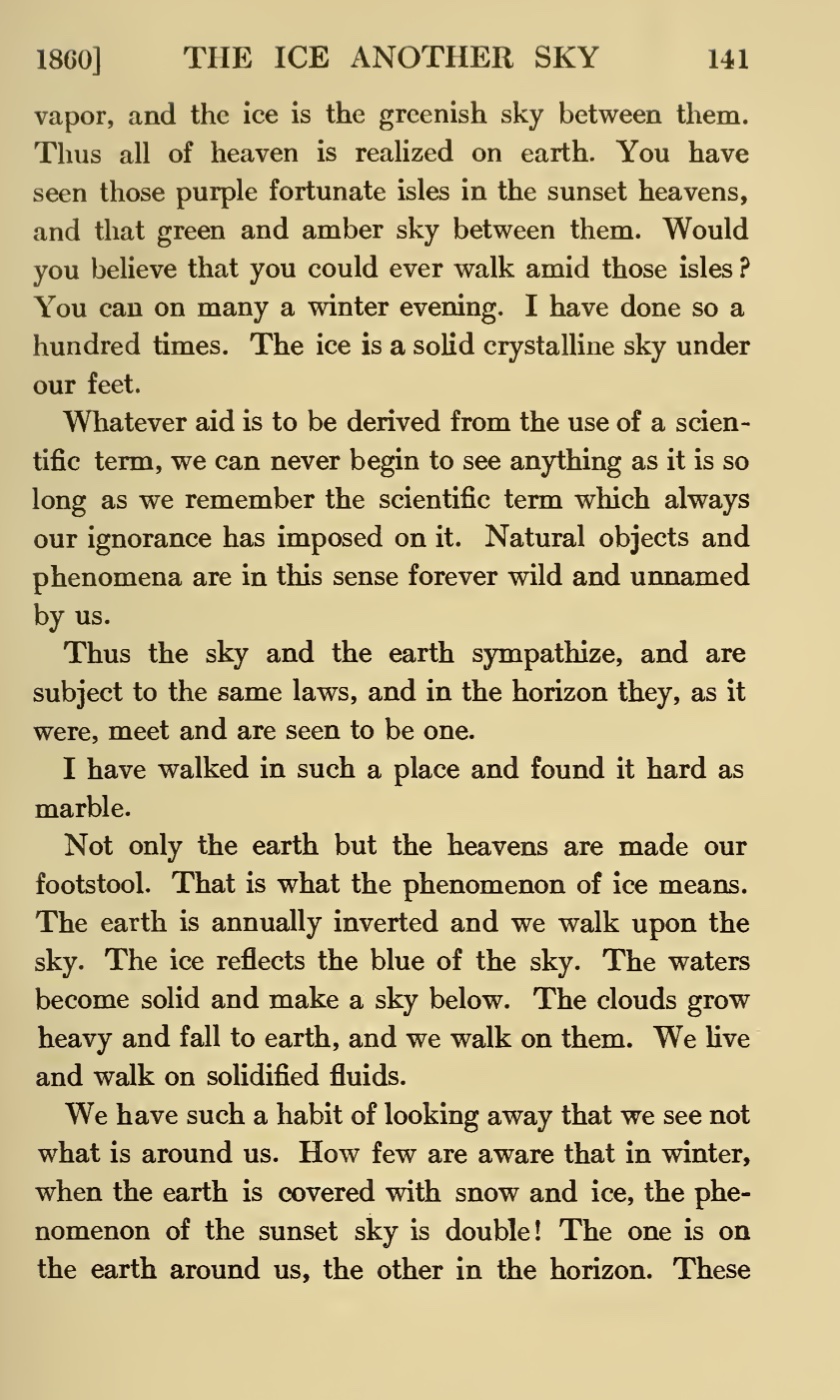
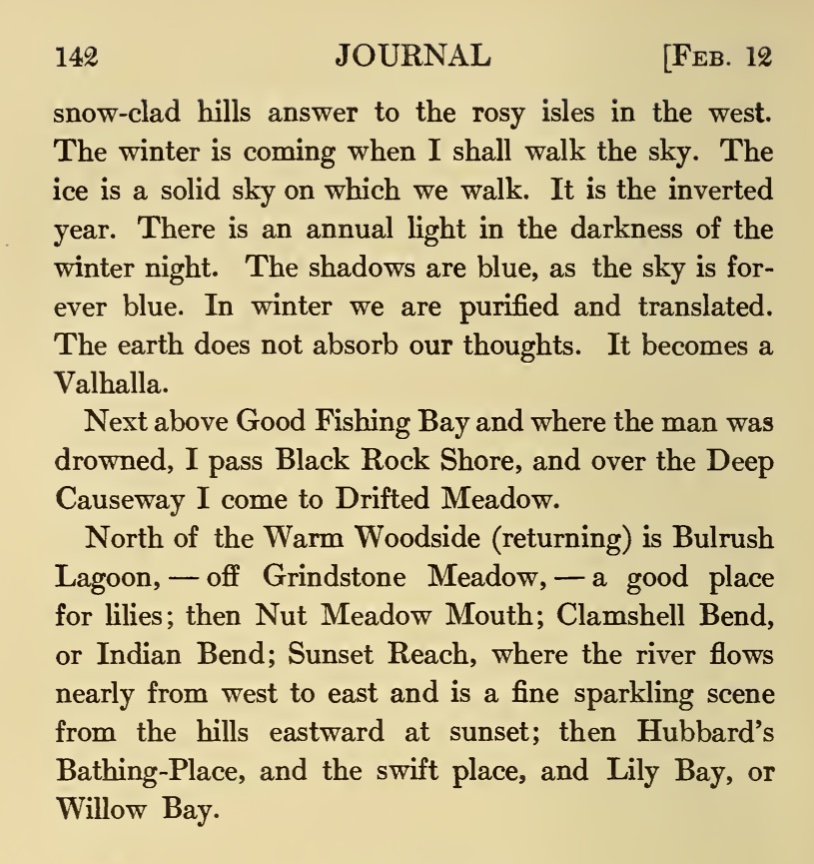
[I was drawn to this passage by the excerpt immediately following. It comes near the end of Thoreau’s entry for February 12, 1860. Then thought to give the full entry (7 printed pages) so readers could see how Thoreau came to the part I’ve excerpted. The 7 pages also contain some of Thoreau’s drawings.]
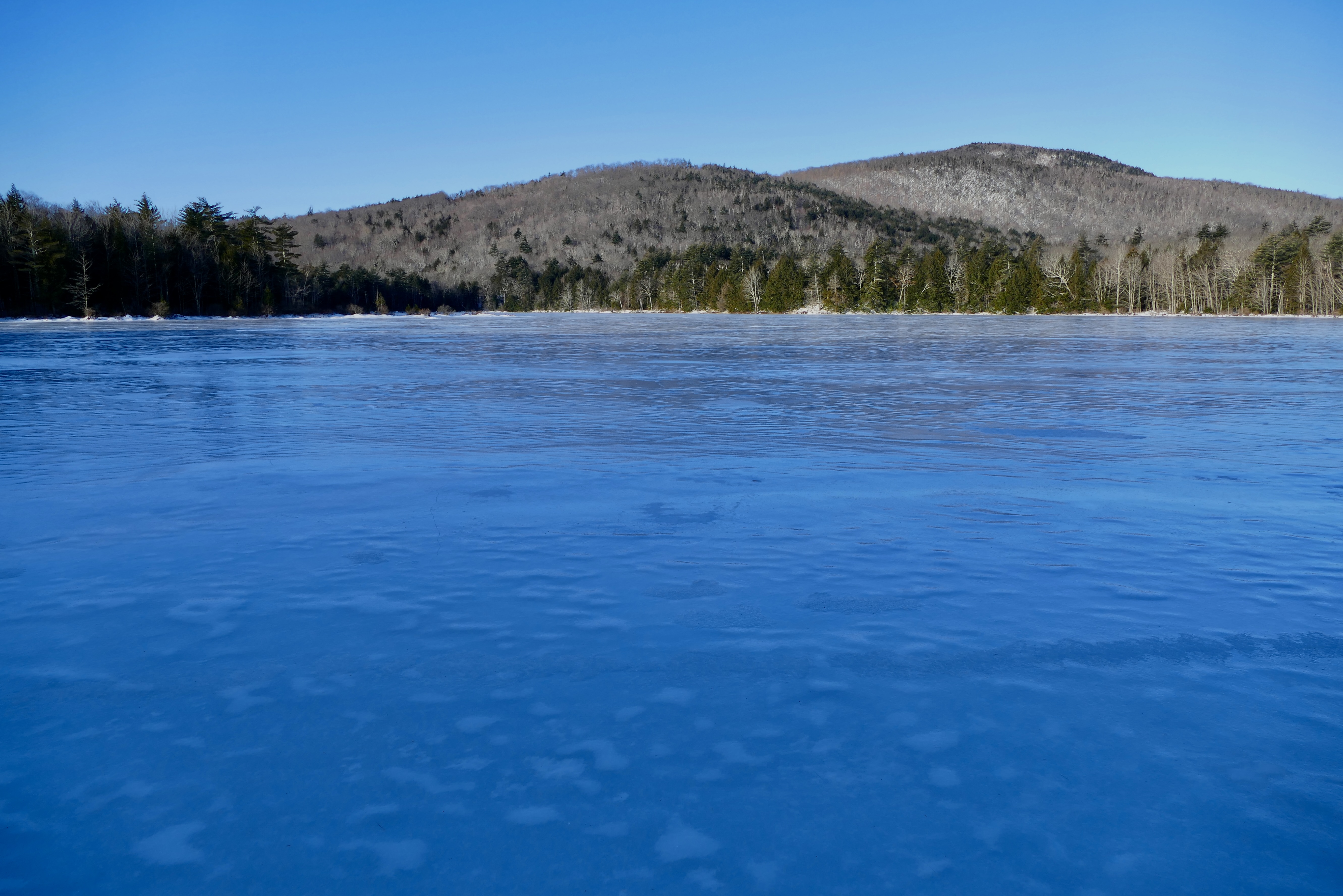
The winter is coming when I shall walk the sky. The ice is a solid sky on which we walk. It is the inverted year. There is an annual light in the darkness of the winter night. The shadows are blue, as the sky is forever blue. In winter we are purified and translated. The earth does not absorb our thoughts. It becomes a Valhalla.



in Thoreau’s Journal:
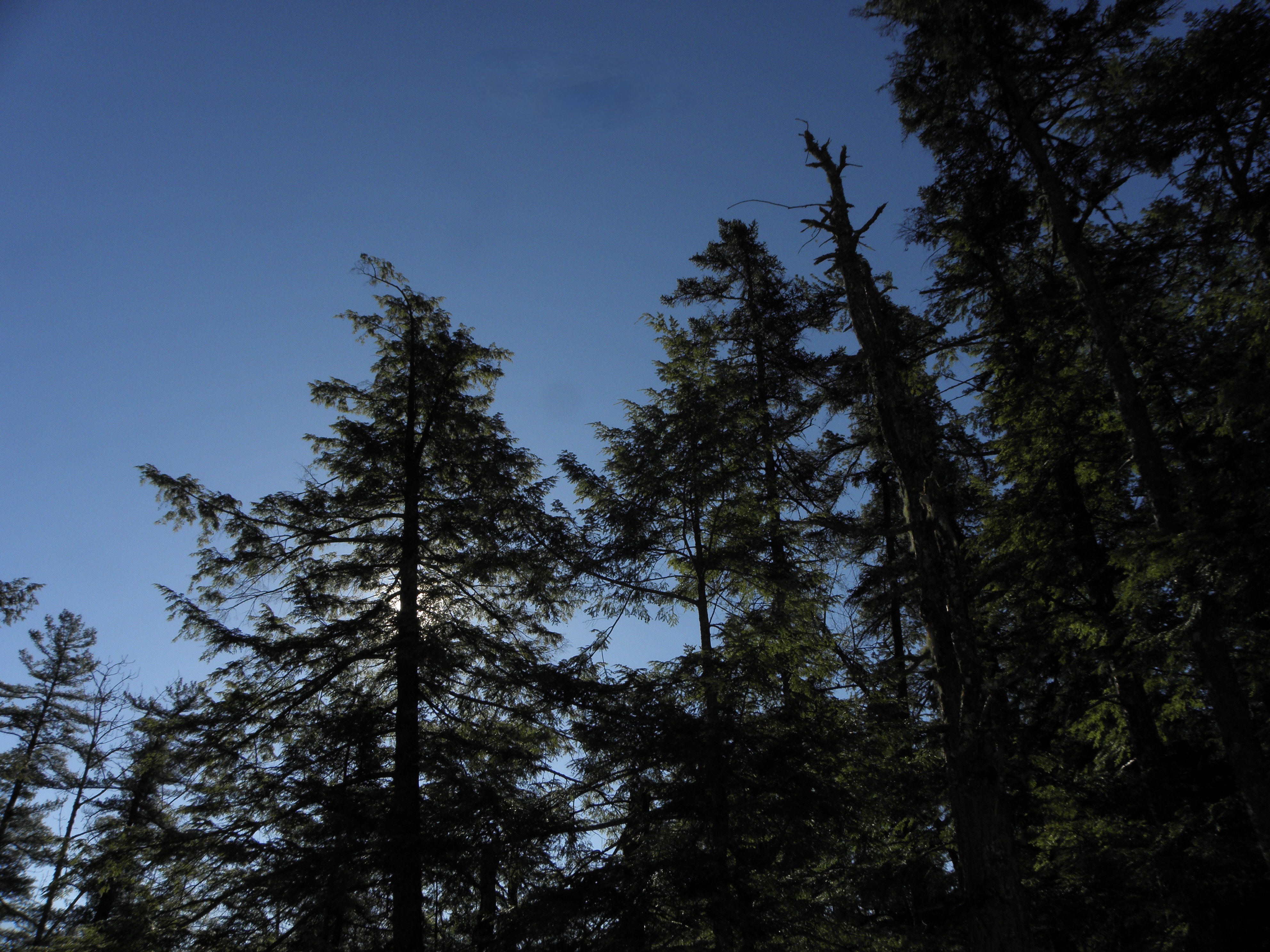
The atmosphere is very blue, tingeing the distant pine woods.
in Thoreau’s Journal:
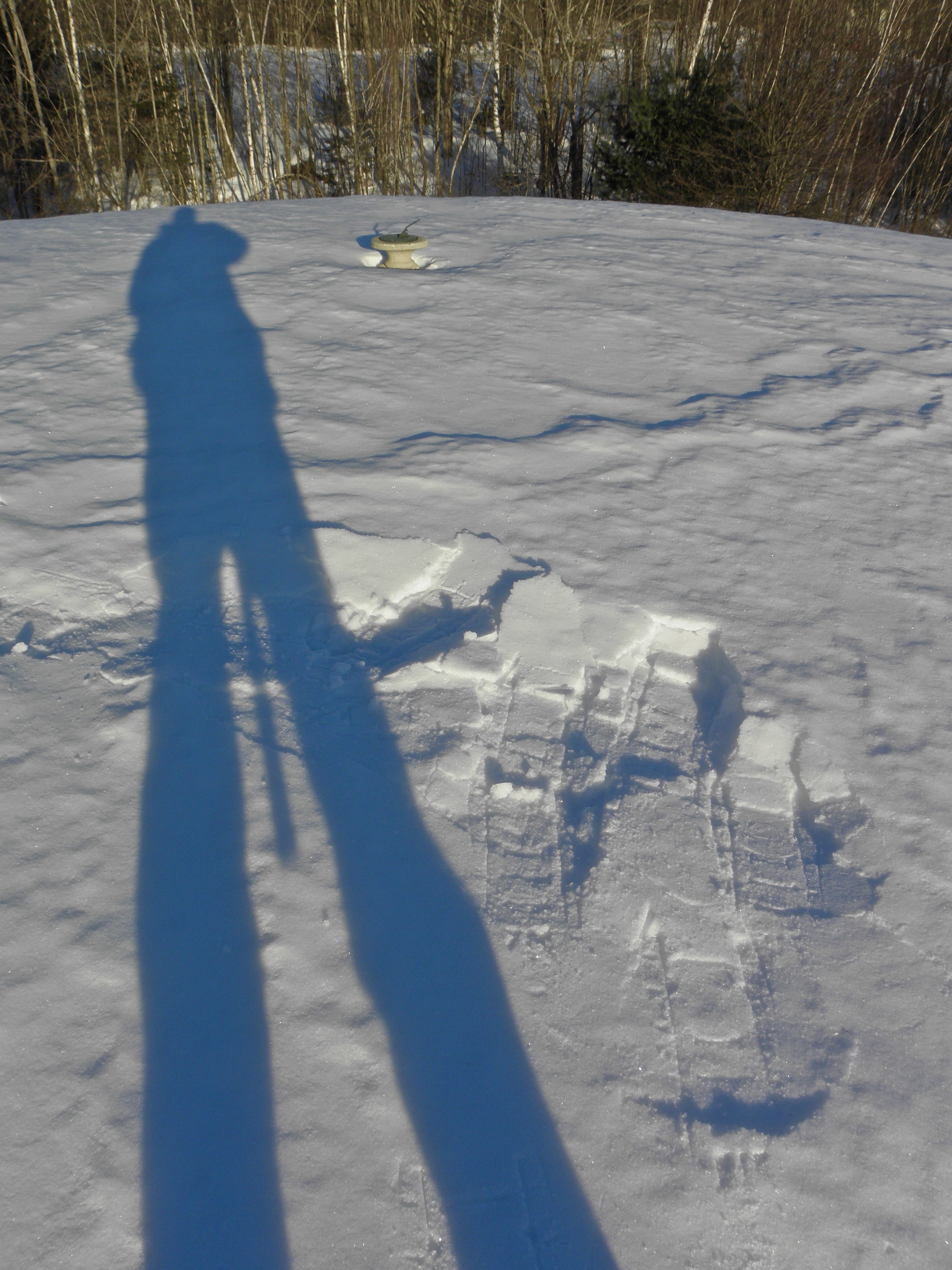
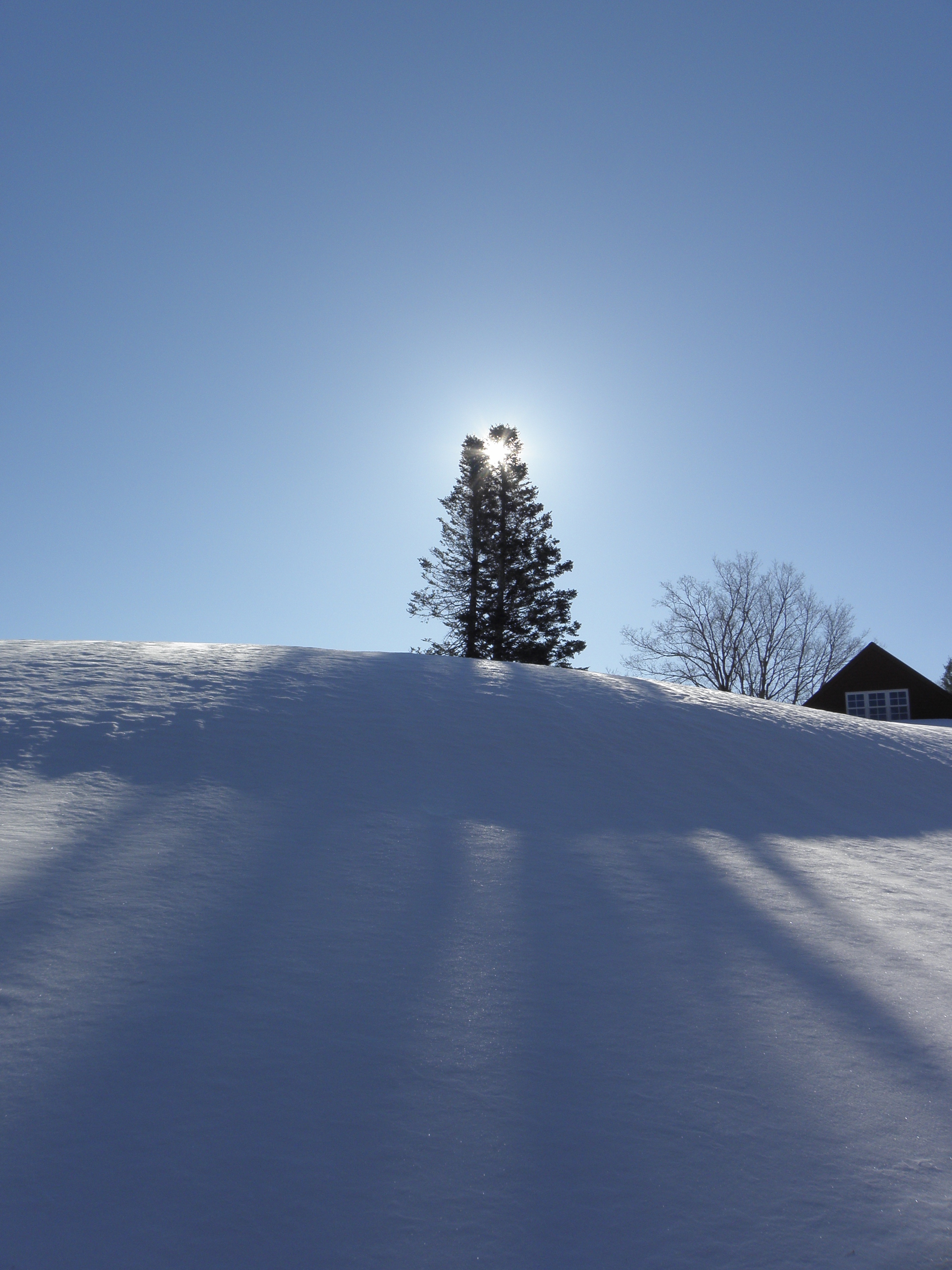
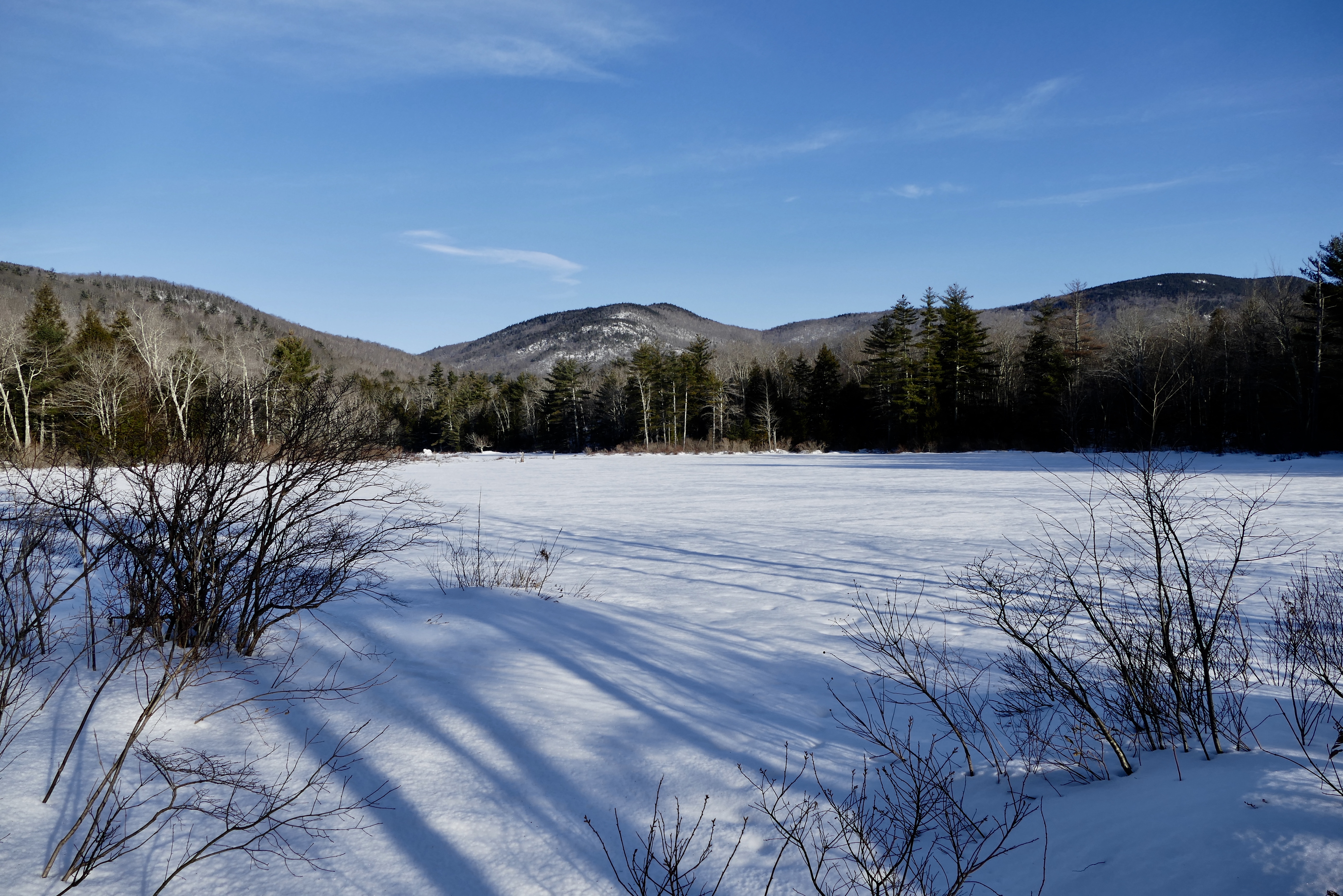
A fine clear day— There is a glare of light from the fresh unstained surface of the snow that it pains the eyes to travel toward the sun. I go across Walden. My shadow is very blue— It is especially blue when there is a bright sun light on pure white snow— It suggests that there may be something divine—something celestial in me.
in Thoreau’s Journal:
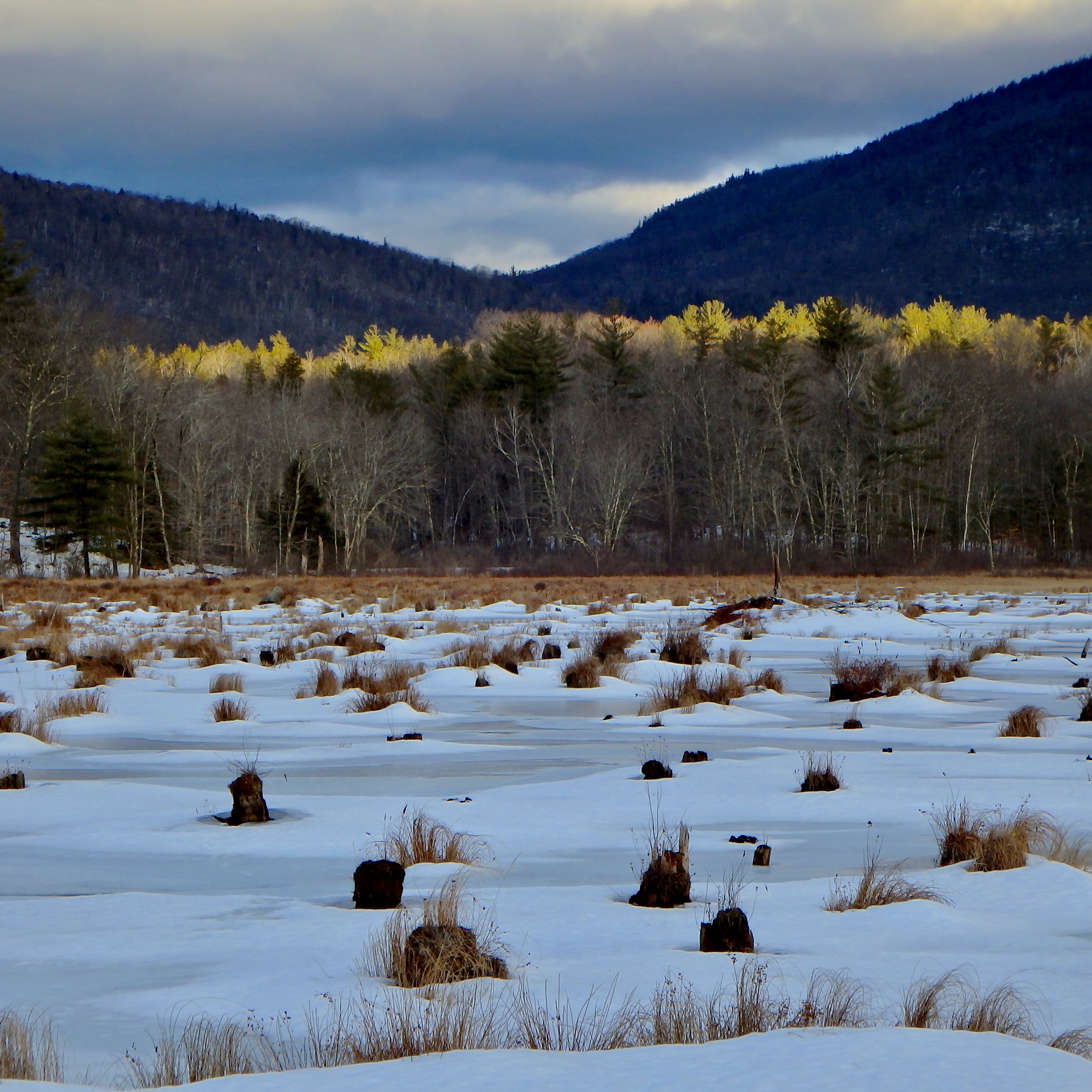
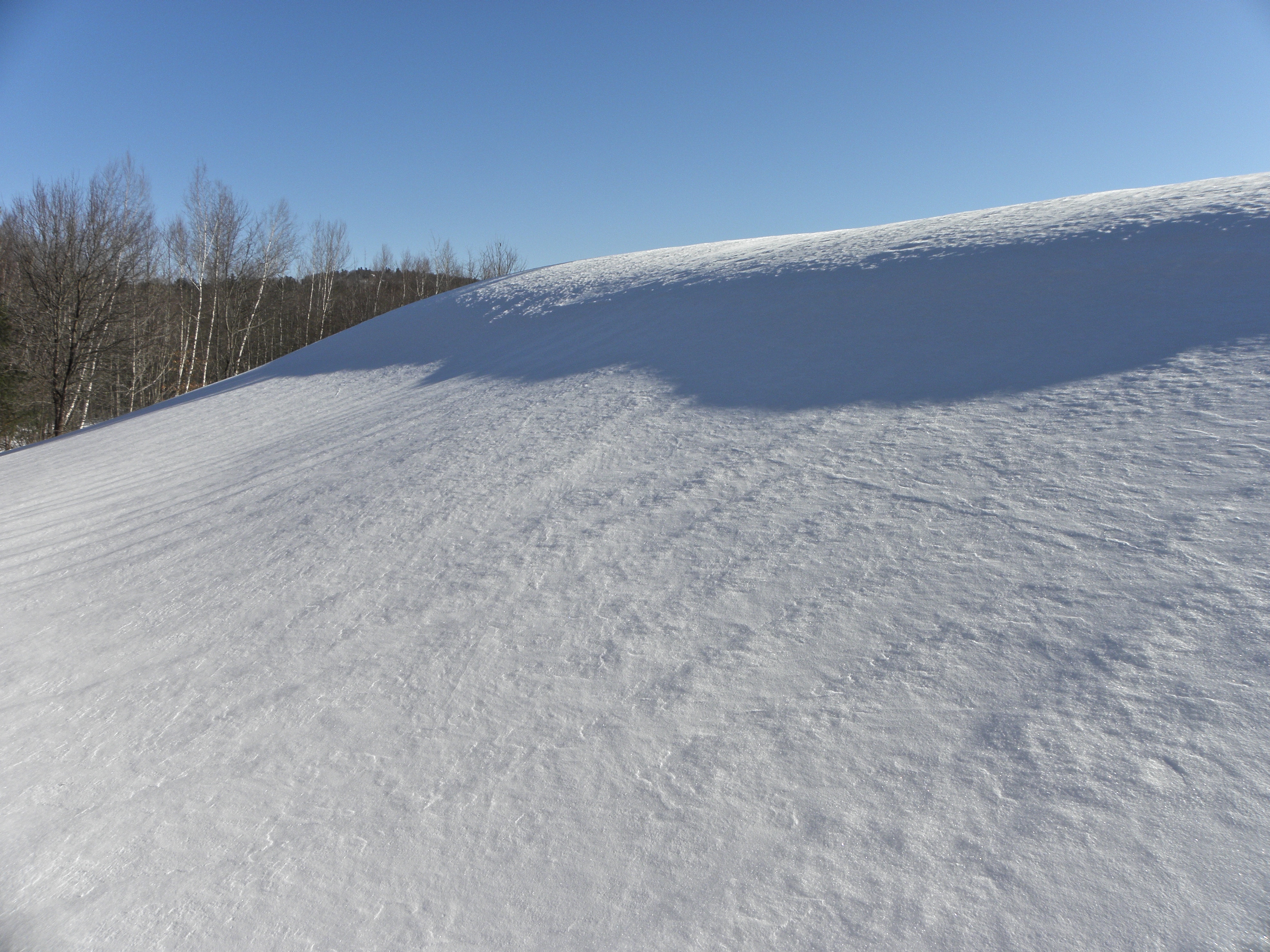
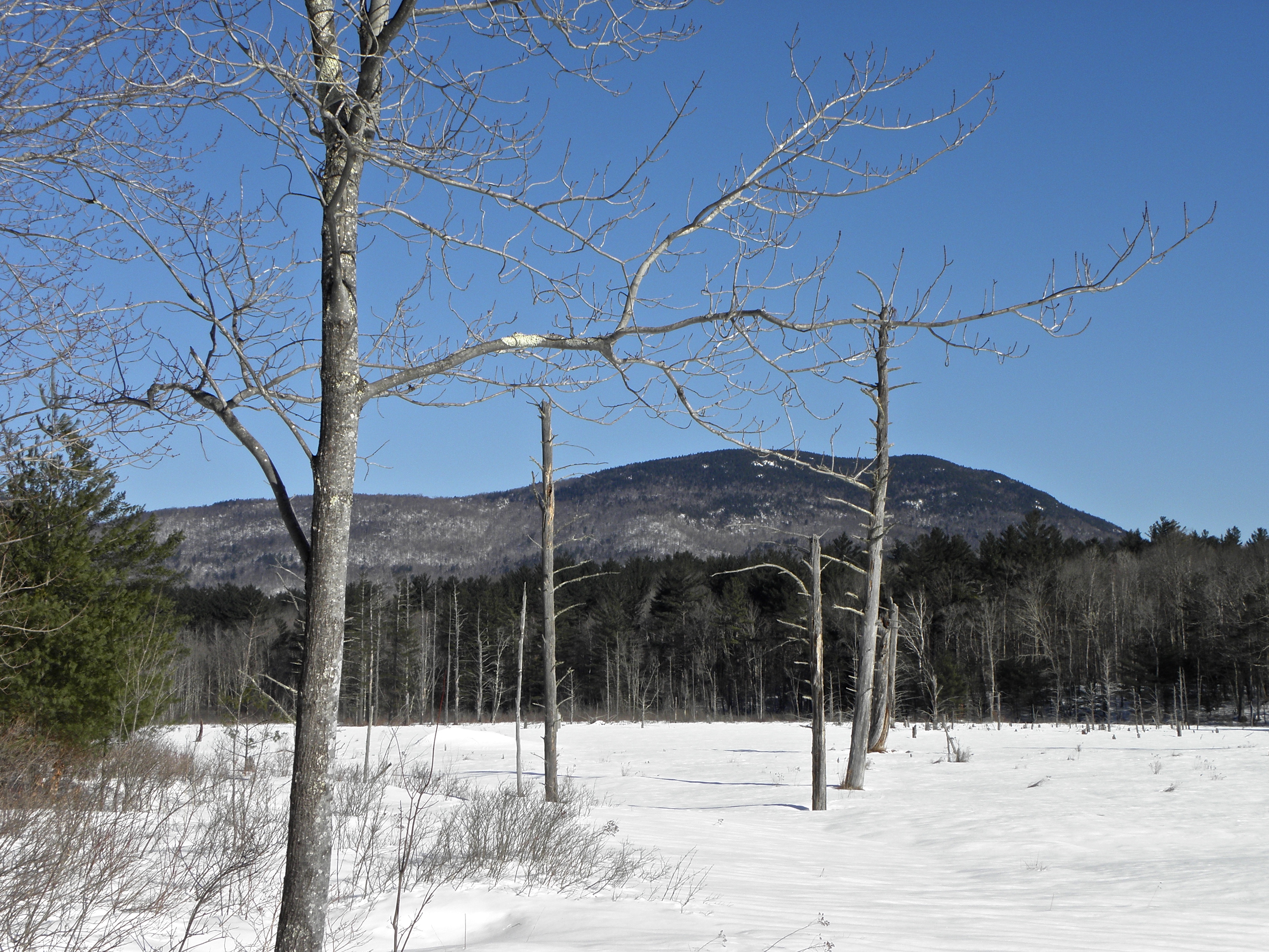
At 9 A M up river to fair Haven Pond. This is our month of the crusted snow. Was this the Indians? I get over the half buried fences at a stride—and the drifts slope up to the tops of the walls on each side. The crust is melted on the S slopes and lets me in—or where the sun has been reflected (yesterday) from a woodside—& rotted it, but the least inclination to the north is evidence of a hard surface— On the meadows and in level open fields away from the reflection of pines & oak leaves it will generally bear.

in Thoreau’s Journal:
My Journal is that of me which would else spill over and run to waste.— gleanings from the field which in action I reap. I must not live for it, but in it for the gods— They are my correspondent to whom daily I send off this sheet post-paid. I am clerk in their counting room and at evening transfer the account from day-book to ledger.
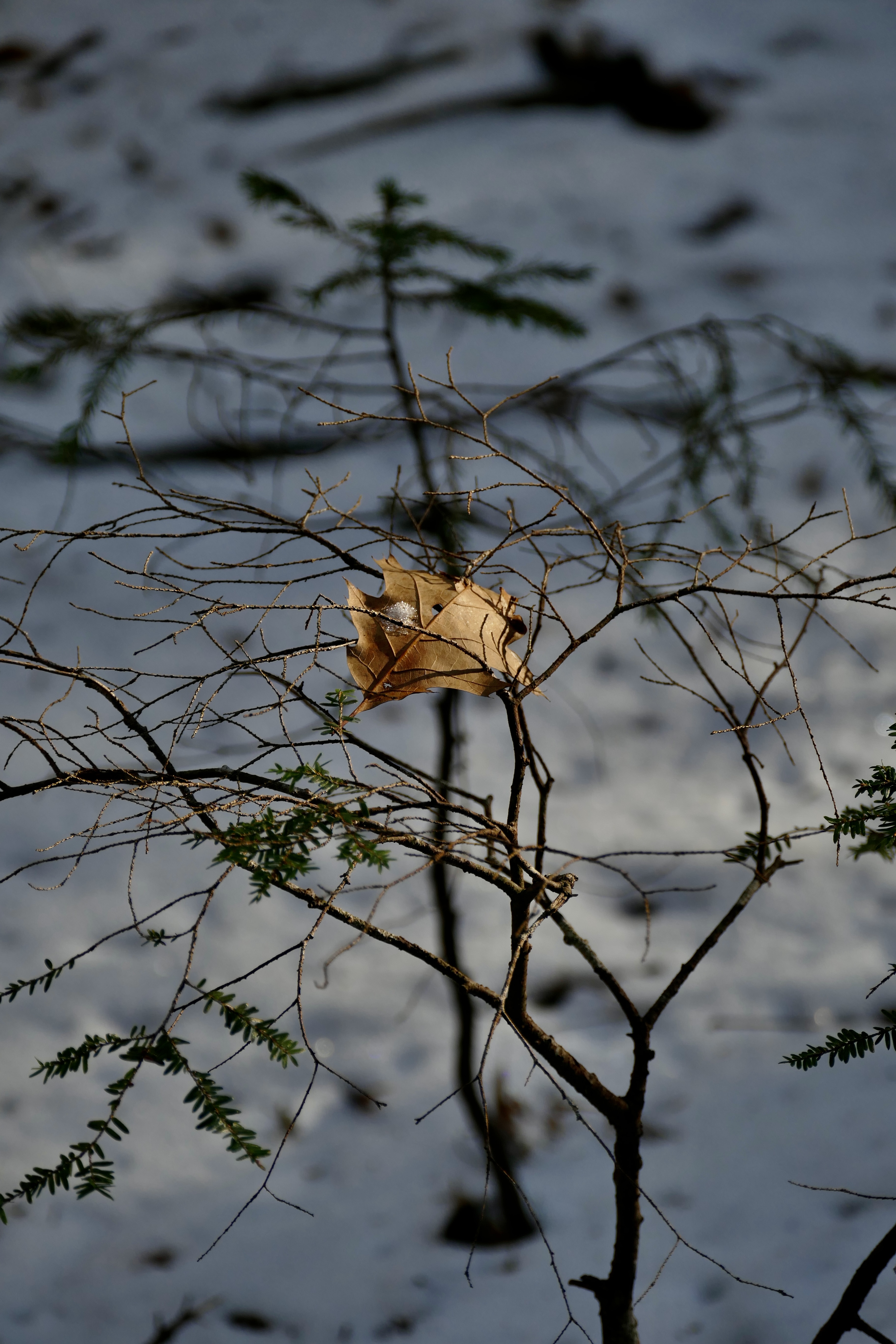
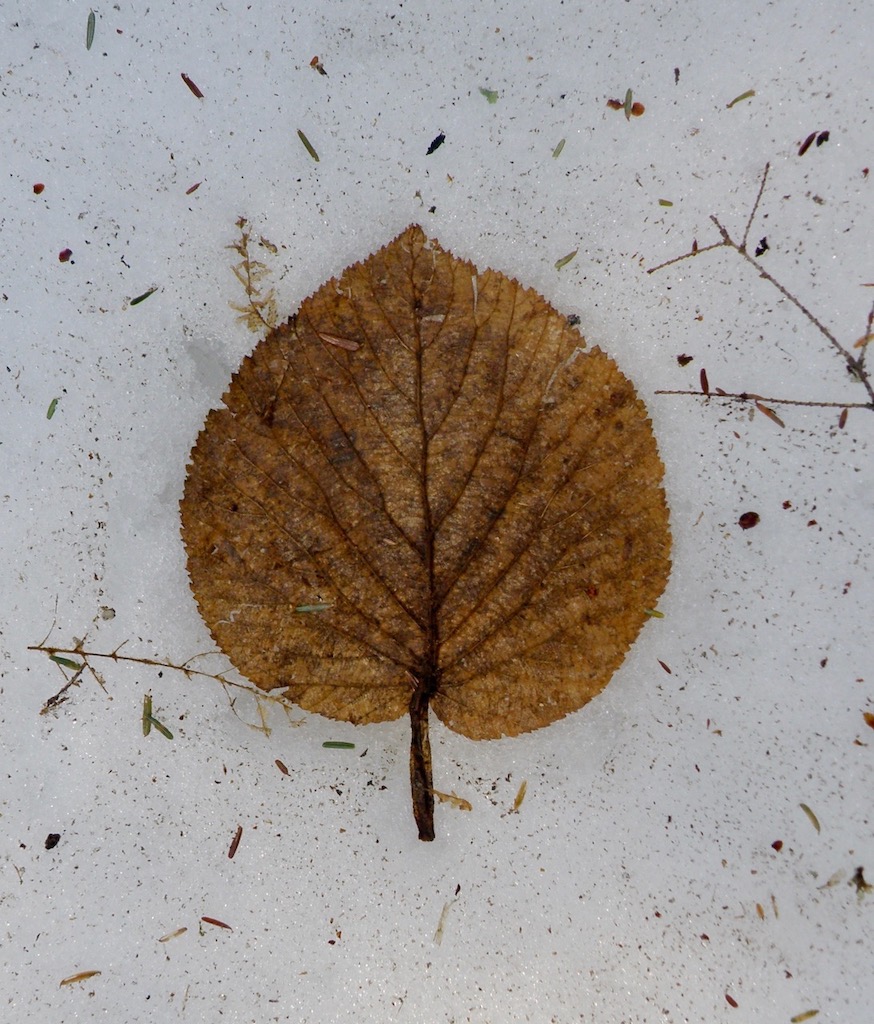
It is as a leaf which hangs over my head in the path — I bend the twig and write my prayers on it then letting it go the bough springs up and shows the scrawl to heaven. As if it were not kept shut in my desk—but were as public a leaf as any in nature—it is papyrus by the river side—it is vellum in the pastures—it is parchment on the hills— I find it every where as free as the leaves which troop along the lanes in autumn— The crow—the goose—the eagle—carry my quill—and the wind blows the leaves—as far as I go— Or if my imagination does not soar, but gropes in slime and mud—then I write with a reed.
It is always a chance scrawl, and commemorates some accident—as great as earthquake or eclipse. Like the sere leaves in yonder vase these have been gathered far and wide—upland and lowland.— forest and field have been ransacked.
 allandibiase.com
You must be logged in to post a comment.