November 19, 1850

in Thoreau’s Journal:

The first really cold day. I find, on breaking off a shrub oak leaf, a little life at the foot of the leafstalk, so that a part of the green comes off. It has not died quite down to the point of separation, as it will do, I suppose, before spring. Most of the oaks have lost their leaves except on the lower branches, as if they were less exposed and less mature there, and felt the changes of the seasons less. The leaves have either fallen or withered long since, yet I found this afternoon, cold as it is, – and there has been snow in the neighborhood,
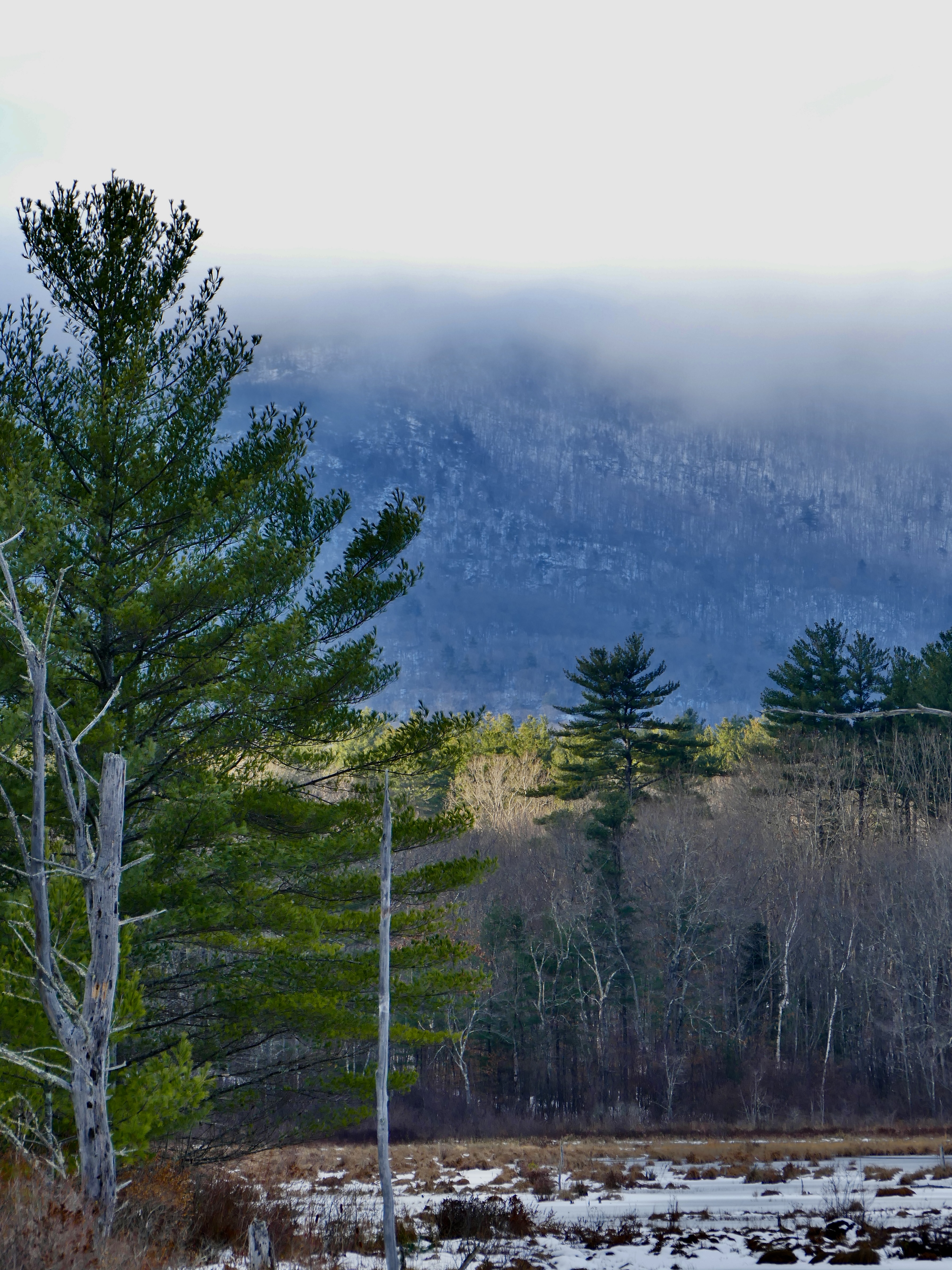
– some sprouts which had come up this year from the stump of a young black-looking oak, covered still with handsome fresh red and green leaves, very large and unwithered and unwilted. It was on the south side of Fair Haven in a warm angle, where the wood was cut last winter and the exposed edge of the still standing wood running north and south met the cliff at right angles and served for a fence to keep off the wind. There were one or two stumps here whose sprouts had fresh leaves which transported me back to October. Yet the surrounding shrub oak leaves were as dry and dead as usual. There were also some minute birches only a year old, their leaves still freshly yellow, and some young wild apple trees apparently still growing, their leaves as green and tender as in summer. The goldenrods, one or more species of the white and some yellow ones, were many of them still quite fresh, though elsewhere they are all whitish and dry. I saw one whose top rose above the edge of a rock, and so much of it was turned white and dry; but the lower part of its raceme was still yellow. Some of the white species seemed to have started again as if for another spring. They had sprung up freshly a foot or more, and were budded to blossom, fresh and green. And sometimes on the same stem were old and dry and white downy flowers, and fresh green blossom-buds, not yet expanded. I saw there some pale blue asters still bright, and the mullein leaves still large and green, one green to its top. And I discovered that when I put my hand on the mullein leaves they felt decidedly warm, but the radical leaves of the goldenrods felt cold and clammy. 

September 21, 1852

in Thoreau’s Journal:

The small scull cap & cress & the mullein still in bloom. I see pigeon woodpeckers oftener now with their light rears. Birches & elms begin to turn yellow—& ferns are quite yellow or brown in many places. I see many tall clustered bluish asters by the brooks like the A undulatus. The blue stemmed golden rod is abundant bright & in its prime. The maples begin to be ripe. How beautiful when a whole maple on the edge of a swamp is like one great scarlet fruit—full of ripe juices— A sign of the ripening—every leaf from lowest limb to topmost spire— is a-glow. The woodbine is red too & its berries are blueing. The flattened black berries of the cucumber root—with the triangular bases of its leaves tinged red beneath as a sort of cup for them. My red ball fungus blossoms in the path in the midst of its jelly. As I was walking through the maple swamp by the Corner spring I was surprised to see apples on the ground—and at first supposed that some body had dropped them, but looking up I detected a wild apple tree, as tall and slender as the young maples and not more than 5 inches in diameter at the ground. This had blossomed & borne fruit this year—

The apples were quite mellow & of a very agreeable flavor—they they had a rusty scraperish look—and I filled my pockets with them. The squirrels had found them out before me. It is an agreeable surprise to find in the midst of a swamp so large and edible a fruit as an apple. Of late we have much cloudy weather without rain. Are not liable to showers as in summer—but may have a storm. The lentago berries appear to drop off before or as soon as they turn. There are few left on the bushes. Many that I bring home will turn in a single night. The sassafras leaves are red. The huckleberry bushes begin to redden. The white actaea berries still hang on—or their red pedicels remain. 

June 19, 1852

in Thoreau’s Journal:

A comfortable breezy June morning. No dust to-day. To explore a segment of country between the Stow hills and the railroad in Acton, west to Boxboro.

A fine, clear day, a journey day. A very small blue veronica in the bank by the roadside at Mrs. Hosmer’s, apparently the same with that I saw on the Cliffs with toothed leaves. Interesting from being blue. The traveller now has the creak of the cricket to encourage him on all country routes, out of the fresh sod, still fresh as in the dawn, not interrupting his thoughts. Very cheering and refreshing to hear so late in the day, this morning sound. The whiteweed colors some meadows as completely as the frosting does a cake. The waving June grass shows watered colors like grain. No mower’s scythe is heard. The farmers are hoeing their corn and potatoes. Some low blackberry leaves are covered with a sort of orange-colored mildew or fungus. The clover is now in its glory. Whole fields are rosed with it, mixed with sorrel, and looking deeper than it is. It makes fields look luxuriant which are really thinly clad. The air is full of its sweet fragrance. I cannot find the linnæa in Loring’s; perhaps because the woods are cut down; perhaps I am too late. The robins sing more than usual, maybe because of the coolness. Buttercups and geraniums cover the meadows, the latter appearing to float on the grass, – of various tints. It has lasted long, this rather tender flower. Methinks there are most tall buttercups now. These and the senecio, now getting stale, prevail in the meadows. Green early blueberries on hillsides passim remind you of the time when berries will be ripe. This is the ante-huckleberry season, when fruits are green. The green fruit of the thorn is conspicuous, and of the wild cherry and the amelanchiers and the thimble-berry. These are the clover days.