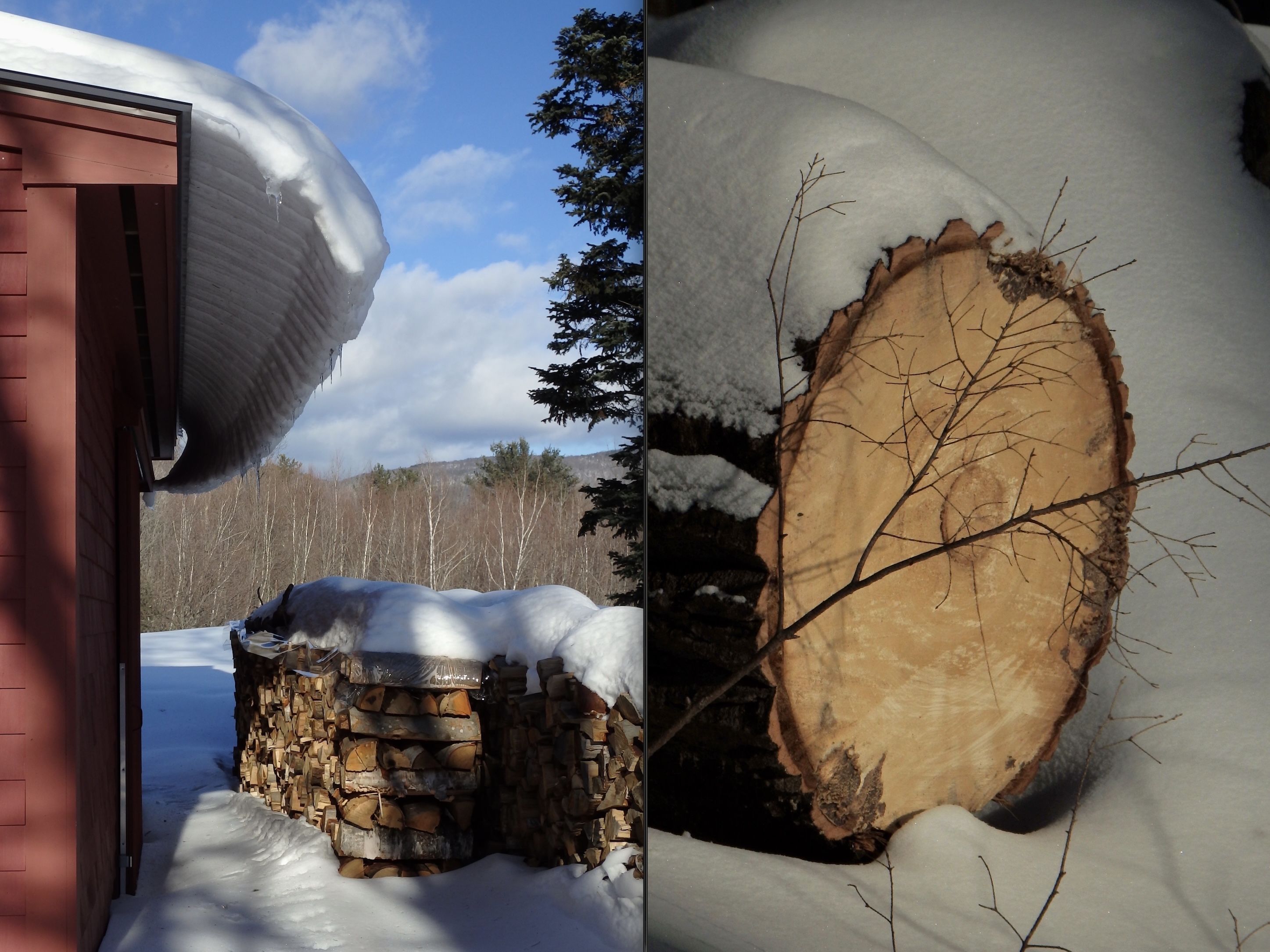
I find that whatever hindrances may occur I write just about the same amount of truth in my Journal; for the record is more concentrated, and usually it is some very real and earnest life, after all, that interrupts. All flourishes are omitted. If I saw wood from morning to night, though I grieve that I could not observe the train of my thoughts during that time, yet, in the evening, the few scrannel lines which describe my day’s occupations will make the creaking of the saw more musical than my freest fancies could have been. I find incessant labor with the hands, which engrosses the attention also, the best method to remove palaver out of one’s style. One will not dance at his work who has wood to cut and cord before the night falls in the short days of winter; but every stroke will be husbanded, and ring soberly through the wood; and so will his lines ring and tell on the ear, when at evening he settles the accounts of the day. I have often been astonished at the force and precision of style to which busy laboring men, unpracticed in writing, easily attain when they are required to make the effort. It seems as if their sincerity and plainness were the main thing to be taught in schools — and yet not in the schools, but in the fields, in actual service, I should say….
I want to see a sentence run clear through to the end, as deep and fertile as a well-drawn furrow which shows that the plow was pressed down to the beam. If our scholars would lead more earnest lives, we should not witness those lame conclusions to their ill-sown discourses, but their sentences would pass over the ground like loaded rollers, and not mere hollow and wooden ones, to press in the seed and make it germinate.
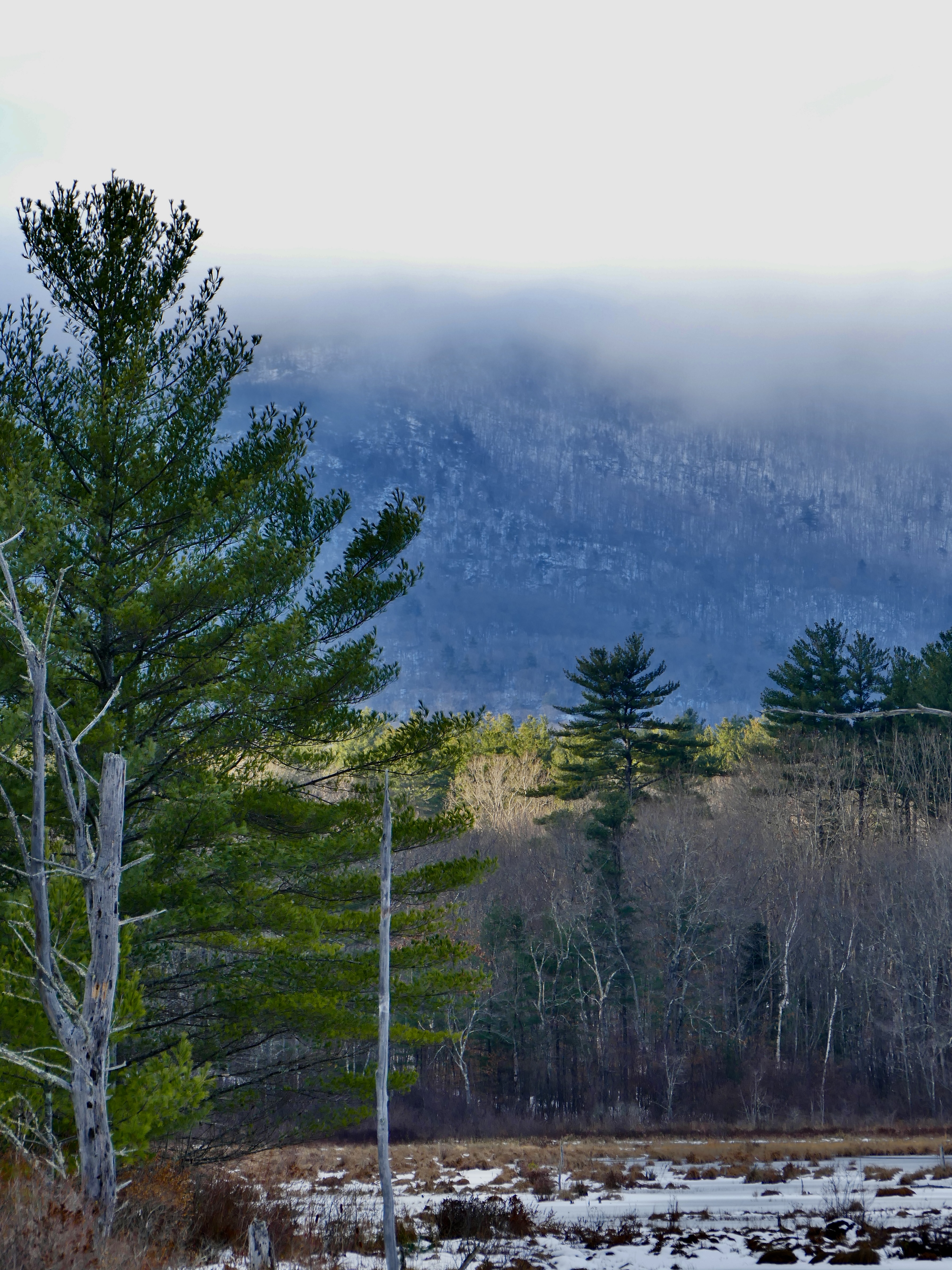
It began to snow again last evening, but soon ceased, and now it has turned out a fine winter morning, with half an inch of snow on the ground, the air full of mist, through which the smokes rise up perfectly straight; and the mist is frozen in minute leafets on the fences and trees and the needles of the pines, silvering them.
I stood by Bigelow the blacksmith’s forge yesterday, and saw him repair an axe. He burned the handle out, then, with a chisel, cut off the red-hot edge even, there being some great gaps in it, and by hammering drew it out and shaped it anew, —all in a few minutes. It was interesting to see performed so simply and easily, by the aid of fire and a few rude tools….
P. M. — To Pink Azalea Woods.
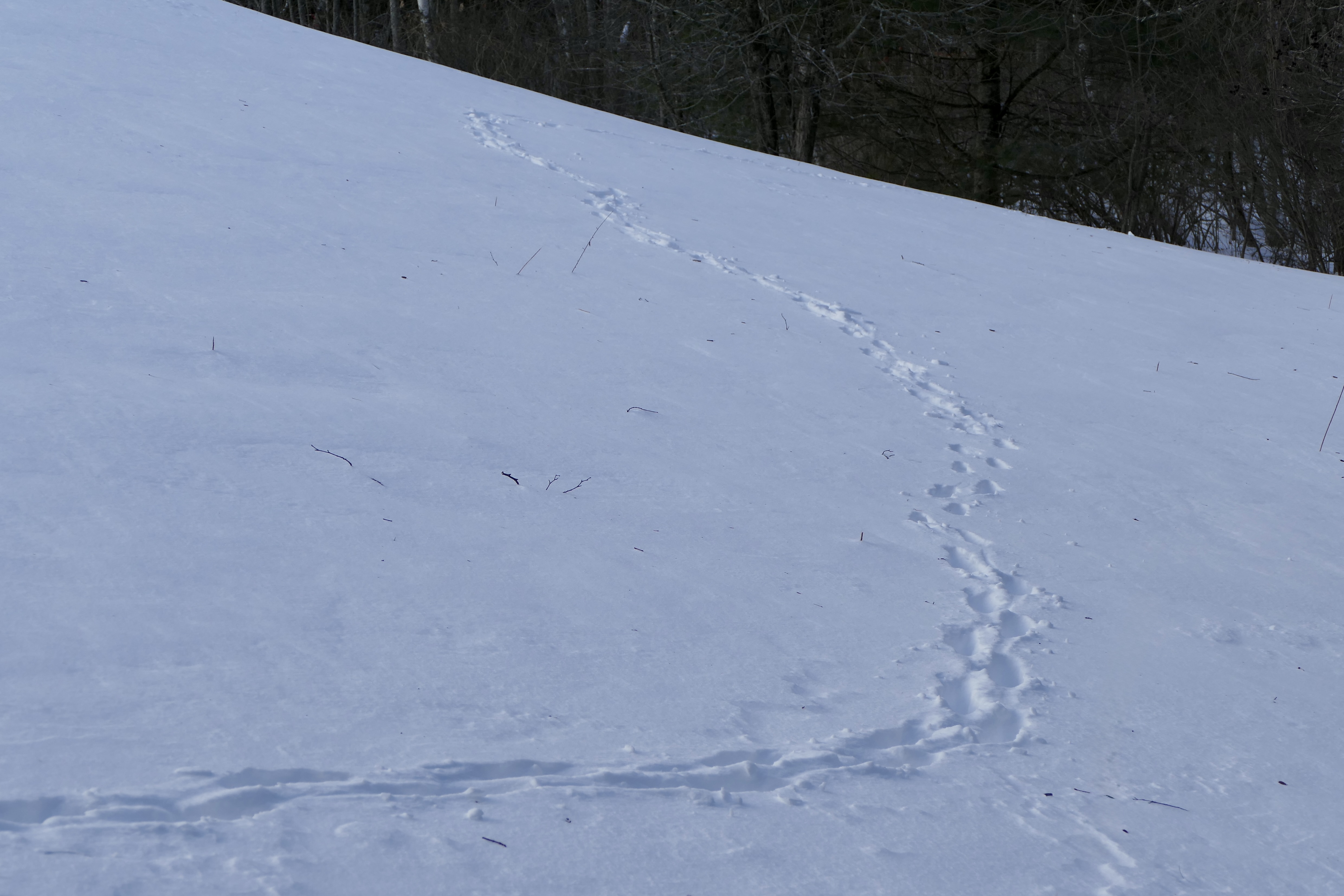
The warm sun has quite melted the thin snow on the south sides of the hills, but I go to see the tracks of animals that have been out on the north sides. First, getting over the wall under the walnut trees on the south brow of the hill, I see the broad tracks of squirrels, probably red, where they have ascended and descended the trees, and the empty shells of walnuts which they have gnawed left on the snow. The snow is so very shallow that the impression of their toes is the more distinctly seen. It imparts life to the landscape to see merely the squirrels’ track in the snow at the base of the walnut tree. You almost realize a squirrel at every tree. The attractions of nature are thus condensed or multiplied. You see not merely bare trees and ground which you might suspect that a squirrel had left, but you have this unquestionable and significant evidence that a squirrel has been there since the snow fell, — as conclusive as if you had seen him.
A little further I heard the sound [of] a downy wood- pecker tapping a pitch pine in a little grove, and saw him inclining to dodge behind the stem. He flitted from pine to pine before me. Frequently, when I pause to listen, I hear this sound in the orchards or streets. This was in one of these dense groves of young pitch pines.
Suddenly I heard the screwing mew and then the whir of a partridge on or beneath an old decaying apple tree which the pines had surrounded. There were several such, and another partridge burst away from one. They shoot off swift and steady, showing their dark-edged tails, almost like a cannon-ball. I saw one’s track under an apple tree and where it had pecked a frozen-thawed apple.
Then I came upon a fox-track made last night, leading toward a farmhouse, —Wheeler’s, where there are many hens, — running over the side of the hill parallel with Wheeler’s new wall. He was dainty in the choice of his ground, for I observed that for a mile he had adhered to a narrow cow-path, in which the snow lay level, for smoothness. Sometimes he had cantered, and struck the snow with his foot between his tracks. Little does the farmer think of the danger which threatens his hens.
In a little hollow I see the sere gray pennyroyal rising above the snow, which, snuffed, reminds me of garrets full of herbs.
Now I hear, half a mile off, the hollow sound of woodchopping, the work of short winter days begun, which is gradually laying bare and impoverishing our landscape. In two or three thicker woods which I have visited this season, I was driven away by this ominous sound.
Further over toward the river, I see the tracks of a deer mouse on a rock, which suddenly come to an end where apparently it had ascended a small pine by a twig which hung over it. Sometimes the mark of its tail was very distinct. Afterwards I saw in the pasture westward where many had run about in the night. In one place many had crossed the cow-path in which I was walking, in one trail, or the same one had come and gone many times. In the large hollows where rocks have been blasted, and on the sides of the river, I see irregular spaces of dark ice bare of snow, which was frozen after the snow ceased to fall. But this ice is rotten and mixed with snow. I am surprised to see the river frozen over for the most part with this thin and rotten snow ice, and the drooping or bent alders are already frozen into this slush, giving to the stream a very wintry aspect. I see some squirrel-tracks about a hole in a stump.
At the azalea meadow or swamp, the red tops of the osiers, which are very dense and of a uniform height, are quite attractive, in the absence of color at this season. Any brighter and warmer color catches our eye at this season. I see an elm there whose bark is worn quite smooth and white and bare of lichens, showing exactly the height at which the ice stood last winter.
Looking more closely at the light snow there near the swamp, I found that it was sprinkled all over (as with pellets of cotton) with regular star-shaped cottony flakes with six points, about an eighth of an inch in diameter and on an average a half an inch apart. It snowed geometry.
How snug and warm a hemlock looks in the winter! [place of drawing] That by the azalea looks thus: There is a tendency in the limbs to arrange themselves ray-wise about a point one third from the base to the top. What singular regularity in the outline of a tree!
I noticed this morning successive banks of frost on the windows, marked by their irregular waving edges, like the successive five, ten, and fifteen fathom lines which mark the depth of the shores on charts.
Thus by the snow I was made aware in this short walk of the recent presence there of squirrels, a fox, and countless mice, whose trail I had crossed, but none of which I saw, or probably should have seen before the snow fell. Also I saw this afternoon the track of one sparrow, probably a tree sparrow, which had run among the weeds in the road.
That grand old poem called Winter is round again without any connivance of mine. As I sit under Lee’s Cliff, where the snow is melted, amid sere pennyroyal and frost-bitten catnep, I look over my shoulder upon an arctic scene. I see with surprise the pond a dumb white surface of ice speckled with snow, just as so many winters before, where so lately were lapsing waves or smooth reflecting water.
I see the holes which the pickerel-fisher has made, and I see him, too, retreating over the hills, drawing his sled behind him. The water is already skimmed over again there. I hear, too, the familiar belching voice of the pond. It seemed as if winter had come without any interval since midsummer, and I was prepared to see it flit away by the time I again looked over my shoulder. It was as if I had dreamed it. But I see that the farmers have had time to gather their harvests as usual, and the seasons have revolved as slowly as in the first autumn of my life. The winters come now as fast as snowflakes. It is wonderful that old men do not lose their reckoning. It was summer, and now again it is winter. Nature loves this rhyme so well that she never tires of repeating it. So sweet and wholesome is the winter, so simple and moderate, so satisfactory and perfect, that her children will never weary of it. What a poem! an epic in blank verse, enriched with a million tinkling rhymes. It is solid beauty. It has been subjected to the vicissitudes of millions of years of the gods, and not a single superfluous ornament remains. The severest and coldest of the immortal critics have shot their arrows at and pruned it till it cannot be amended.
The first really cold day. I find, on breaking off a shrub oak leaf, a little life at the foot of the leafstalk, so that a part of the green comes off. It has not died quite down to the point of separation, as it will do, I suppose, before spring. Most of the oaks have lost their leaves except on the lower branches, as if they were less exposed and less mature there, and felt the changes of the seasons less. The leaves have either fallen or withered long since, yet I found this afternoon, cold as it is, – and there has been snow in the neighborhood,
– some sprouts which had come up this year from the stump of a young black-looking oak, covered still with handsome fresh red and green leaves, very large and unwithered and unwilted. It was on the south side of Fair Haven in a warm angle, where the wood was cut last winter and the exposed edge of the still standing wood running north and south met the cliff at right angles and served for a fence to keep off the wind. There were one or two stumps here whose sprouts had fresh leaves which transported me back to October. Yet the surrounding shrub oak leaves were as dry and dead as usual. There were also some minute birches only a year old, their leaves still freshly yellow, and some young wild apple trees apparently still growing, their leaves as green and tender as in summer. The goldenrods, one or more species of the white and some yellow ones, were many of them still quite fresh, though elsewhere they are all whitish and dry. I saw one whose top rose above the edge of a rock, and so much of it was turned white and dry; but the lower part of its raceme was still yellow. Some of the white species seemed to have started again as if for another spring. They had sprung up freshly a foot or more, and were budded to blossom, fresh and green. And sometimes on the same stem were old and dry and white downy flowers, and fresh green blossom-buds, not yet expanded. I saw there some pale blue asters still bright, and the mullein leaves still large and green, one green to its top. And I discovered that when I put my hand on the mullein leaves they felt decidedly warm, but the radical leaves of the goldenrods felt cold and clammy.
P.M. — To Smith’s chestnut grove and Saw Mill Brook.
The large sugar maples on the Common are now at the height of their beauty. One, the earliest to change, is partly bare. This turned so early and so deep a scarlet that some thought that it was surely going to die. Also that one at the head of the Turnpike reveals its character now as far as you can see it. Yet about ten days ago all but one of these was quite green, and I thought they would not acquire any bright tints. A delicate but warmer than golden yellow is the prevailing color, with scarlet cheeks. They are great regular oval masses of yellow and scarlet. All the sunny warmth of the season seems to be absorbed in their leaves. There is an auction on the Common, but its red flag is hard to be discerned amid this blaze of color. The lowest and inmost leaves next the bole are of the most delicate yellow and green, as usual, like the complexion of young men brought up in the house.
Little did the fathers of the town anticipate this brilliant success then they caused to be imported from further in the country some straight poles with the tops cut off, which they called sugar maple trees, —and a neighboring merchant’s clerk, as I remember, by way of just planted beans about them. Yet these which were then jestingly called bean-poles are these days for the most beautiful objects noticeable in our streets. They are worth all and more than they have cost, —though one of the selectmen did take the cold which occasioned his death in the setting them out, —if only because they have filled the open eyes of children with their rich color so unstintedly so many autumns. We will not ask them to yield us sugar in the spring, while they yield us so fair a prospect in the autumn. Wealth may be the inheritance of a few in the houses, but it is equally distributed on the Common. All children alike can revel in this golden harvest. These trees, throughout the street, are at least equal to an annual festival and holiday, or a week of such, —not requiring any special police to keep the peace, —and poor indeed must be that New England village’s October which has not the maple in its streets. This October festival costs no powder or ringing of bells, but every tree is a liberty-pole on which a thousand bright flags are run up. Hundreds of children’s eyes are steadily drinking in this color, and by these teachers even the truants are caught and educated the moment they step abroad. It is as if some cheap and innocent gala-day were celebrated in our town every autumn, —a week or two of such days.
What meant the fathers by establishing this living institution before the church, —this institution which needs no repairing nor repainting, which is continually “enlarged and repaired” by its growth? Surely trees should be set in our streets with a view to their October splendor. Do you not think it will make some odds to these children that they were brought up under the maples? Indeed, neither the truant nor the studious are at present taught colors in the schools. These are instead of the bright colors in apothecary shops and city windows. It is a pity we have not more red maples and some hickories in the streets as well. Our paint-box is very imperfectly filled. Instead of, or besides, supplying paint-boxes, I would supply these natural colors to the young.
I know of one man at least, called an excellent and peculiarly successful farmer, who has thoroughly repaired his house and built a new barn with a barn cellar, such as every farmer seems fated to have, who has not a single tree or shrub of any kind about his house or within a considerable distance of it.
No annual training or muster of soldiery, no celebration with its scarfs and banners, could import into the town a hundredth part of the annual splendor of our October. We have only to set the trees, or let them stand, and Nature will find the colored drapery, —flags of all her nations, some of whose private signals hardly the botanist can read. Let us have a good many maples and hickories and scarlet oaks, then I say. Blaze away! Shall that dirty roll of bunting in the gun-house be all the colors a village can display? A village is not complete unless it has these trees to mark the season in it. They are as important as a town clock. Such a village will not be found to work well. It has a screw loose; an essential part is wanting. Let us have willows for spring, elms for summer, maples and walnuts and tupelos for autumn, evergreens for winter, and oaks for all seasons. What is a gallery in a house to a gallery in the streets! I think that there is not a picture-gallery in the country which would be worth so much to us as is the western view under the elms of our Main Street. They are the frame to a picture, and we are not in the dilemma of the Irishman who, having bought a costly gilt picture-frame at an action, found himself obliged to buy a picture at private sale to put into it, for our picture is already painted with each sunset behind it. An avenue of elms as large as our largest, and three miles long, would seem to lead to some admirable place, though only Concord were at the end of it. Such a street as I have described would be to the traveller, especially in October, an ever-changing panorama.
A village needs these innocent stimulants of bright and cheery prospects to keep off melancholy and superstition. Show me two villages, one embowered in trees and blazing with all the glories of October, the other a merely trivial and treeless waste, and I shall be sure the in the latter will be found the most desperate and hardest drinkers. What if we were to take half as much pains in protecting them as we do in setting them out, —not stupidly tie our horses to our dahlia stems? They are cheap preachers, permanently settled, which preach their half-century, and century, aye, and century and a half sermons, with continually increasing influence and unction, ministering to many generations of men, and the least we can do is to supply them with suitable colleagues as they grow infirm.
Children are now everywhere playing with the brown and withered leaves of elms and buttonwoods, which strew the trees and are collected into heaps in the sluiceways. In the woods even the little pea-vine turns a delicate yellow and is more conspicuous than ever, and in the now neglected gardens the asparagus-beds, greenish without, glow yellow within, as if a fire were bursting out there.
As I go down the Turnpike past Clintonia Swamp, I am struck by the magical change which has taken place in the red maple swamps, which just a fortnight ago were splendid masses of scarlet and yellow and crimson, rising amid the yet green trees, —pines and oaks, etc., —like immense flower-beds on one side of the town, visible for miles, attracting the eyes of all travellers; now, —though a few late ones are bright as ever in some places, —all their splendor gone, wafted away, as it were by a puff of wind, and they are the mere ghosts of trees, unnoticed by any, or, if noticed at all, like the smoke that is seen where a blaze is extinguished, or as the red clouds at evening change suddenly to gray and black, — so suddenly their glory departs, —desolate gray twigs.
The Salix alba is a light and silvery green. Since the red maples generally fell, the chestnuts have been yellowing, and the oaks reddening and yellowing. The chestnuts are now in their prime, though many leaves are fallen. The forest, which showed but little ripeness ten days ago, except about its edges and here and there as you looked down on it from a height, is now seen to be generally of a mellow brownish yellow, like perfectly ripe fruit, which we know to be more perfectly ripe for it being a little specked. By the brook, witch-hazel, as an underwood, is in the height of its change, but elsewhere exposed large bushes are bare. Rheus toxicodenron is fallen. The hornbeam is a greenish yellow, or yellow as it were dusted with green. The maple-leaved viburnum, now at its height, varies, with more or less of shade, from dark crimson through a delicate pale crimson to whitish. The sage willow, a light yellow, in prime, though hardly noticed amid the more conspicuous oaks. Larches have begun to change in water.
As I come though Hubbard’s Woods I see the wintergreen, conspicuous now about the freshly fallen white pine needles. Their shining green is suddenly revealed above the pale-brown ground. I hail its cool unwithering green, one of the humbler allies by whose aid we are to face the winter.
Saw, October 14th, a snake a Ball’s Hill, like a stiriped snake, but apparently yellow-spotted above and with the flatter head? Noticed a little snake, eight or nine inches long, in the rut in the road in the Lincoln woods. It was brown above with a paler-brown dorsal stripe, which was bounded on each side by a row of dark-brown or blackish dots one eighth inch apart, the opposite rows alternating. Beneatg, light cream-color or yellowish white. Evidently Storer’s Coluber ordinatus. It ran along the deep sandy rut and would probably be run over there.
See larks, with their white tail-feathers, fluttering low over the meadows these days.
Minott was sitting outside, as usual, and inquired if I saw any game in my walks these days; since, now that he cannot go abroad himself, he likes to hear from the woods. He tried to detain me to listen to some of his hunting-stories, especially about a slut that belonged to a neighbor by the name of Billlings, which was excellent for squirrels, rabbits, and partridges, and would always follow him when he went out, though Billings was “plaguy made about it;” however, he had only to go by Billlings to have the dog accompany him. B. afterward carried her up country and gave her away, the news of which almost broke Minott’s heart. He said he could have cried when he heard of it, for he had dreamed of her several nights. She was a plaguy good dog for squirrels, etc, but her pups were none of them equal to herself. It was not time for squirrels now, because the leaves were not off enough. He used sometimes to take his old king’s-arm on these excursions. It was heavy, but it was sure. His present gun has a flint lock and has often been repaired, and he said he didn’t suppose it would fetch more than a dollar if put up at auction now. But he wouldn’t take twenty dollars for it. He didn’t want to part with it. He liked to look at it.
As leaves fall along the river and in the woods, the squirrels and musquash make haste to shelter and conceal themselves by constructing nests and cabins.
The small scull cap & cress & the mullein still in bloom. I see pigeon woodpeckers oftener now with their light rears. Birches & elms begin to turn yellow—& ferns are quite yellow or brown in many places. I see many tall clustered bluish asters by the brooks like the A undulatus. The blue stemmed golden rod is abundant bright & in its prime. The maples begin to be ripe. How beautiful when a whole maple on the edge of a swamp is like one great scarlet fruit—full of ripe juices— A sign of the ripening—every leaf from lowest limb to topmost spire— is a-glow. The woodbine is red too & its berries are blueing. The flattened black berries of the cucumber root—with the triangular bases of its leaves tinged red beneath as a sort of cup for them. My red ball fungus blossoms in the path in the midst of its jelly. As I was walking through the maple swamp by the Corner spring I was surprised to see apples on the ground—and at first supposed that some body had dropped them, but looking up I detected a wild apple tree, as tall and slender as the young maples and not more than 5 inches in diameter at the ground. This had blossomed & borne fruit this year—
The apples were quite mellow & of a very agreeable flavor—they they had a rusty scraperish look—and I filled my pockets with them. The squirrels had found them out before me. It is an agreeable surprise to find in the midst of a swamp so large and edible a fruit as an apple. Of late we have much cloudy weather without rain. Are not liable to showers as in summer—but may have a storm. The lentago berries appear to drop off before or as soon as they turn. There are few left on the bushes. Many that I bring home will turn in a single night. The sassafras leaves are red. The huckleberry bushes begin to redden. The white actaea berries still hang on—or their red pedicels remain.
My attic chamber has compelled me to sit below with the family at evening for a month. I feel the necessity of deepening the stream of my life; I must cultivate privacy. It is very dissipating to be with people too much. As C. says, it takes the edge off a man’s thoughts to have been much in society. I cannot spare my moonlight and my mountains for the best of man I am likely to get in exchange––
I am inclined now for a pensive evening walk
Methinks we think of spring mornings and autumn evenings. I go via Hubbard Path. Chelone say two days X at Conants meadow beyond Wheelers. July has been to me a trivial month. It began hot and continued drying, then rained some toward the middle, bringing anticipations of the fall, and then was hot again about the 20th. It has been a month of haying, heat, low water, and weeds. Birds have grown up and flown more or less in small flocks, though I notice a new sparrow’s nest and eggs and perhaps a catbird’s eggs lately. The woodland quire has steadily diminished in volume.
At the bass I now find that that memorable hum has ceased and the green berries are formed. Now blueberries, huckleberries, and low blackberries are in their prime. The fever-bush berries will not be ripe for two or three weeks.
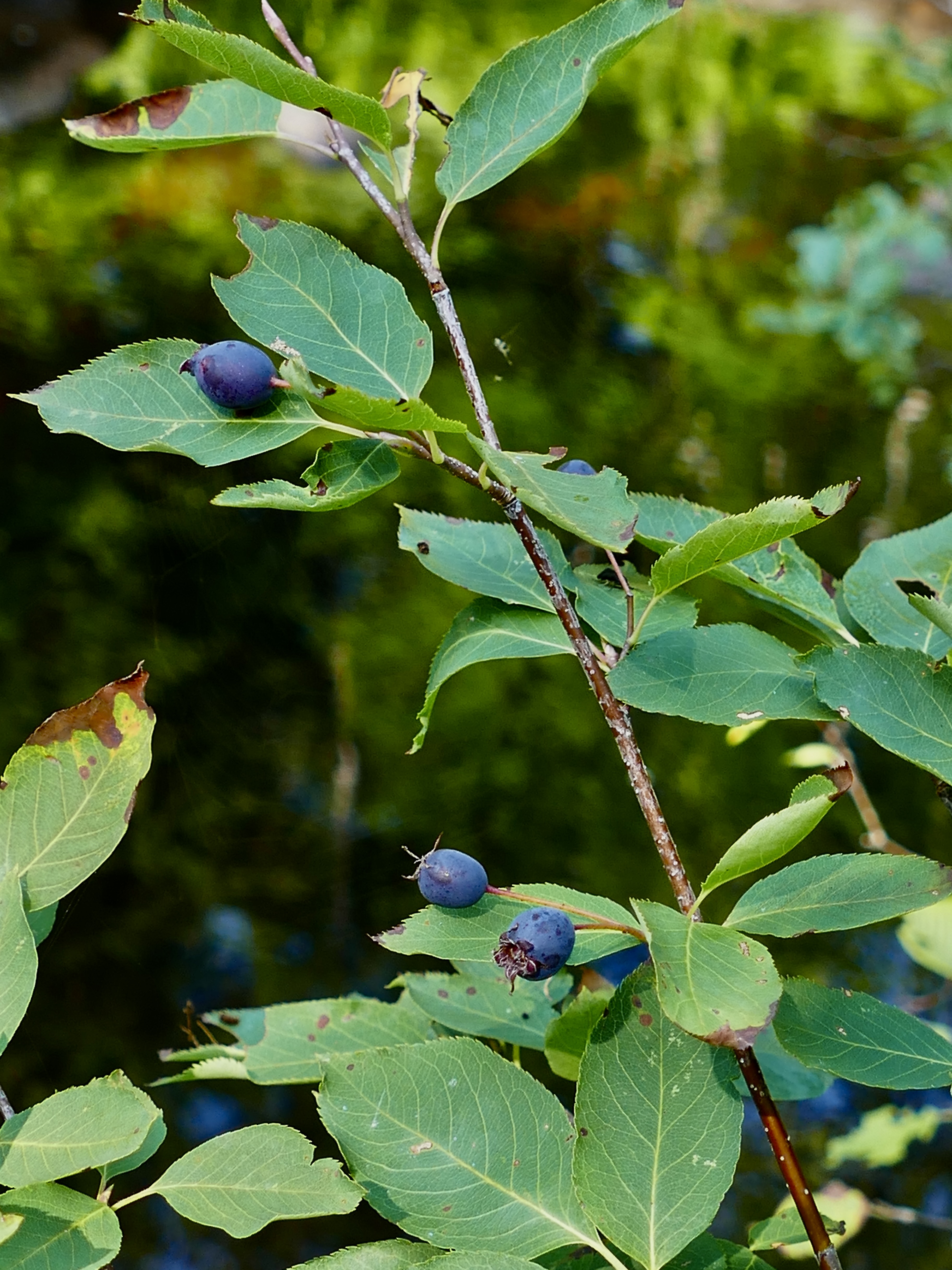
At Bittern Cliff the Gerardia quercifolia (?), apparently four or five days at least. How interesting the small alternate cornel trees, with often a flat top, a peculiar ribbed and green leaf, and pretty red stems supporting its harmless blue berries inclined to drop off ! The sweet viburnum, not yet turning. I see apparently a thistle-down over the river at Bittern Cliff; it is borne toward me, but when it reaches the rock some influence raises it high above the rock out of my reach. What a fall-like look the decayed and yellow leaves of the large Solomon’s-seal have in the thickets now! These, with skunk-cabbage and hellebore, suggest that the early ripeness of leaves, etc., has somewhat normal in it,— there is a fall already begun. Eupatorium sessilifolium, one or two stamens apparently for two days; its smooth leaf distinguishes it by the touch from the sunflower.
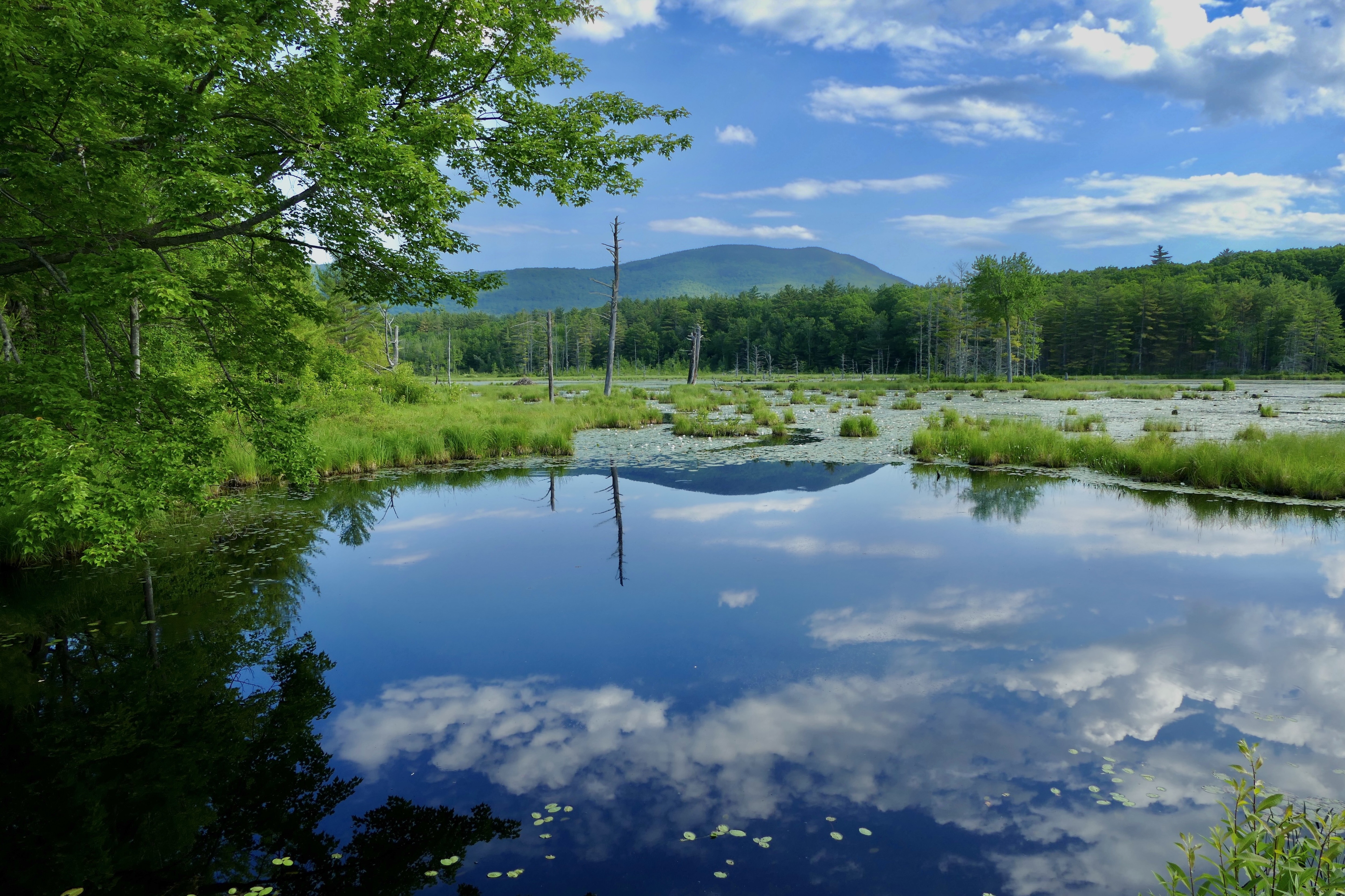
I sat on the Bittern Cliff as the still eve drew on. There was a man on Fair Haven furling his sail and bathing from his boat. A boat on a river whose waters are smoothed, and a man disporting in it! How it harmonizes with the stillness and placidity of the evening! Who knows but he is a poet in his yet obscure but golden youth? Few else go alone into retired scenes without gun or fishing-rod. He bathes in the middle of the pond while his boat slowly drifts away. As I go up the hill, surrounded by its shadow, while the sun is setting, I am soothed by the delicious stillness of the evening, save that on the hills the wind blows. I was surprised by the sound of my own voice. It is an atmosphere burdensome with thought. For the first time for a month, at least, I am reminded that thought is possible. The din of trivialness is silenced. I float over or through the deeps of silence. It is the first silence I have heard for a month. My life had been a River Platte, tinkling over its sands but useless for all great navigation, but now it suddenly became a fathomless ocean. It shelved off to unimagined depths.
I sit on rock on the hill top––warm with the heat of the departed sun, in my thin summer clothes. Here are the seeds of some berries in the droppings of some bird on the rock. The sun has been set fifteen minutes, and a long cloudy finger, stretched along the northern horizon, is held over the point where it disappeared. I see dark shadows formed on the south side of the woods east of the river. The creaking of the crickets becomes clear and loud and shrill, —a sharp tinkling, like rills bubbling up from the ground. After a little while the western sky is suddenly suffused with a pure white light, against which the hickories further east on the hill show black with beautiful distinctness. Day does not furnish so interesting a ground. A few sparrows sing as in the morning and the spring; also a peawai and a chewink. Meanwhile the moon in her first quarter is burnishing her disk. Now suddenly the cloudy finger and the few scattered clouds glow with the parting salute of the sun; the rays of the sun, which has so long sunk below the convex earth, are reflected from each cloudy promontory with more incomparable brilliancy than ever.
The hardhack leaves stand up so around the stem that now, at first starlight, I see only their light undersides a rod off. Do they as much by day? The surface of the forest on the east of the river presents a singularly cool and wild appearance, —cool as a pot of green paint, ––stretches of green light and shade, reminding me of some lonely mt side. The nighthawk flies low-skimming over the ground now. How handsome lie the oats which have been cradled in long rows in the field, a quarter of a mile uninterruptedly!
The thick stub ends, so evenly laid, are almost as rich a sight to me as the graceful tops. A few fireflies in the meadows. I am uncertain whether that so large and bright and high was a fire-fly or a shooting star. Shooting stars are but fireflies of the firmament. The crickets on the causeway make a steady creak, on the dry pasture-tops an interrupted one. I was compelled to stand to write where a soft, faint light from the western sky came in between two willows.
Fields today sends me a specimen copy of my “Walden” It is to be published on the 12 inst.
A comfortable breezy June morning. No dust to-day. To explore a segment of country between the Stow hills and the railroad in Acton, west to Boxboro.
A fine, clear day, a journey day. A very small blue veronica in the bank by the roadside at Mrs. Hosmer’s, apparently the same with that I saw on the Cliffs with toothed leaves. Interesting from being blue. The traveller now has the creak of the cricket to encourage him on all country routes, out of the fresh sod, still fresh as in the dawn, not interrupting his thoughts. Very cheering and refreshing to hear so late in the day, this morning sound. The whiteweed colors some meadows as completely as the frosting does a cake. The waving June grass shows watered colors like grain. No mower’s scythe is heard. The farmers are hoeing their corn and potatoes. Some low blackberry leaves are covered with a sort of orange-colored mildew or fungus. The clover is now in its glory. Whole fields are rosed with it, mixed with sorrel, and looking deeper than it is. It makes fields look luxuriant which are really thinly clad. The air is full of its sweet fragrance. I cannot find the linnæa in Loring’s; perhaps because the woods are cut down; perhaps I am too late. The robins sing more than usual, maybe because of the coolness. Buttercups and geraniums cover the meadows, the latter appearing to float on the grass, – of various tints. It has lasted long, this rather tender flower. Methinks there are most tall buttercups now. These and the senecio, now getting stale, prevail in the meadows. Green early blueberries on hillsides passim remind you of the time when berries will be ripe. This is the ante-huckleberry season, when fruits are green. The green fruit of the thorn is conspicuous, and of the wild cherry and the amelanchiers and the thimble-berry. These are the clover days.
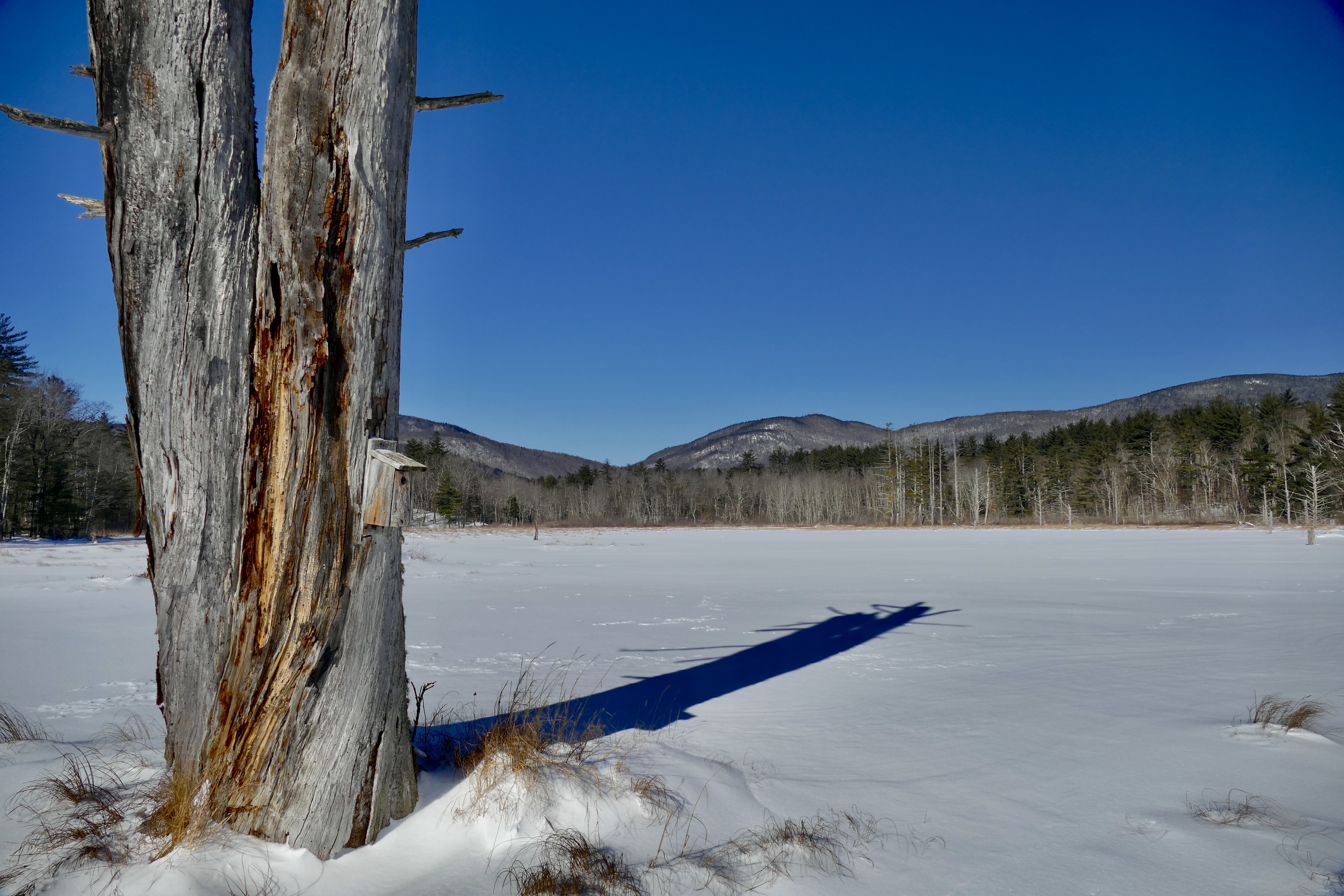
There is a few inches of snow perfectly level which now for nearly a week has covered the ice— Going toward the sun you are snow-blinded–– At each clump of willows on the meadow it looks as if there were a hillock––out of which they grow–– This appearance is produced by the willow twigs holding up the ice to height at which it was frozen after the last thaw about 2 feet above the present level.— It forms a regularly rounded hillock. We look at every track in the snow — Every little while there is the track of a fox across the river—turning aside sometimes to a muskrats cabin or a point of ice—where he has left some traces— frequently the larger track of a hound which has followed his trail— It is much easier & pleasanter to walk thus on the river—the snow being shallow & level —& there is no such loud squeaking or cronching of the snow as in the road—and This road is so wide that you do not feel confined in it—& you never meet travelers with whom you have no sympathy. The winter, cold & bound out as it is, is thrown to us like a bone to a famishing dog, & we are expected to get the marrow out of it. While the milkmen in the outskirts are milking so many scores of cows before sunrise these winter mornings, it is our task to milk the winter itself. It is true it is like a cow that is dry & our fingers are numb—& there is none to wake up us— Some desert the field & go into winter quarters in the city— They attend the oratorios while the only music that we hear is the squeaking of the snow under our boots. But the winter was not given to us for no purpose— We must thaw its cold with our genialness. We are tasked to find out & appropriate all the nutriment it yields— If it is a cold & hard season—its fruit no doubt is the more concentrated & nutty. It took the cold & bleakness of November to ripen the walnut—but the human brain is the kernel which the winter itself matures— Not till then does its shell come off— The seasons were not made in vain— Because the fruits of the earth are already ripe—we are not to suppose there is no fruit left for winter to ripen. — It is for man the seasons and the all the fruits exist. The winter was made to concentrate & harden & mature the kernel of his brain—to give tone & firmness & consistency to his thought— Then is the great harvest of the year—the harvest of thought— All previous harvests are stubble to this—mere fodder & green crop. Now we burn with a purer flame like the stars, our oil is winter-strained. We are islanded in Atlantic & Pacific—& Indian Oceans of thought— Bermudas or Friendly or Spice Islands—
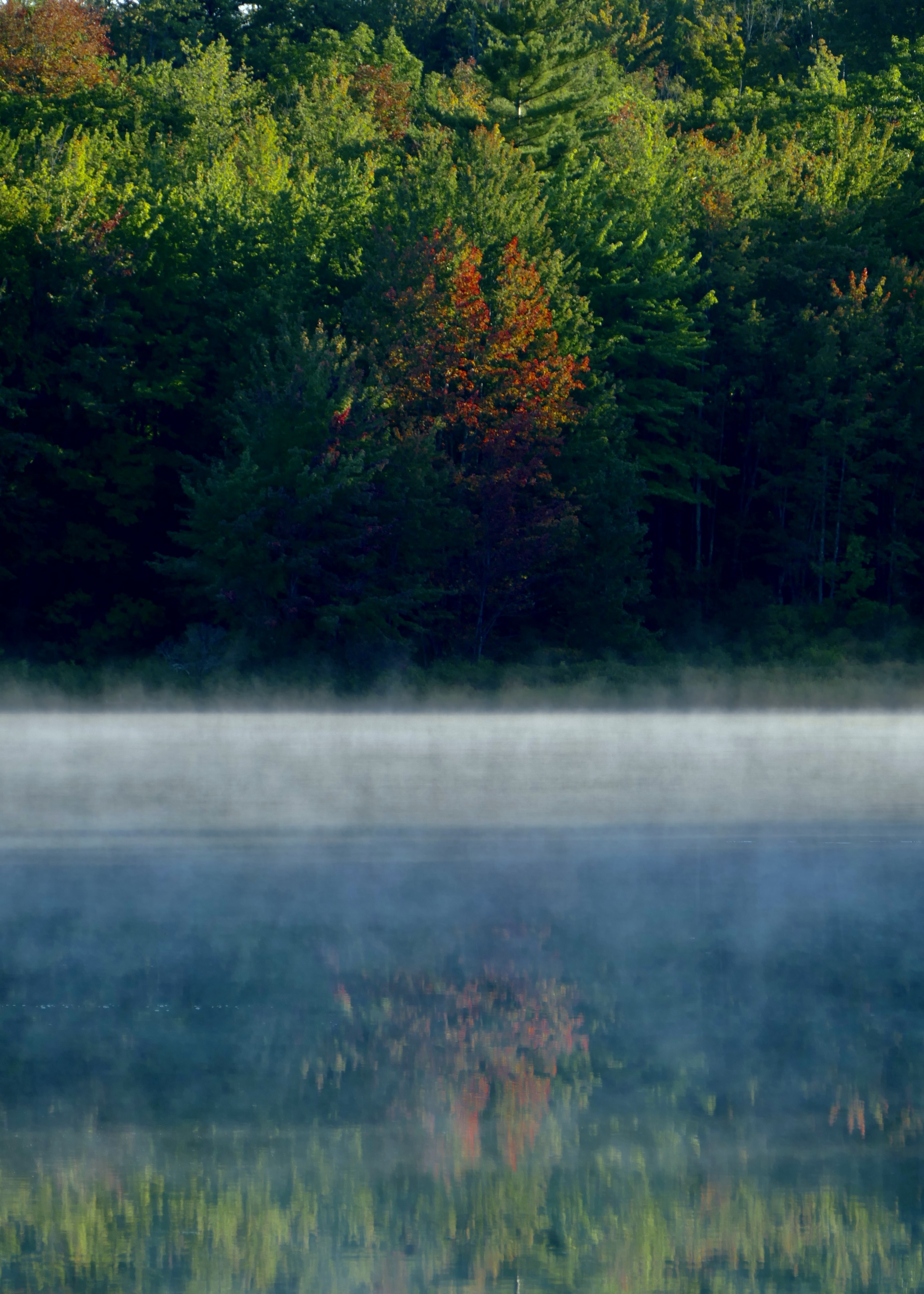
A small red maple has grown, perchance, far away on some moist hillside, a mile from any road, unobserved. It has faithfully discharged the duties of a maple there, all winter and summer, neglected none of its economies, added to its stature in the virtue which belongs to a maple, by a steady growth all summer, and is nearer heaven than it was in the spring, never having gone gadding abroad; and now, in this month of September, when men are turned travellers, hastening to the seaside, or the mountains, or the lakes — in this month of travelling — this modest maple, having ripened its seeds, still without budging an inch, travels on its reputation, runs up its scarlet flag on that hillside, to show that it has finished its summer’s work before all other trees, and withdraws from the contest.
Thus that modest worth which no scrutiny could have detected when it was most industrious, is, by the very tint of its maturity, by its very blushes, revealed at last to the careless and distant observer. It rejoices in its existence; its reflections are unalloyed. It is the day of thanksgiving with it. At last, its labors for the year being fully consummated and every leaf ripened to its full, it flashes out conspicuous to the eye of the most casual observer, with all the virtue and beauty of a maple — Acer rubrum. In its hue is no regret nor pining. Its leaves have been asking their parent from time to time in a whisper, “When shall we redden?” It has faithfully husbanded its sap, and builded without babbling nearer and nearer to heaven. Long since it committed its seeds to the winds and has the satisfaction of knowing perhaps that a thousand little well-behaved maples are already established in business somewhere. It deserves well of Mapledom. It has afforded a shelter to the wandering bird. Its autumnal tint shows how it has spent its summer; it is the hue of its virtue.


 allandibiase.com
You must be logged in to post a comment.