in Thoreau’s Journal:
All sorts of men come to Cattle show— I see one with a blue hat.
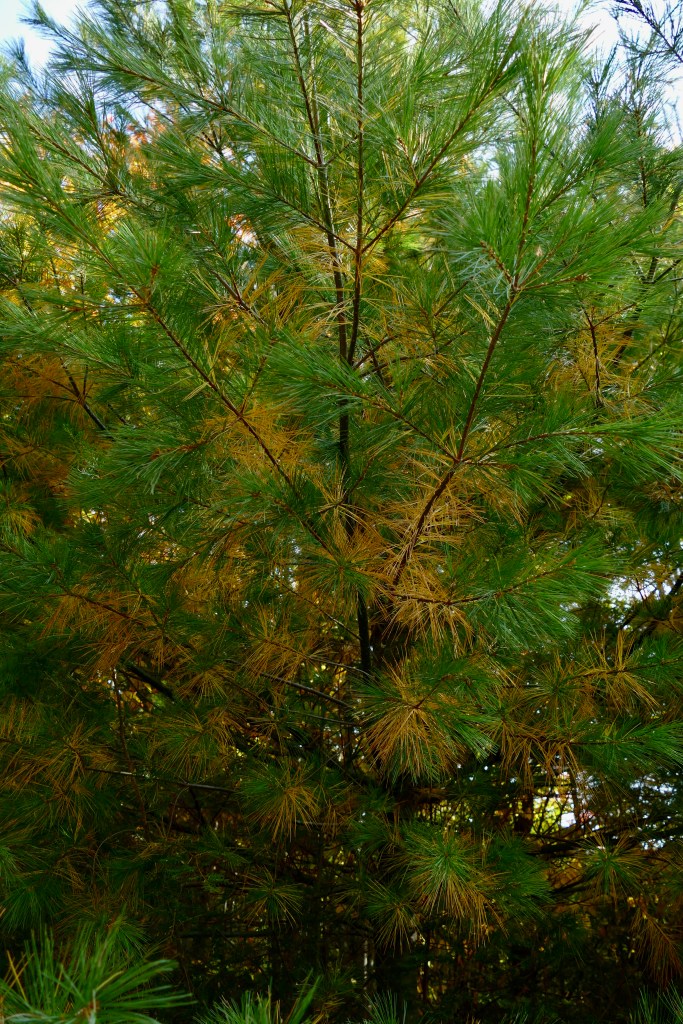
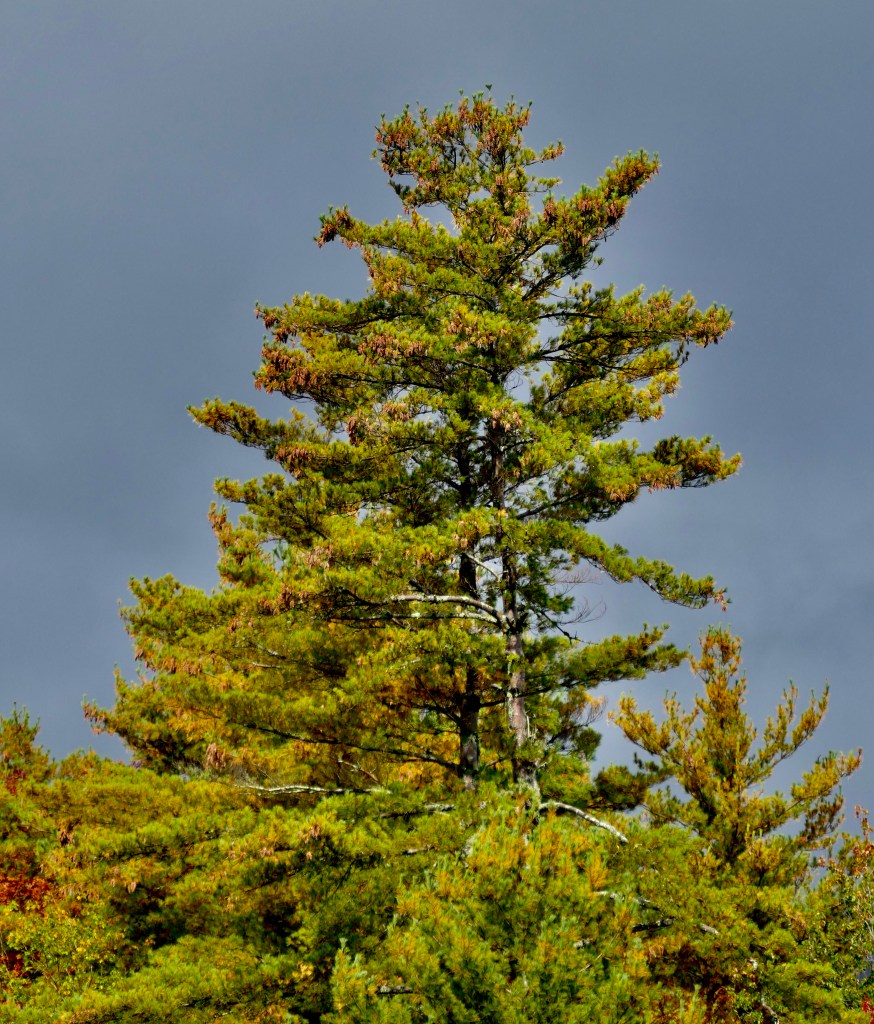
I hear that some have gathered Fringed Gentian. Pines have begun to be particolored with yellow leaves—
in Thoreau’s Journal:
All sorts of men come to Cattle show— I see one with a blue hat.
I hear that some have gathered Fringed Gentian. Pines have begun to be particolored with yellow leaves—
in Thoreau’s Journal:
P. M. – To old mill-site behind Ponkawtasset. Poke berries in the sprout-land east of the red huckleberry still fresh and abundant, perhaps a little past prime. I never saw so many. The plants stand close together, and their drooping racemes three to five inches long, of black or purplish-black berries (ending in red and less [an indecipherable word]), almost crowd one another, hanging around the bright-purple, now for the most part bare, stems.
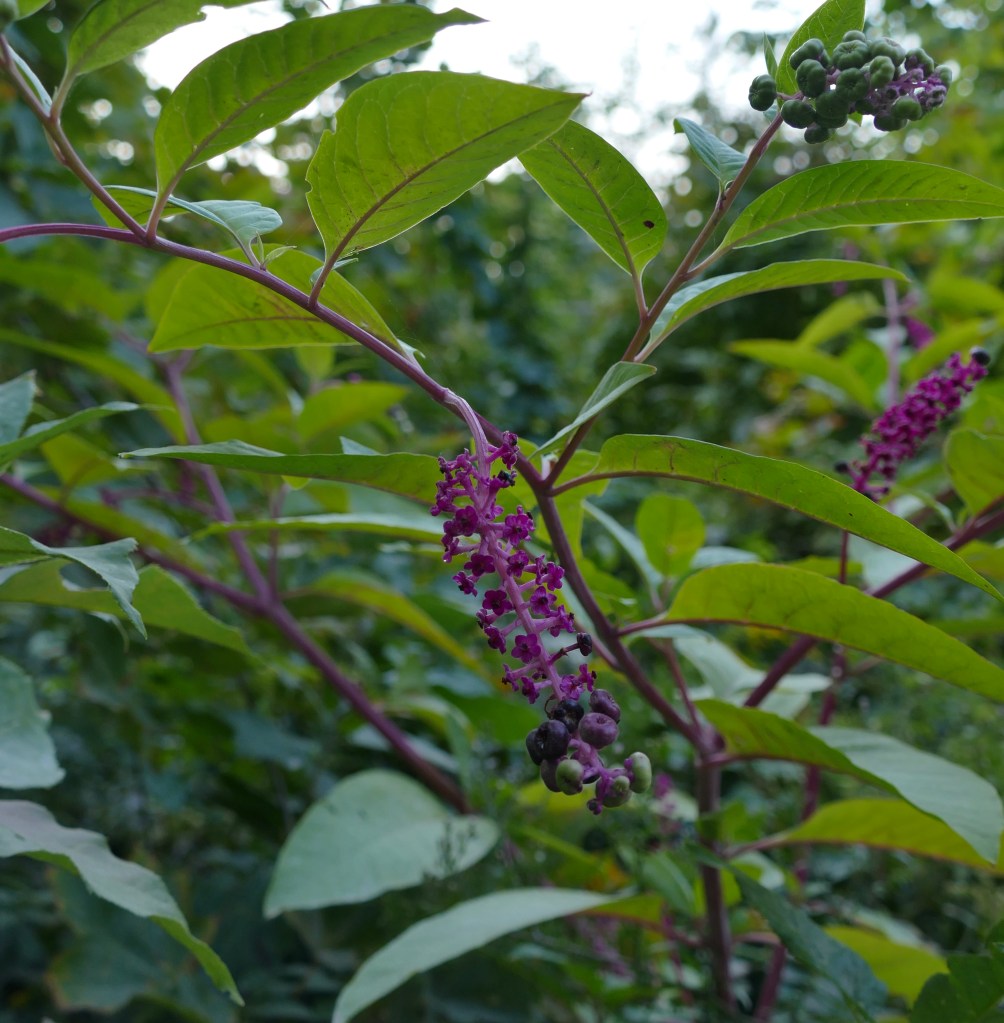
I hear some birds about, but see none feeding on the berries. I could soon gather bushels there. The arum berries are still fresh and abundant, perhaps in their prime. A large cluster is two and a half inches long by two wide and rather flattish. One, which has ripened prematurely, the stalk being withered and drooping, resembles a very short thick ear of scarlet corn. This might well enough be called snake-corn. These singular vermilion-colored berries, about a hundred of them, surmount a purple bag on a peduncle six or eight inches long. It is one of the most remarkable and dazzling, if not the handsomest, fruits we have. These were by violet wood-sorrel wall. How many fruits are scarlet now! – barberries, prinos, etc. A flock of vireo-like, somewhat yellowish birds, very neat, white beneath and olive above, in garden.
in Thoreau’s Journal:
A small red maple has grown, perchance, far away on some moist hillside, a mile from any road, unobserved. It has faithfully discharged the duties of a maple there, all winter and summer, neglected none of its economies, added to its stature in the virtue which belongs to a maple, by a steady growth all summer, and is nearer heaven than it was in the spring, never having gone gadding abroad; and now, in this month of September, when men are turned travellers, hastening to the seaside, or the mountains, or the lakes — in this month of travelling — this modest maple, having ripened its seeds, still without budging an inch, travels on its reputation, runs up its scarlet flag on that hillside, to show that it has finished its summer’s work before all other trees, and withdraws from the contest. Thus that modest worth which no scrutiny could have detected when it was most industrious, is, by the very tint of its maturity, by its very blushes, revealed at last to the careless and distant observer. It rejoices in its existence; its reflections are unalloyed. It is the day of thanksgiving with it. At last, its labors for the year being fully consummated and every leaf ripened to its full, it flashes out conspicuous to the eye of the most casual observer, with all the virtue and beauty of a maple — Acer rubrum. In its hue is no regret nor pining. Its leaves have been asking their parent from time to time in a whisper, “When shall we redden?” It has faithfully husbanded its sap, and builded without babbling nearer and nearer to heaven. Long since it committed its seeds to the winds and has the satisfaction of knowing perhaps that a thousand little well-behaved maples are already established in business somewhere. It deserves well of Mapledom. It has afforded a shelter to the wandering bird. Its autumnal tint shows how it has spent its summer; it is the hue of its virtue.

in Thoreau’s Journal:

Some single red maples are very splendid now––the whole tree bright scarlet––against the cold green pines––now when very few trees are changed a most remarkable object in the landscape. Seen a mile off. It is too fair to be believed––especially seen against the light–– Some are a reddish or else greenish yellow––others with red or yellow cheeks–– I suspect that the yellow maples had not scarlet blossoms.
in Thoreau’s Journal:
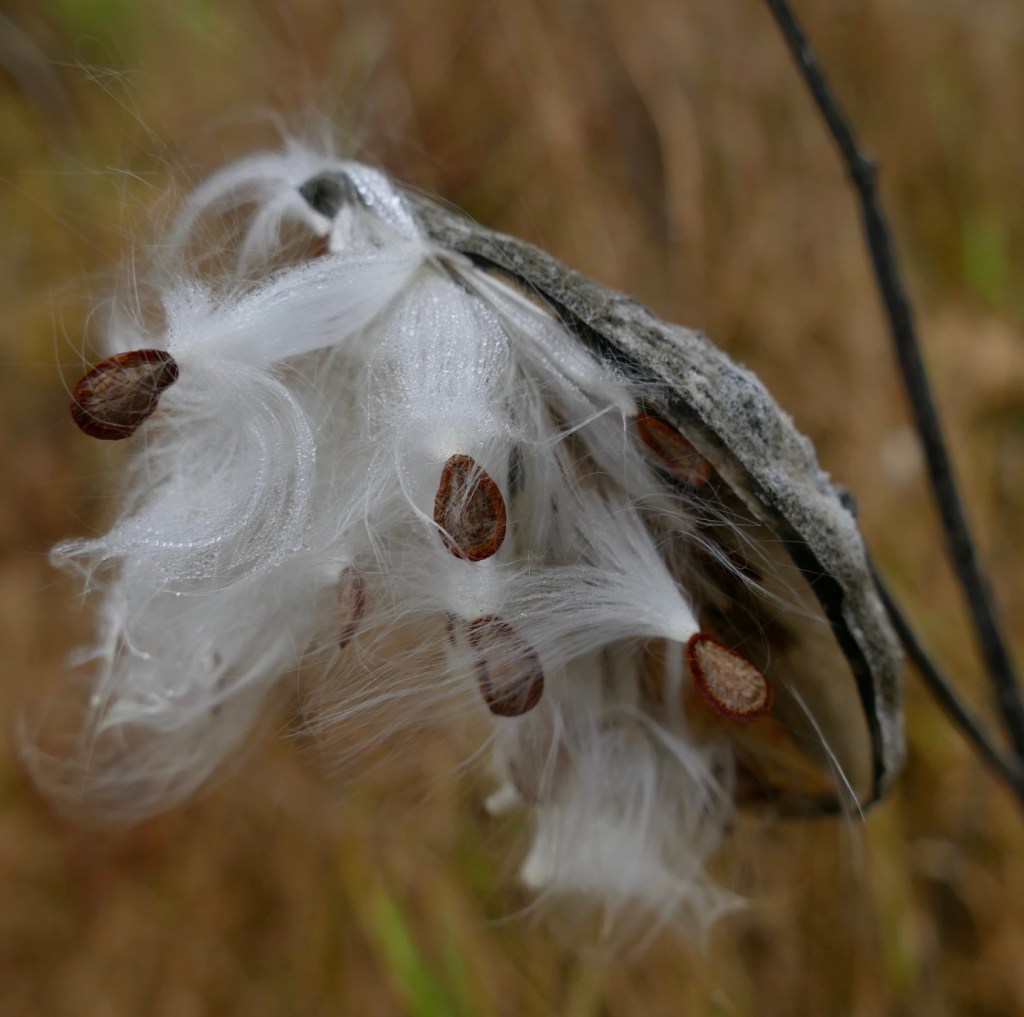
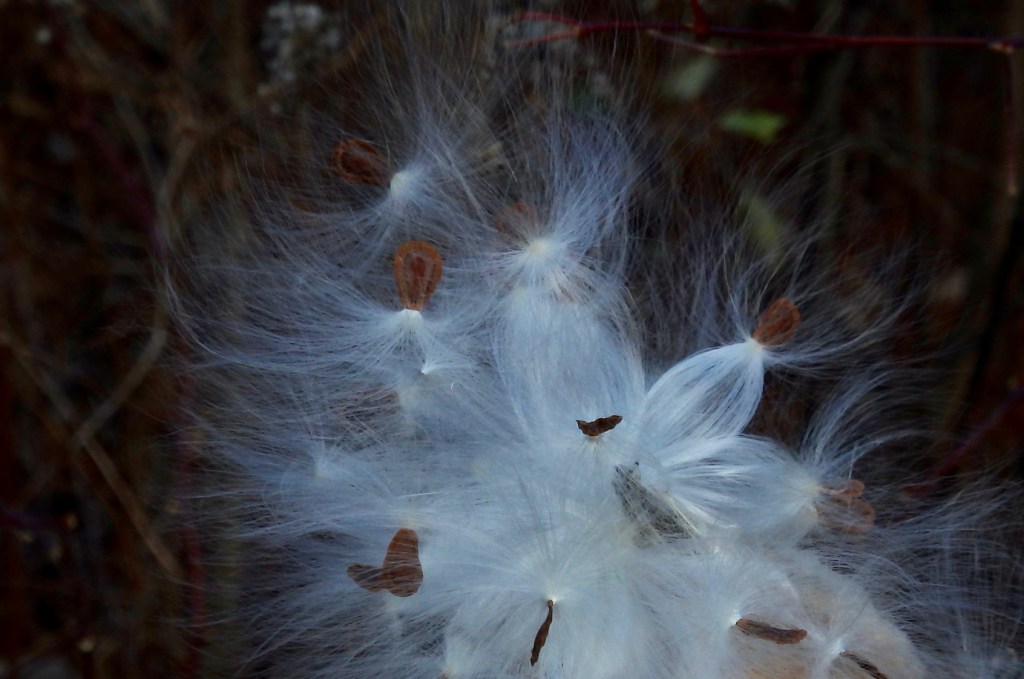
I did not see but the seeds of milkweed would be borne many hundred miles––and those which were ripened in New England might plant themselves in Pennsylvania. Packed in a little oblong chest––armed with soft downy prickles & lined with a smooth silky lining––lie some hundred of pear shaped seeds or shaped like the weight of steel-yards––the plumb. Closely packed and filling the follicle one or 2 hundred seeds––which have derived their nutriment through a band of extremely fine silken threads attached by their extremities to the core. At length when the seeds are matured & cease to require nourishment form the plant––being weaned & the pod with dryness & frost bursting––the extremities of the silken threads detach them selves from the core & from being the conduits of nutriment to the seed become the buoyant balloon which like some spiders’ webs bears the seeds to new & distant fields. They merely serve to buoy up the full fed seed.–– far finer than the finest thread. Think of the great variety of balloons which are buoyed up by similar means. I am interested in the fate or success of every such venture which the autumn sends forth.
in Thoreau’s Journal:
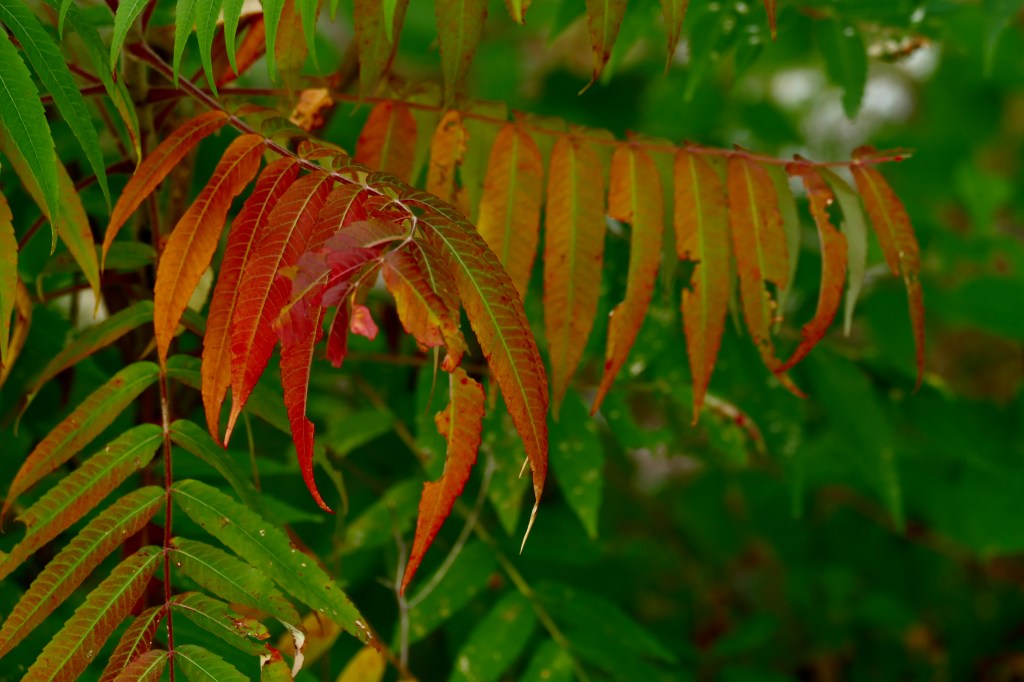
In Cohush Swamp the sumach leaves have turned a very deep red, but have not lost their fragrance. I notice wild apples growing luxuriantly in the midst of the swamp, rising red over the colored, painted leaves of the sumach, and reminding me that they were ripened and colored by the same influences, –some green, some yellow, some red, like the leaves.
in Thoreau’s Journal:

Now look out for redness on the face
of the earth–such as is seen on the cheek of
the sweet viburnum–or as frosty morning
walk imparts to a man’s face– Very brilliant
& remarkable now are the prinos berries–when
so brilliant & pert–when most things
flowers & berries have withered.

I gather pretty good wild pears near the New Road–nowin prime.
The C. sericea bushes along the edge of the great meadows–are
now turned mulberry–& here is an end of its berries then.
The hard frosts of the 21st & 22nd have put an end to several kinds of plants
& prob. berries for this year–
This is the crisis when many kinds conclude their summer–.
in Thoreau’s Journal:
It is a beautifully clear and bracing air with just enough coolness full of the memory of frosty morning––through which all things are distinctly seen & the fields look as smooth as velvet––

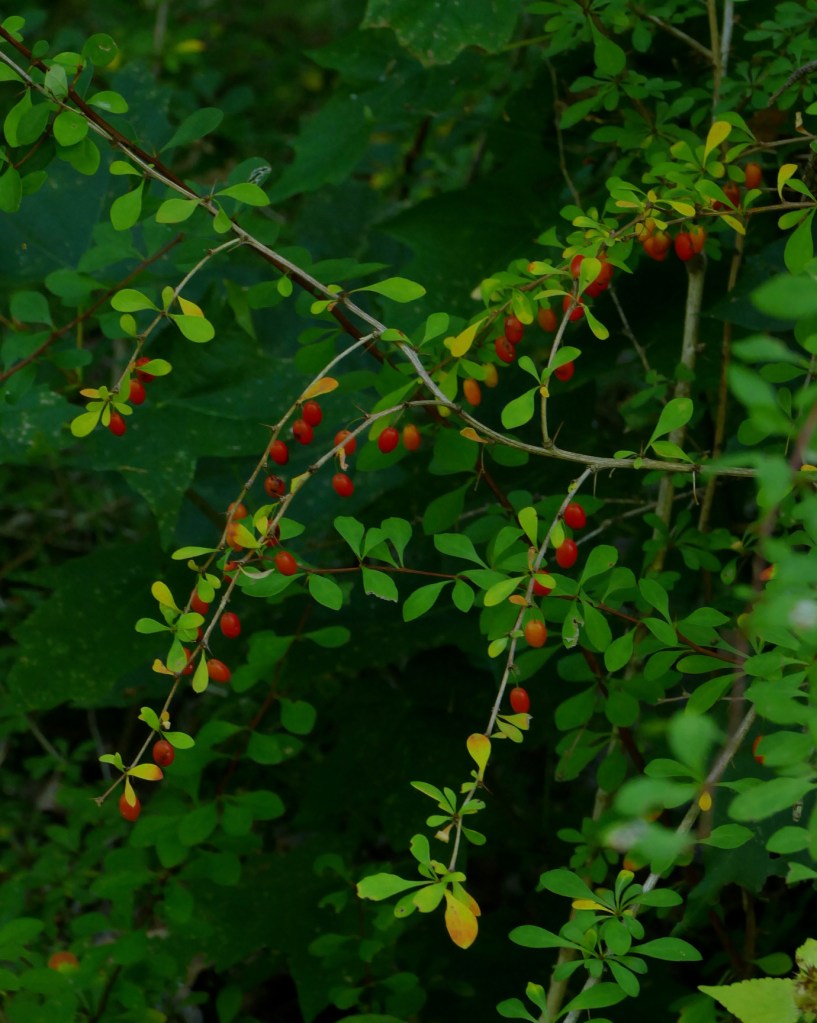
The fragrance of grapes is on the breeze & the red drooping barberries sparkle amid the leaves…
the forests have a singularly rounded & bowery look clothing the hills quite down to the water’s edge & leaving no shore; the Ponds are like drops of dew amid and partly covering the leaves. So the great globe is luxuriously crowded without margin.

in Thoreau’s Journal:

The maples begin to be ripe. How beautiful when a whole maple on the edge of a swamp is like one great scarlet fruit—full of ripe juices— A sign of the ripening—every leaf from lowest limb to topmost spire— is a-glow.
in Thoreau’s Journal:

Not a fish can leap or an insect fall on it but it is reported in lines of beauty—in circling dimples—as it were the constant welling up of its fountain—the gentle pulsing of its life—the heaving of its breast. The thrills of joy & those of pain are indistinguishable. How sweet the phenomena of the lake—! Everything that moves on its surface produces a sparkle. The peaceful Pond!
in Thoreau’s Journal:
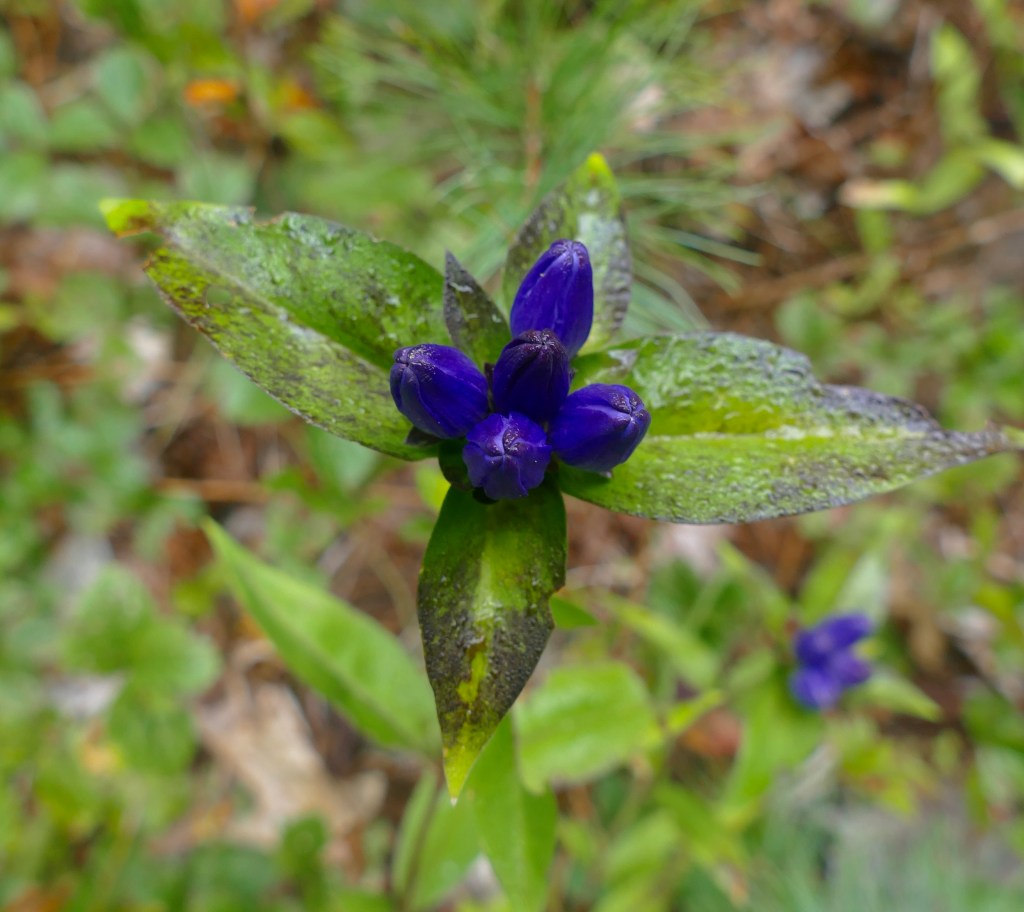
The soapwort gentian cheers & surprises with solid bulbs of blue from the shore—the stale grown purplish. It abounds along the river—after so much has been mown.


in Thoreau’s Journal:
The Prinos berries now quite red. How densely they cover the bushes! very handsome contrasting with the leaves.

in Thoreau’s Journal:
Nature never makes haste; her systems revolve at an even pace. The bud swells imperceptibly, without hurry or confusion, as though the short spring days were an eternity. All her operations seem separately, for the time, the single object for which all things tarry. Why, then, should man hasten as if anything less than eternity were allotted for the least deed? Let him consume never so many æons, so that he go about the meanest task well, though it be but the paring of his nails. If the setting sun seems to hurry him to improve the day while it lasts, the chant of the crickets fails not to reassure him, even-measured as of old, teaching him to take his own time henceforth forever.


in Thoreau’s Journal:
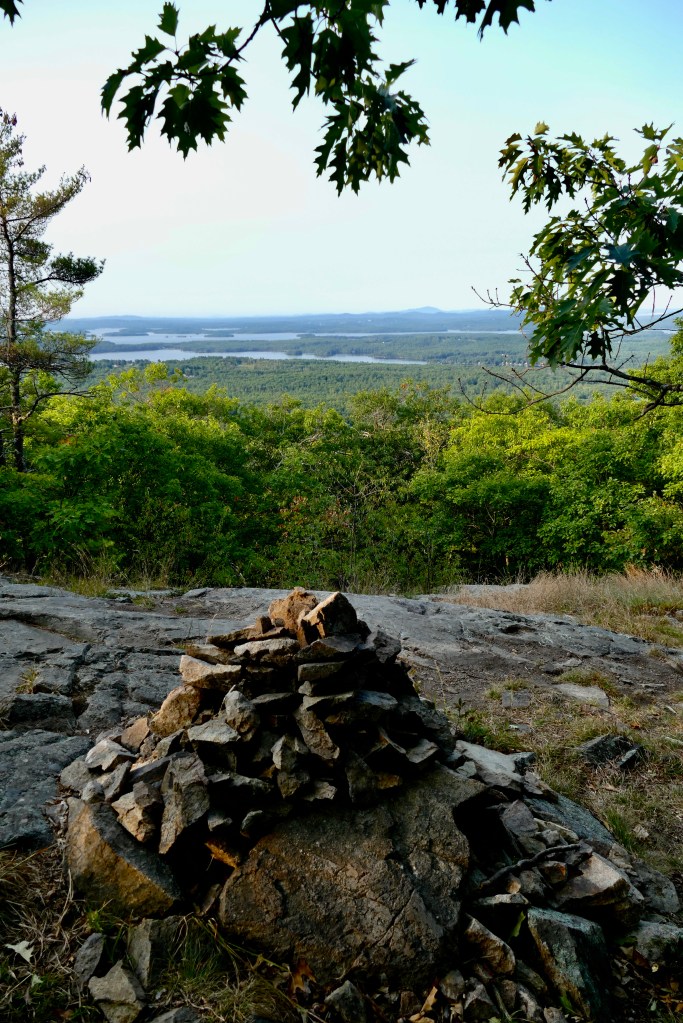
I am invited to take some party of ladies or gentlemen on an excursion, – to walk or sail, or the like, – but by all kinds of evasions I omit it, and am thought to be rude and unaccommodating therefore. They do not consider that the wood-path and the boat are my studio, where I maintain a sacred solitude and cannot admit promiscuous company. I will see them occasionally in an evening or at the table, however. They do not think of taking a child away from its school to go a-huckleberrying with them. Why should not I, then, have my school and school hours to be respected? Ask me for a certain number of dollars if you will, but do not ask me for my afternoons.
in Thoreau’s Journal:
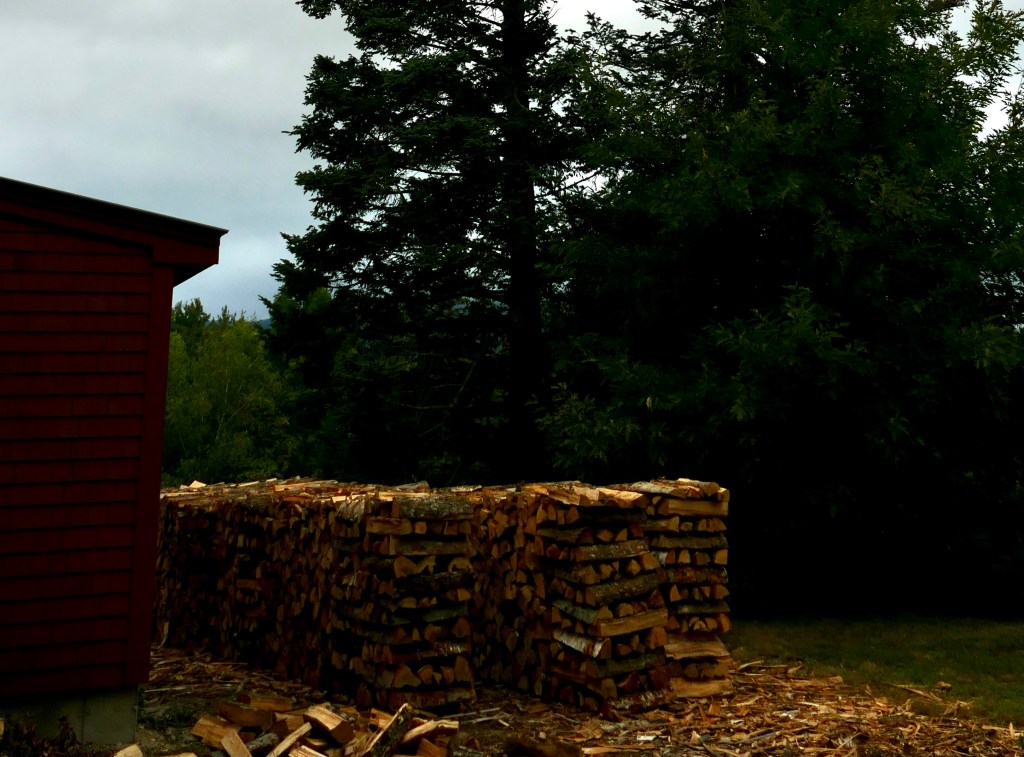
I love to see anything that implies a simpler mode of life and greater nearness to the earth.
in Thoreau’s Journal:
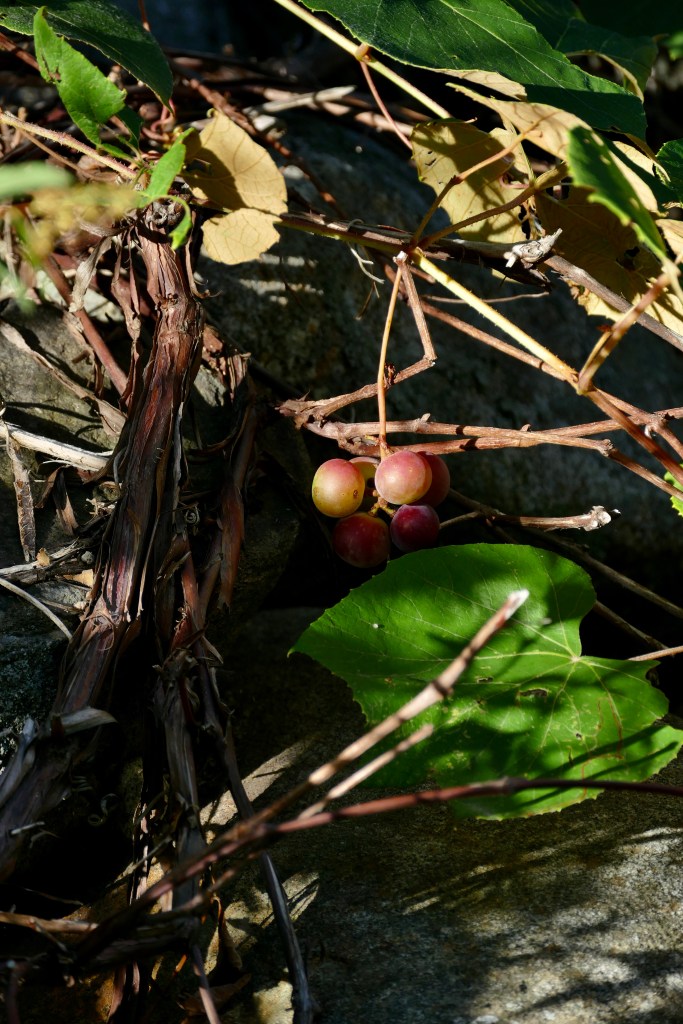
Like the fruits, when cooler weather and frosts arrive, we too are braced and ripened. When we shift from the shady to the sunny side of the house, and sit there in an extra coat for warmth, our green and leafy and pulpy thoughts acquire color and flavor, and perchance a sweet nuttiness at last, worth your cracking.
in Thoreau’s Journal:
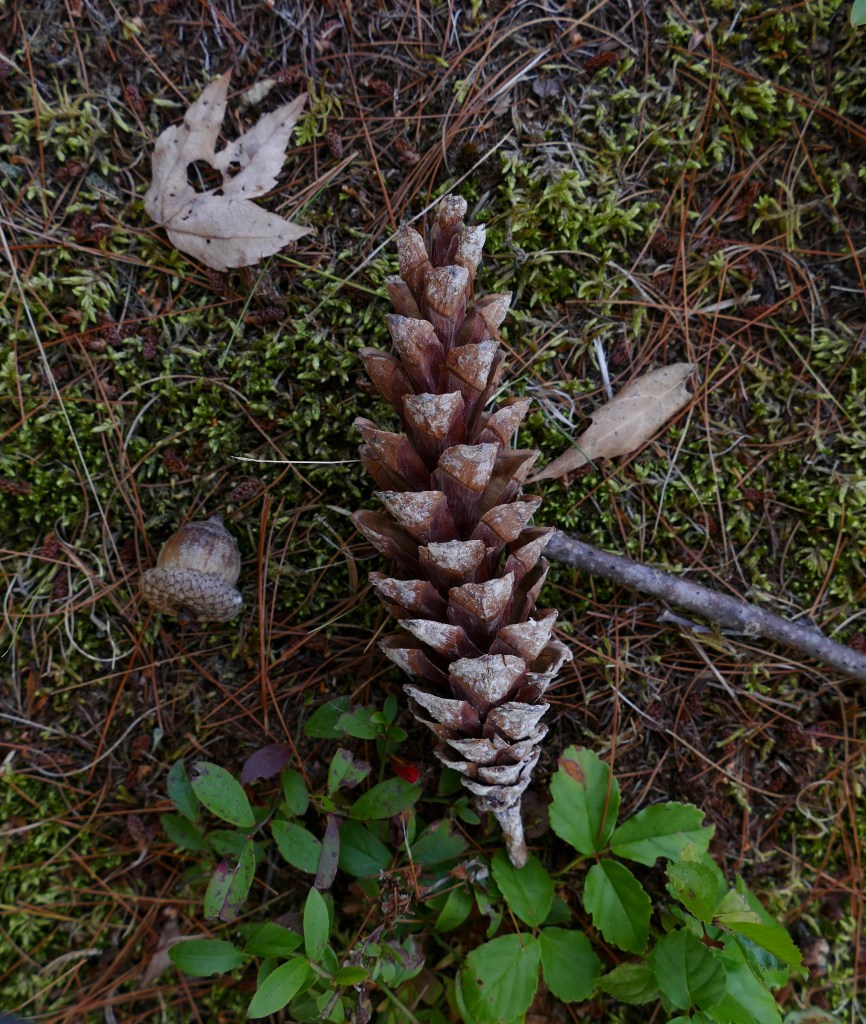
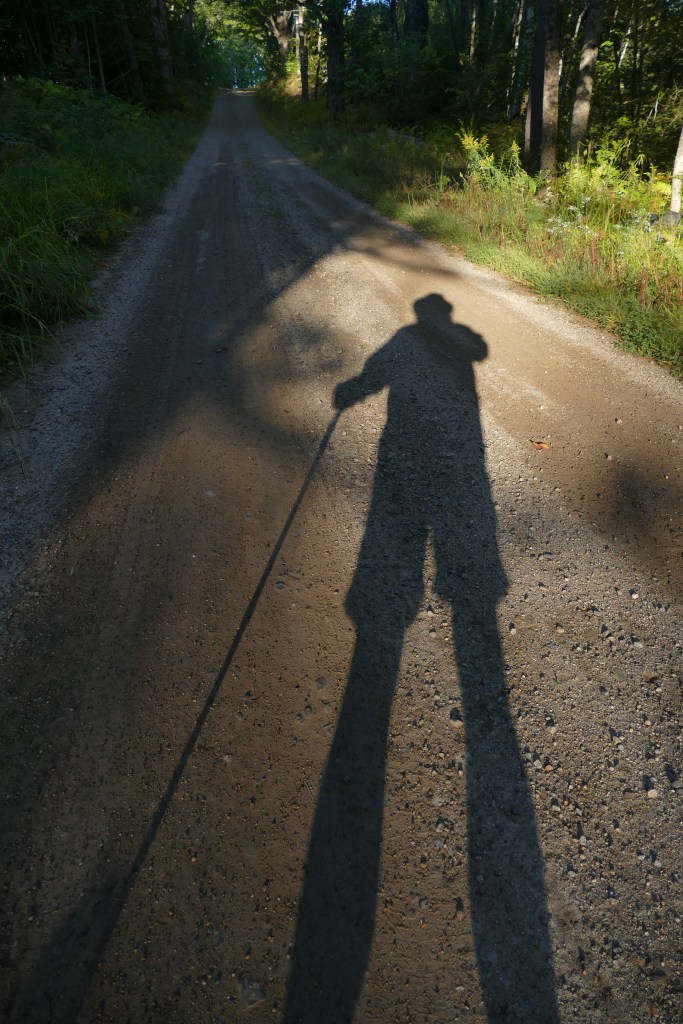
There are various degrees of living out-of-doors. You must be outdoors long, early and late, and travel far and earnestly, in order to perceive the phenomena of the day. Even then much will escape you. Few live so far outdoors as to hear the first geese go over.
in Thoreau’s Journal:

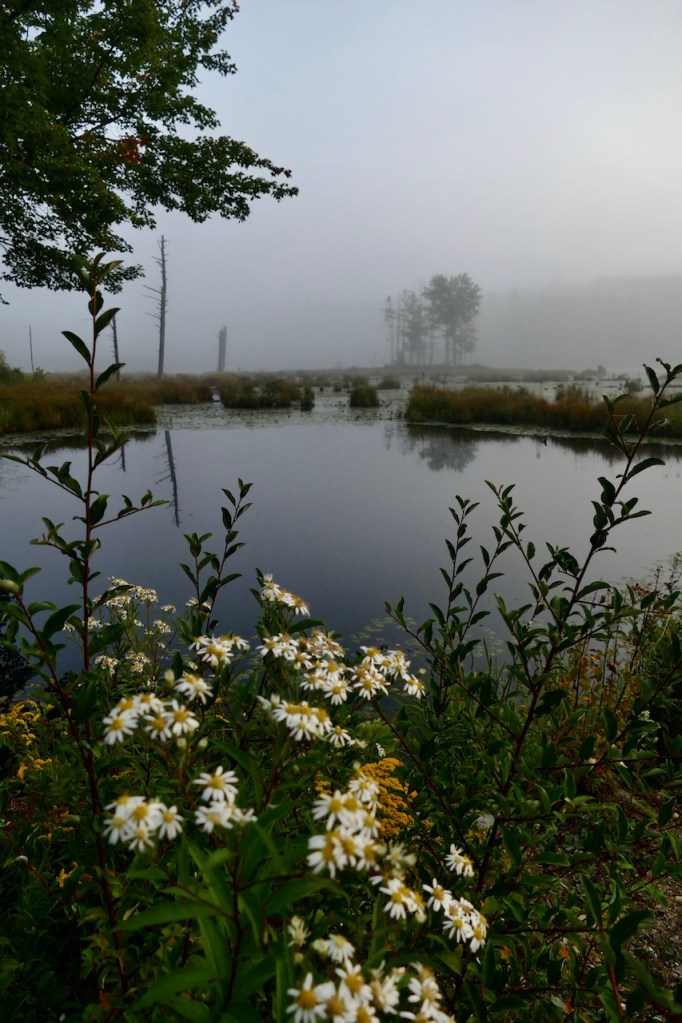
This is the season of fogs.

in Thoreau’s Journal:
The conspicuous & handsome bluish masses of A puniceus erect or fallen stretch in endless rows along the brook — often as high as your head— Sometimes make islands in the meadows.
in Thoreau’s Journal:
If you sit at an open attic window almost anywhere, about the 20th of September, you will see many a milkweed down go sailing by on a level with you, — though commonly it has lost its freight, —notwithstanding that you may not know of any of these plants growing in your neighborhood.


You must be logged in to post a comment.