in Thoreau’s Journal:

It is a record of the mellow and ripe moments that I would keep.
in Thoreau’s Journal:

It is a record of the mellow and ripe moments that I would keep.
in Thoreau’s Journal:
How nicely is nature adjusted. The least disturbance of her equilibrium is betrayed and corrects itself. As I looked down on the surface of the brook, I was surprised to see a leaf floating, as I thought, up stream, but I was mistaken.

The motion of a particle of dust on the surface of any brook far inland shows which way the earth declines toward the sea, which way lies the constantly descending route, and the only one.
in Thoreau’s Journal:
We are tempted to call these the finest days of the year.

Take Fair Haven Pond, for instance, a perfectly level plain of snow, untrodden as yet by any fisherman, surrounded by snow-clad hills, dark evergreen woods, and reddish oak leaves, so pure and still.
in Thoreau’s Journal:
A clump of white pines seen far westward over the shrub-oak plain which is now lit up by the setting sun, a soft feathery grove, with their gray stems indistinctly seen, like human beings come to their cabin door, standing expectant on the edge of the plain, inspires me with a mild humanity. The trees indeed have hearts. The sun seems to send its farewell ray far and level over the copes to them, and they silently receive it with gratitude, like a group of settlers with their children.

The pines impress me as human. A slight vaporous cloud floats high over them, while in the west the sun goes down apace behind glowing pines and golden clouds which like mountains skirt the horizon. Nothing stands up more free from blame in this world than a pine-tree.
in Thoreau’s Journal:

The witch hazel is covered with fruit, and droops over gracefully, like a willow, the yellow foundation of its flowers still remaining.
in Thoreau’s Journal:

Apples are thawed now, and are very good. Their juice is the best kind of bottled cider that I know. They are all good in this state, and your jaws are the cider press.

in Thoreau’s Journal:
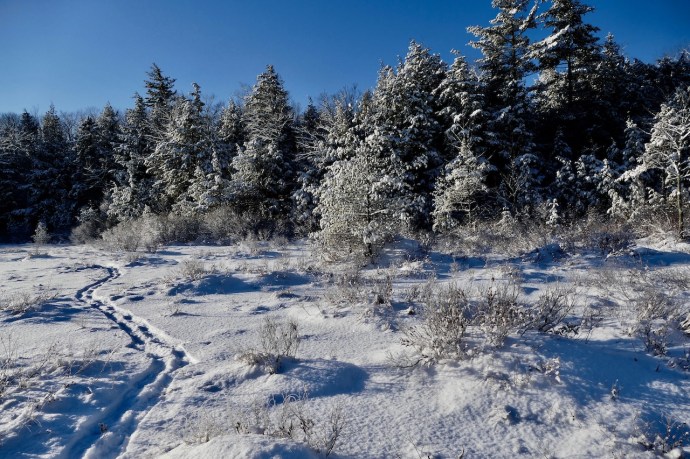
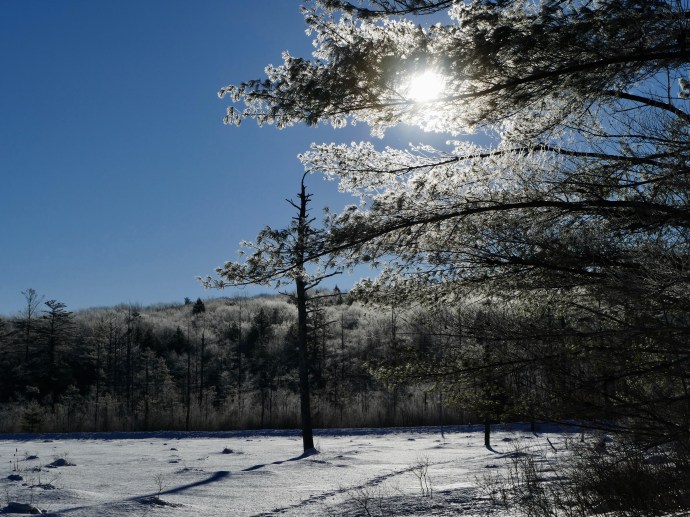
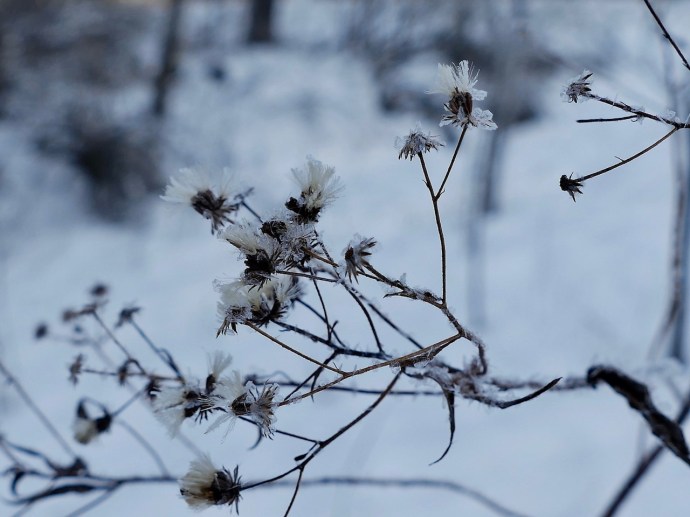
The winter morning is the time to see in perfection the woods and shrubs wearing their snowy and frosty dress. Even he who visits them half an hour after sunrise will have lost some of their most delicate and fleeting beauties.

The trees wear their morning burden but coarsely after midday, and it no longer expresses the character of the tree…the stems and branches of the trees look black by contrast.

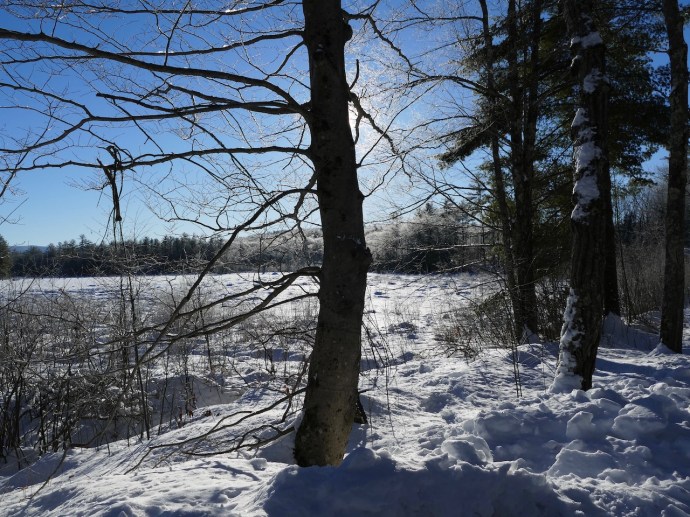
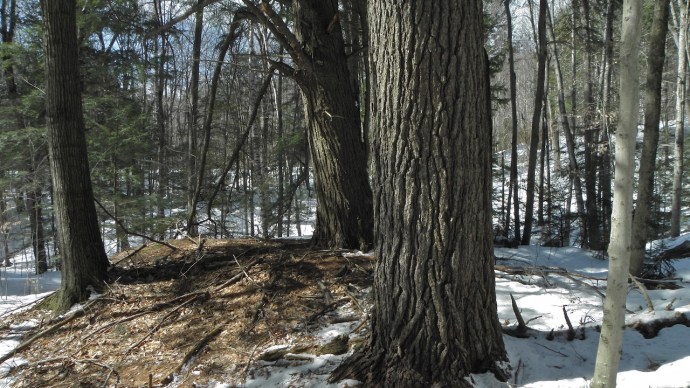
You wander zigzag through the aisles of the woods where stillness and twilight reign. I do not know but a pine woods is as substantial and as memorable a fact as a friend. I am more sure to come away from it cheered than from this who are nearest to being my friends. [note: photos are of spruce trees not pines!]
in Thoreau’s Journal:

Would you be well, see that you are attuned to each mood of nature.
in Thoreau’s Journal:
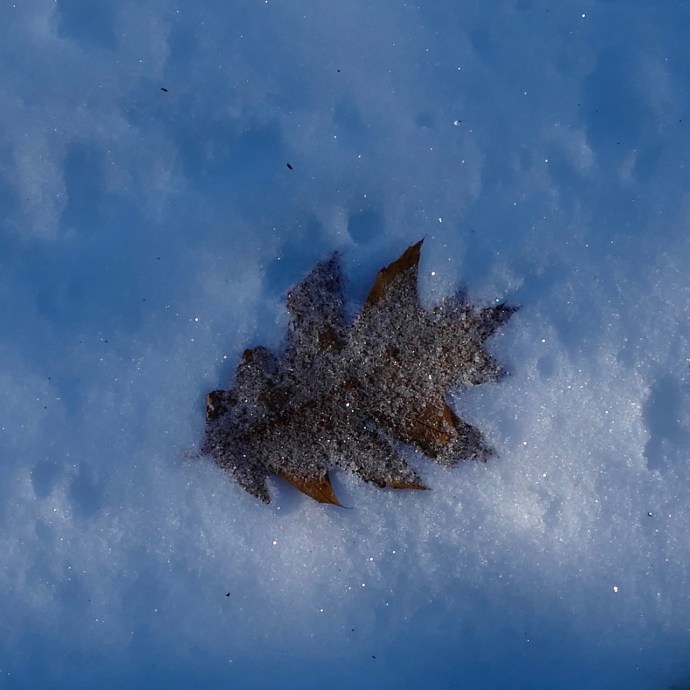
I still recall that characteristic winter evening of December 9th. The cold, dry, and wholesome diet my mind and senses necessarily fed on, —oak leaves, bleached and withered weeds that rose above the snow, the now dark green of the pines, and perchance the faint metallic chip of a single tree sparrow; the hushed stillness of the wood at sundown, aye, all the winter day, the short boreal twilight, the smooth serenity and reflections of the pond, still alone free from ice; the melodious hooting of the owl, heard at the same time with the yet more distant whistle of a locomotive, more aboriginal, and perchance more enduring here than that, heard above all the voices of Concord, as if they were not, the last strokes of the woodchopper (how little he is Anglicized!) who presently bends his steps homeward; the gilded bar of cloud across the apparent outlet of the pond, conducting my thoughts into the eternal west, the deepening horizon glow, and the hasty walk homeward to enjoy the long winter evening.

The hooting of the owl; that is a sound which my red predecessors heard here more than a thousand years ago it rings far and wide, occupying the space rightfully, — grand, primeval, aboriginal sound. There is no whisper in it of the Bulkeleys, the Flints, the Hosmers, who recently squatted here, nor of the first parish, nor of Concord Fight, nor of the last town-meeting.
in Thoreau’s Journal:

Ah, who can tell the serenity and clarity of a New England winter sunset? This could not be till the cold and the snow came. What isles those western clouds, in what a sea!
in Thoreau’s Journal:

December 12, 2018 Photo
My first true winter walk is perhaps that which I take on the river, or where I cannot go in the summer. It is the walk peculiar to winter, and now first I take it. I see that the fox has already taken the same walk before me, just along the edge of the button-bushes where not even he can go in the summer. We both turn our steps hither at the same time.

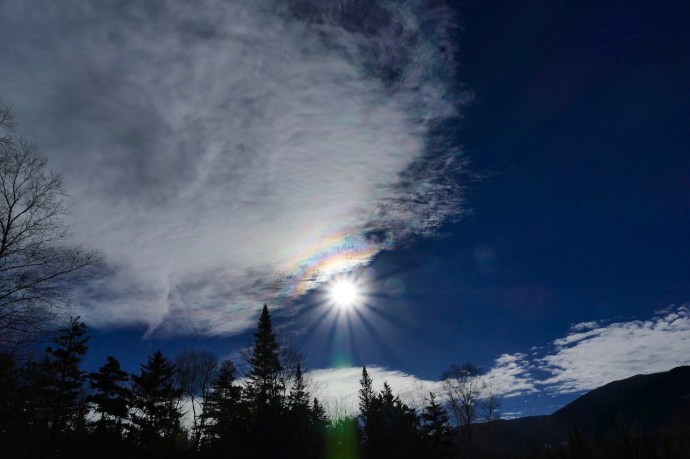
Now at 2:30 P.M., the melon-rind arrangement of the clouds, really parallel columns of fine mackerel sky reaching quite across the heavens from west to east with clear intervals of blue sky; and a fine-grained vapor like spun glass extending in the same direction beneath the former. In half an hour, all the mackerel sky is gone. What an ever-changing scene is the sky, its drifting cirrus and stratus!
in Thoreau’s Journal:

My last stronghold is the forest.
in Thoreau’s Journal:
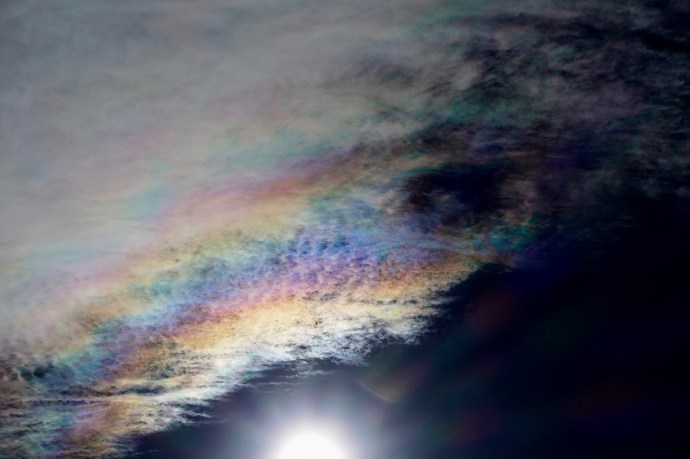
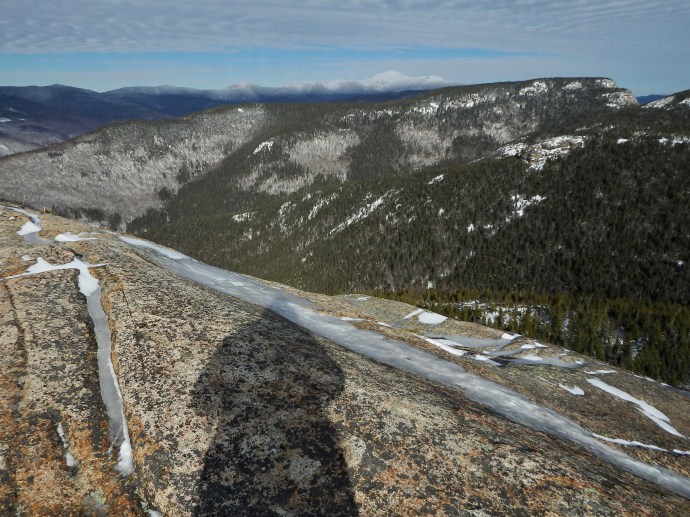
The winter with its snow and ice is not an evil to be corrected…..To perceive freshly, with fresh senses, is to be inspired. Great winter itself looked like a precious gem reflecting rainbow colors from one angle. My body is all sentient. As I go here or there, I am tickled by this or that I come into contact with, as if I touched the wires of a battery. I can generally recall, have fresh in my mind, several scratches last received. These I continually recall to mind, reimpress and harp upon. The age of miracles is each moment thus returned; now it is wild apples, now river reflections, now a flock of lesser red-polls. In winter, too, resides immortal youth and perennial summer….

What if we could daguerreotype our thoughts and feelings !
in Thoreau’s Journal:
Another still more glorious day, if possible. Indian summer, even. These are among the finest days in the year, on account of the wholesome bracing coolness and clearness. Paddled up Assabet.

Passed in some places between shooting ice crystals extending from both sides of the stream.
in Thoreau’s Journal:

A few petals of the witch-hazel still hold on.

in Thoreau’s Journal:
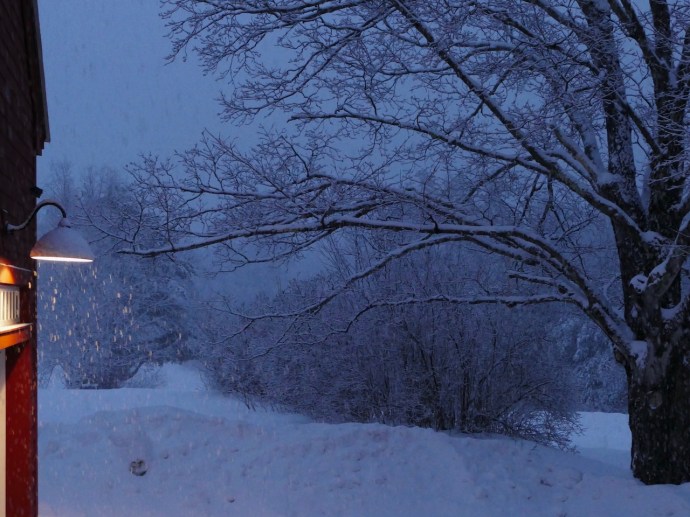
It snowed in the night of the 6th and the ground is now covered. our first snow 2 inches deep A week ago I saw cows being driven home from pasture— Now they are kept at home. Here’s an end to their grazing.

The farmer improves this first light snow to accomplish some pressing jobs—to move some particular rocks on a drag, or the like— I perceive how quickly he has seized the opportunity.

I see no tracks now of cows or men or boys beyond the edge of the wood—suddenly they are shut up—the remote pastures & hills beyond the woods are now closed to cows & cowherds aye & to cowards I am struck by this sudden solitude & remoteness which these places have acquired. The dear privacy & retirement & solitude which winter makes possible—carpeting the earth with snow, furnishing more than woolen feet to all walkers, crounching the snow only.

From Fair Haven I see the hills & fields aye & the icy woods in the Corner shine gleam with the dear old wintery sheen. Those are not surely the cottages I have seen all summer. They are some cottages which I have in my mind.
in Thoreau’s Journal:
That grand old poem called Winter is round again without any connivance of mine. As I sit under Lee’s Cliff, where the snow is melted, amid sere pennyroyal and frostbitten catnip, I look over my shoulder upon an arctic scene, and see with surprise the pond, a dumb white surface of ice speckled with snow, just as so many winters before, where so lately were lapsing waves or smooth, reflecting water….

It seemed as if winter had come without any interval since midsummer…
in Thoreau’s Journal:
On all sides in swamps and about their edges, and in the woods, the bare shrubs are sprinkled with buds more or less noticeable and pretty, their little gemmae or gems their most vital and attractive parts now, almost all the greenness and color left, greens and salads for the birds and rabbits. Our eyes go searching along the stem for what is most vivacious and characteristic, the concentrated summer gone into winter quarters.

For we are hunters pursuing the summer on snow-shoes and skates all winter long, and there is really but one season in our hearts.
in Thoreau’s Journal:
Many living leaves are very dark red now the only effect of the frost on them—the checker-berry—Andromeda—low cedar and more or less lambkill—&c. Saw & heard a downy woodpecker on an apple tree—have not many winter birds, like this & the chickadee, a sharp note like tinkling glass or icicles — The chip of the tree-sparrow also & whistle of the shrike is not wintry in the same way?—& The sonorous hooting owl— But not so the jay & E. Linaria —& still less the crow. Now for the short days & early twilight—in which I hear the sound of wood chopping.
The sun goes down behind a low cloud & the world is darkened—the partridge is budding on the apple tree—& burst away from the pathside. Fair Haven pond is skimmed completely over— The ground has been frozen more or less—about a week—not very hard….

Before I got home the whole atmosphere was suddenly filled with a mellow yellowish light equally diffused—so that it seemed much lighter around me than immediately after the sun sank behind the horizon cloud 15 minutes before. — Apparently not till the sun had sunk thus far did I stand in the angle of reflection.
in Thoreau’s Journal:

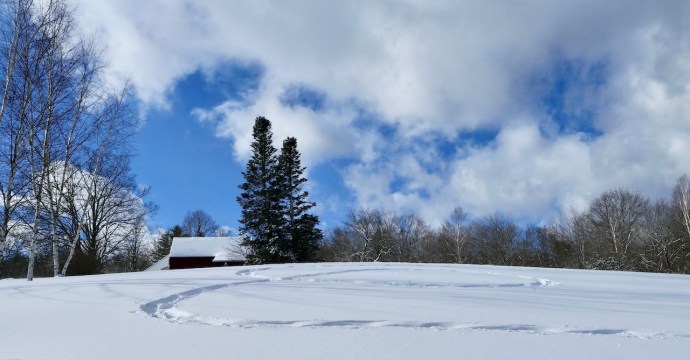
Awake to winter, and snow two or three inches deep, the first of any consequence.
You must be logged in to post a comment.