in Thoreau’s Journal:
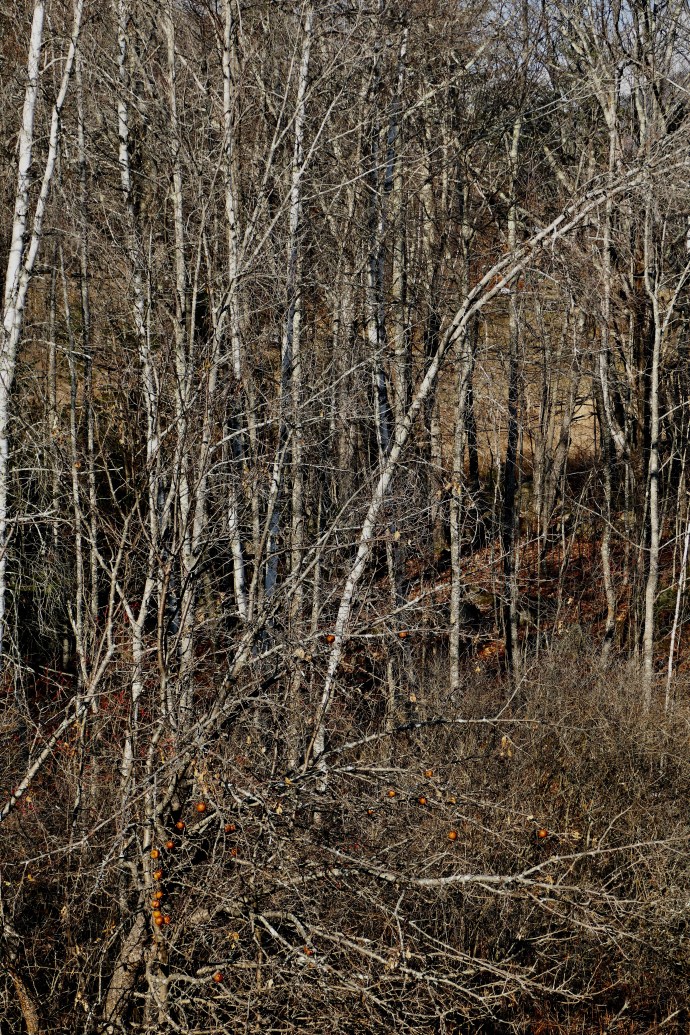
Rain and wind, bringing down the leaves and destroying the little remaining brilliancy.

October 30, 2017
in Thoreau’s Journal:
Rain and wind, bringing down the leaves and destroying the little remaining brilliancy.

October 30, 2017
in Thoreau’s Journal:

The thickly fallen leaves make it slippery in the woods, especially climbing hills….

in Thoreau’s Journal:
4 months of the green leaf make all our summer, if I reckon from June 1st to Oct 1st—the growing season & methinks there are about 4 months when the ground is white with snow That would leave two months for Spring & 2 for autumn. October the month of ripe or painted leaves—Nov. perchance the month of withered leaves.

in Thoreau’s Journal:

This morning I awoke and found it snowing and the ground covered with snow….
in Thoreau’s Journal:
Everything beautiful impresses us as sufficient to itself.

It is surprising how any reminiscence of a different season of the year affects us. When I meet with any such in my Journal, it affects me as poetry, and I appreciate that other season and that particular phenomenon more than at the time. The world so seen is all one spring, and full of beauty. You only need to make a faithful record of an average summer day’s experience and summer mood, and read it in the winter, and it will carry you back to more than that summer day alone could show.

Only the rarest flower, the purest melody, of the season thus comes down to us.
in Thoreau’s Journal:

Some small husky white asters still survive.
in Thoreau’s Journal:

Every part of nature teaches that the passing away of one life is the making room for another.
in Thoreau’s Journal:

The milkweed now rapidly discounting. The lanceolate pods having opened, the seeds spring out on the least jar, or when dried by the sun and form a little fluctuating white silky mass or tuft, each held by a fine thread until a stronger puff of wind sets them free.

It is pleasant to see the plant thus dispersing its seeds.
in Thoreau’s Journal:

I look up northwest to my mountains, as a farmer to his hill-lot or rocky pasture from his door…. My eyes it is alone that wander to these blue pastures which no drought affects. I am content to dwell here and see the sun go down behind my mountain fence.
in Thoreau’s Journal:

Now again as in the spring we begin to look for sheltered and sunny places where we may sit.
in Thoreau’s Journal:
The clouds have lifted in the northwest, and I see the mountains in sunshine (all the more attractive from the cold I feel here), with a tinge of purple on them, —a cold, but memorable and glorious outline. This is an advantage of mountains in the horizon; they show you fair weather from the midst of foul.

October 19, 2017
in Thoreau’s Journal:

The leaves have fallen so plentifully that they quite conceal the water along the shore….
in Thoreau’s Journal:

How much beauty in decay!
in Thoreau’s Journal:

I think the reflections are never purer and more distinct than now at the season of the fall of the leaf, just before the cool twilight has come, when the air has a finer grain, just as our mental reflections are more distinct at this season of the year when the evenings grow cool and lengthen, and our winter evenings with their brighter fires may be said to begin.
in Thoreau’s Journal:
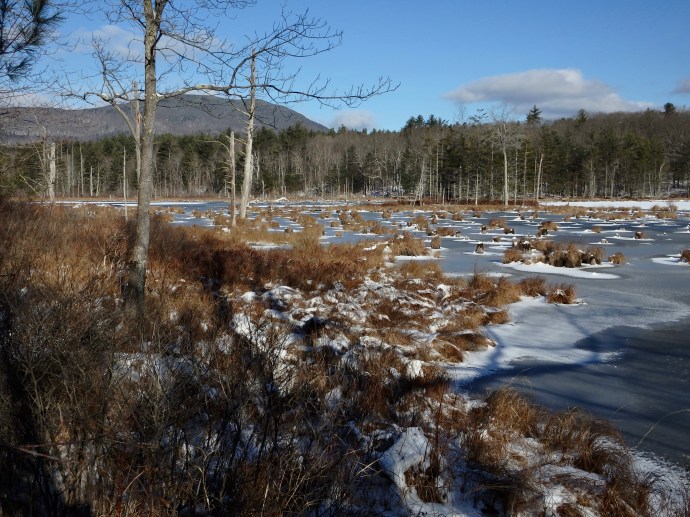
This clear, cold, Novemberish light is inspiriting. Some twigs which are bare, and weeds, begin to glitter with hoary light.

The very edge or outline of a tawny or russet hill has this hoary light on it. Your thoughts sparkle like the water surface and the downy twigs. From the shore you look back on the silver-plated river.
in Thoreau’s Journal:

Walked across half a mile to Pelham’s Pond. whose waves were dashing quite grandly. A house near with two grand elms in front —
in Thoreau’s Journal:
1856: Any flowers seen now may be called late ones. I see perfectly fresh succory, not to speak of yarrow….

1857: I take these walks to every point of the compass, and it is always harvest time with me. I am always gathering my crop from these woods and fields and waters, and no man is in my way, or interferes with me. My crop is not their crop. To-day I see them getting in their beans and corn, and they are a spectacle to me, but are soon out of my sight. I go abroad over the land each day to get the best I can find, and that is never carted off, even to the last day of November.
in Thoreau’s Journal:
Fair Haven Pond never, I think, looks so handsome as at this season. It is a sufficiently clear and warm, a rather Indian summer day, and they are gathering the apples in the orchard. The warmth is required now, and we welcome and appreciate it all. The chickadee takes heart too, and sings above these warm rocks. Birches, hickories, aspens, etc., are like innumerable small flames on the hillsides about the pond, which is now most beautifully framed with the autumn-tinted woods and hills.

The water or lake, from however distant a point seen, is always the center of the landscape. Fair Haven lies more open, and can be seen from more distant points than any other of our ponds. The air is singularly fine-grained, the sward looks short and firm. The mountains are more distinct from the rest of the earth and slightly impurpled, seeming to lie up more. How peaceful great nature! There is no disturbing sound….
in Thoreau’s Journal:

I love very well this cloudy afternoon, so sober and favorable to reflection, after so many bright ones.
in Thoreau’s Journal:
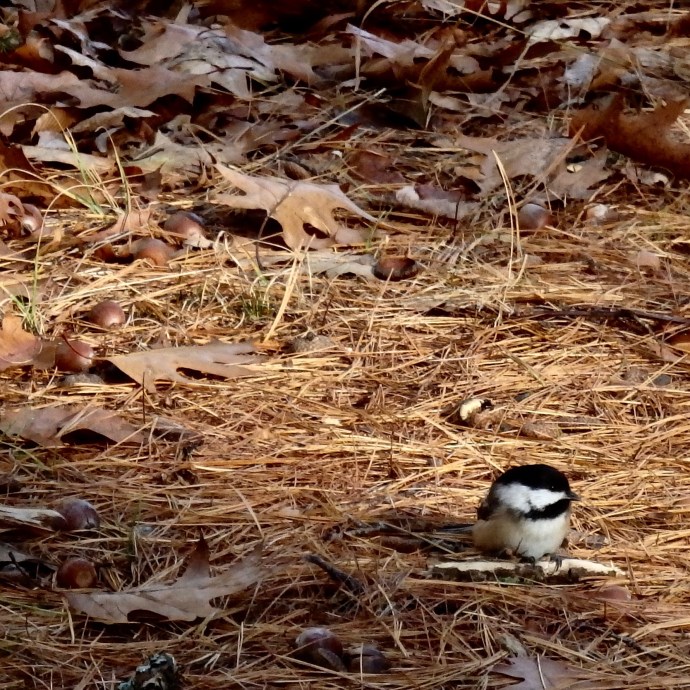
The note of the chickadee heard now in cooler weather above many fallen leaves, has a new significance.
There was a very severe frost this morning;

ground stiffened, probably a chestnut-opening frost, a season ripeness, opener of the burrs that contain the Indian Summer. Such is the cold of early or mid- October. The leaves and weeds had a stiff, hoary appearance.
You must be logged in to post a comment.