June 26, 1852

in Thoreau’s Journal:

Just so much beauty and virtue as there is in the world, and just so much ugliness and vice, you see expressed in flowers. 

Each human being has his flower which expresses his character.  In them nothing is concealed, but everything published. 

June 24, 1852

in Thoreau’s Journal:

The Linnaea borealis [twin-flower] just going out of bloom.  I should have found it long ago. Its leaves densely cover the ground.

June 23, 1852

in Thoreau’s Journal:

The pretty little Mitchella repens with its twin flowers spots the ground under the pines with its downy petalled cross shaped flowers & its purplish buds.

OLYMPUS DIGITAL CAMERA

June 21, 1857

in Thoreau’s Journal:

That solitude was sweet to me as a flower.

I sat down on the boundless level and enjoyed the solitude, drank it in, the medicine for which I had pined… 

June 19, 1852

in Thoreau’s Journal:

What subtle differences between one season and another! The warmest weather has, perchance, arrived and the longest days, but not the driest.

When I remember gathering ripe blackberries on sandy fields or stones by the roadside, the very berries warmed by the sun, I am convinced of this. The seasons admit of infinite degrees in their revolutions.  Found one of the purple orchises in an open meadow.

June 18, 1860

in Thoreau’s Journal:

I see in the southerly bays of Walden the pine pollen now washed up thickly; only at the bottom of the bays, especially the deep long bay, where it is a couple of rods long by six to twenty-four inches wide and one inch deep; pure sulphur-yellow, and now has no smell. It has come quite across the pond from where the pines stand, full half a mile, probably washed across most of the way.

June 16, 1852

in Thoreau’s Journal:

Paddle from the ash tree to the swimming-place. The further shore is crowded with polygonums (leaves) and pontederia leaves. There seems to have intervened no night. The heat of the day is unabated. You perspire before sunrise. The bullfrogs boom still. The river appears covered with an almost imperceptible blue film. The sun is not yet over the bank. What wealth in a stagnant river! There is music in every sound in the morning atmosphere. As I look up over the bay, I see the reflections of the meadow woods and the Hosmer hill at a distance, the tops of the trees cut off by a slight ripple. Even the fine grasses on the near bank are distinctly reflected. Owing to the reflections of the distant woods and hills, you seem to be paddling into a vast hollow country, doubly novel and interesting. Thus the voyageur is lured onward to fresh pastures.  The melting heat begins again as soon as the sun gets up. My shoes are covered with the reddish seeds of the grass, for I have been walking in the dew. I hear a stake-driver, like a man at his pump, which sucks, — fit sound for our sluggish river. What is the devil’s-needle about? He hovers about a foot above the pads on humming wings thus early, from time to time darting one side as if in pursuit of some invisible prey. Most would suppose the stake-driver the sound of a farmer at a distance at his pump, watering his cattle. It oftener sounds like this than like a stake, but sometimes exactly like a man driving a stake in the meadow. Mistook a crow blackbird, on a dark-brown rock rising out of the water, for a crow or a bittern, referring it to a greater distance than the actual, by some mirage. It had a boat tail, conspicuous when it flew. The bullfrogs lie on the very surface of the pads, showing their great yellow throats, color of the yellow breeches of the old school, and protuberant eyes. His whole back out, revealing a vast expanse of belly. His eyes like ranunculus or yellow lily buds, winking from time to time and showing his large dark-bordered tympanum. Imperturbable-looking. His yellow throat swells up like a small moon at a distance over the pads when he croaks. The floating pondweed (Potamogeton natans), with the oblong oval leaf floating on the surface, now in bloom. The yellow water ranunculus still yellows the river in the middle, where shallow, in beds many rods long. It is one of the capillary-leaved plants.

June 15, 1840

in Thoreau’s Journal:

I stood by the river to-day considering the forms of the elms reflected in the water. For every oak and birch, too, growing on the hilltop, as well as for elms and willows, there is a graceful ethereal tree making down from the roots, as it were the original idea of the tree, and sometimes Nature in high tides brings her mirror to its foot and makes it visible.  Anxious Nature sometimes reflects from pools and puddles the objects which our grovelling senses may fail to see relieved against the sky with the pure ether for background.

June 14, 1853

in Thoreau’s Journal:

Went through the woods along the old Canal to Haynes’ Pasture from the height of which we looked down on the rich New-Hampshire wood we had come out of––the ground rising within the wood gave it the appearance of woods rising by successive stages from a smaller growth on the edge to stately trees in the middle.  & Nobscot was seen in the S.W. through the blue furnace mist. This seems the true hour to be abroad sauntering far from home–– Your thoughts being already turned toward home––your walk in one sense ended–– You are in that favorable frame of mind described by De Quincy, open to great impressions––& you see those rare sights with the unconscious side of the eye––which you could not see by a direct gaze before––

Then the dews begin to descend in your mind & its atmosphere is strained of all impurities –– And home is farther away than ever––here is home ––the beauty of the world impresses you–– There is a coolness in your mind as in a well–– Life is too grand for supper.––  The wood-thrush launches forth his evening strains from the midst of the pines. I admire the moderation of this master–– There is nothing tumultuous in his song––he launches forth one strain with all his heart & life & soul––of pure & unmatchable melody––and then he pauses and gives the hearer & himself time to digest this and then another & at suitable intervals.  Men talk of the rich song of other birds––the thrasher––mocking bird––nightingale––but I doubt I doubt–– They know not what they say; There is as great an interval between the Thrasher & the Wood Thrush as between Thompson’s Seasons & Homer.  –– The sweetness of the day crystalizes in this morning coolness.

June 11, 1851

in Thoreau’s Journal:

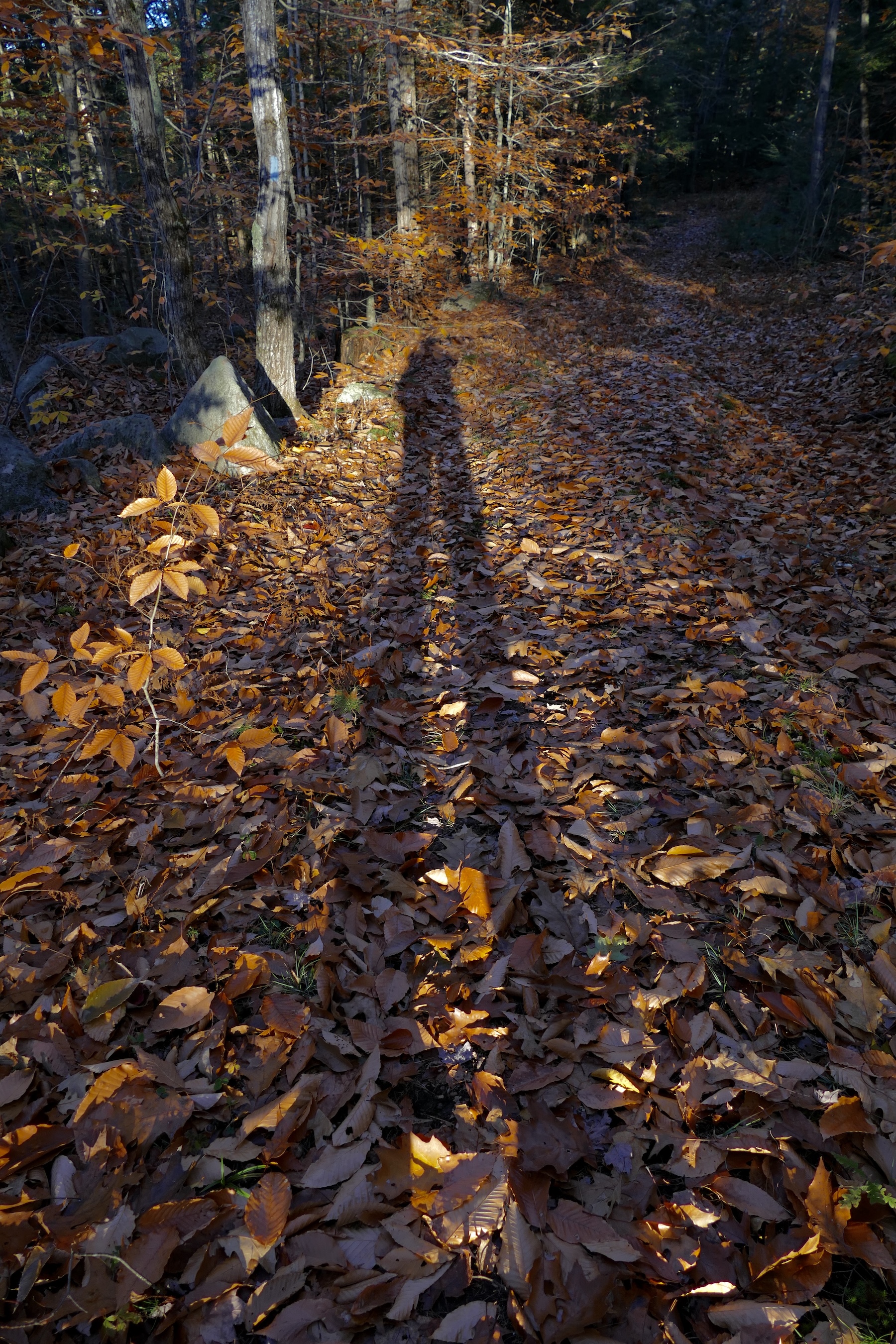
My shadow has the distinctness of a second person, a certain black companion bordering on the imp, and I ask, “Who is this?” which I see dodging behind me as I am about to sit down on a rock.

No one to my knowledge, has observed the minute differences in the seasons. Hardly two nights are alike. The rocks do not feel warm to-night, for the air is warmest; nor does the sand particularly. A book of the seasons, each page of which should be written out-of-doors, or in its own locality wherever it may be.

June 10, 1853

in Thoreau’s Journal:

The mountain laurel will begin to bloom to-morrow. The frost some weeks since killed most of the buds and shoots, except where they were protected by trees or by themselves, and now new shoots have put forth and grow four or five inches from the sides of what were the leading ones. It is a plant which plainly requires the protection of the wood.

June 7, 1851

in Thoreau’s Journal:

It is a certain faery land where we live––you may walk out in any direction over the earth’s surface––lifting your horizon––and everywhere your path––climbing the convexity of the globe leads you between heaven and earth–– ––not away from the light of the sun and stars––& the habitations of men. I wonder that I ever get 5 miles on my way––the walk is so crowded with events––& phenomena. How many questions there are which I have not put to the inhabitants!