in Thoreau’s Journal:
Up river on ice & snow to Fair Haven Pond––
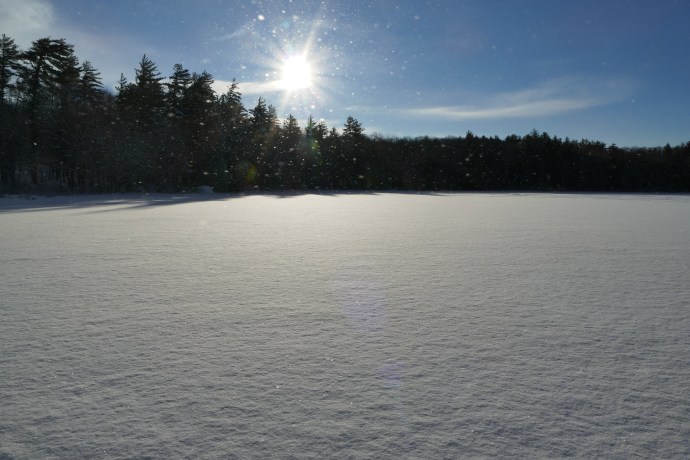
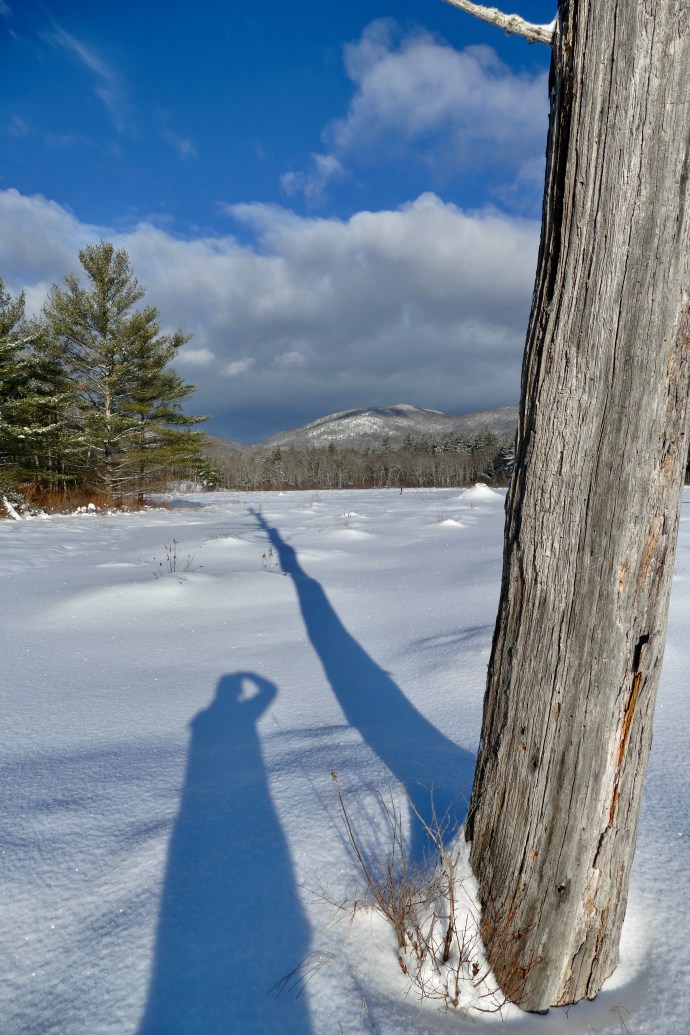
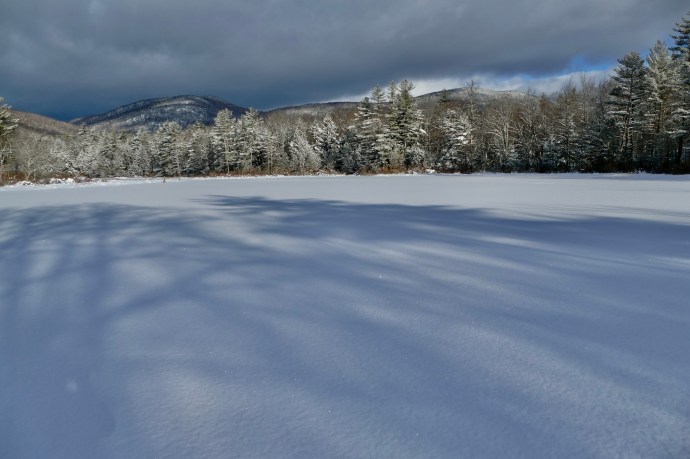
There is a few inches of snow perfectly level which now for nearly a week has covered the ice— Going toward the sun you are snow-blinded–– At each clump of willows on the meadow it looks as if there were a hillock––out of which they grow–– This appearance is produced by the willow twigs holding up the ice to height at which it was frozen after the last thaw about 2 feet above the present level.— It forms a regularly rounded hillock. We look at every track in the snow — Every little while there is the track of a fox across the river—turning aside sometimes to a muskrats cabin or a point of ice—where he has left some traces— frequently the larger track of a hound which has followed his trail— It is much easier & pleasanter to walk thus on the river—the snow being shallow & level —& there is no such loud squeaking or cronching of the snow as in the road—and This road is so wide that you do not feel confined in it—& you never meet travelers with whom you have no sympathy. The winter, cold & bound out as it is, is thrown to us like a bone to a famishing dog, & we are expected to get the marrow out of it. While the milkmen in the outskirts are milking so many scores of cows before sunrise these winter mornings, it is our task to milk the winter itself. It is true it is like a cow that is dry & our fingers are numb—& there is none to wake up us— Some desert the field & go into winter quarters in the city— They attend the oratorios while the only music that we hear is the squeaking of the snow under our boots. But the winter was not given to us for no purpose— We must thaw its cold with our genialness. We are tasked to find out & appropriate all the nutriment it yields— If it is a cold & hard season—its fruit no doubt is the more concentrated & nutty. It took the cold & bleakness of November to ripen the walnut—but the human brain is the kernel which the winter itself matures— Not till then does its shell come off— The seasons were not made in vain— Because the fruits of the earth are already ripe—we are not to suppose there is no fruit left for winter to ripen. — It is for man the seasons and the all the fruits exist. The winter was made to concentrate & harden & mature the kernel of his brain—to give tone & firmness & consistency to his thought— Then is the great harvest of the year—the harvest of thought— All previous harvests are stubble to this—mere fodder & green crop. Now we burn with a purer flame like the stars, our oil is winter-strained. We are islanded in Atlantic & Pacific—& Indian Oceans of thought— Bermudas or Friendly or Spice Islands—
Shall we take refuge in cities in November?— shall the nut fall green from the tree? Let not the year be disappointed of its crop— A crazy man walked into an empty pulpit one Sunday & taking up a hymnbook remarked — We have had a good fall for getting in corn & potatoes—let us sing winter— So I say let us sing winter— What else can we sing—and our voices be in harmony with the season.

As we walked up the river—a little flock of chickadees apparently flew to us from a woodside 15 rods off & uttered their lively day day day—& followed us along at a considerable distance—flitting by our side on the button bushes & willows—it is the most if not the only sociable bird we have.
Now is the time to fill ice houses- – Brown filled his last week.
I will be a country man— I will not go to the city—even in winter, any more than the sallows & sweet-gale by the river do— I see their yellow osiers & freckled handsomely imbricated buds still rising above the ice & snow there—to cheer me—
The white rabbit is a large fellow well furred—what does he get to eat—being a vegetable liver—? He must be hardy & cunning in his way— His race have learned by long practice to find their food where a new comer would inevitably starve.
How retired an otter manages to live. He grows to be 4 feet longer without any mortal getting a glimpse of him.
Sometimes one of those great cakes of green ice from Walden or Sam Barretts pond slips from the ice man’s sled in the street and lies there like a great emerald—an object of interest to all travelers.
The hips of the late rose are still abundant & perfect amid the button bushes—














You must be logged in to post a comment.