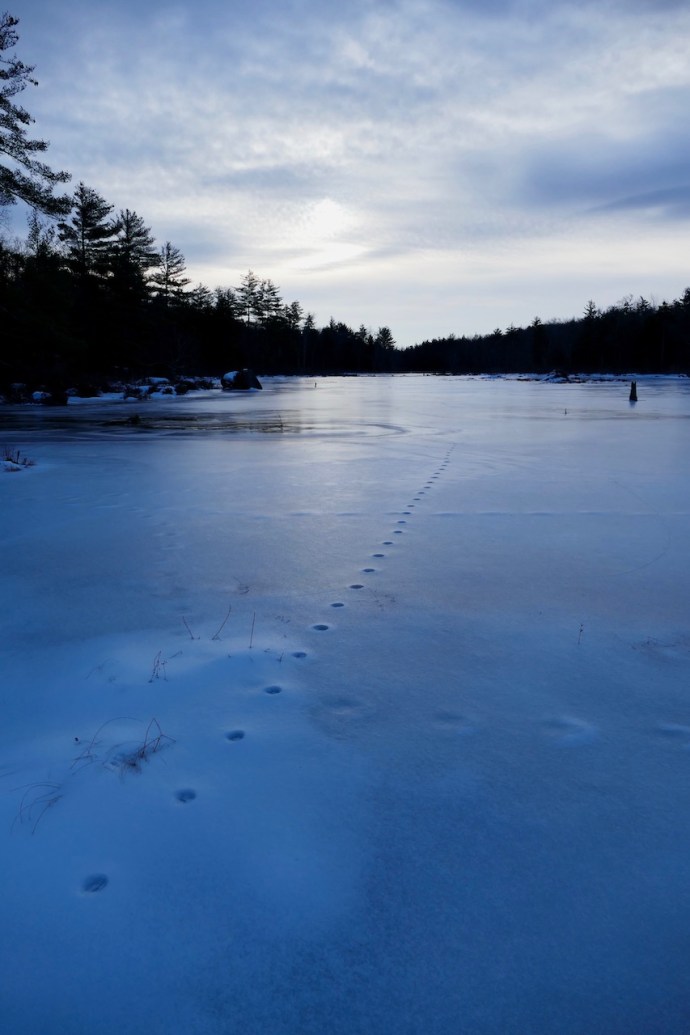
in Thoreau’s Journal:
I do not know of any more exhilarating walking than up or down a broad field of smooth ice like this in a cold, glittering, winter day, when your rubbers give you a firm hold on the ice.
in Thoreau’s Journal:
I do not know of any more exhilarating walking than up or down a broad field of smooth ice like this in a cold, glittering, winter day, when your rubbers give you a firm hold on the ice.
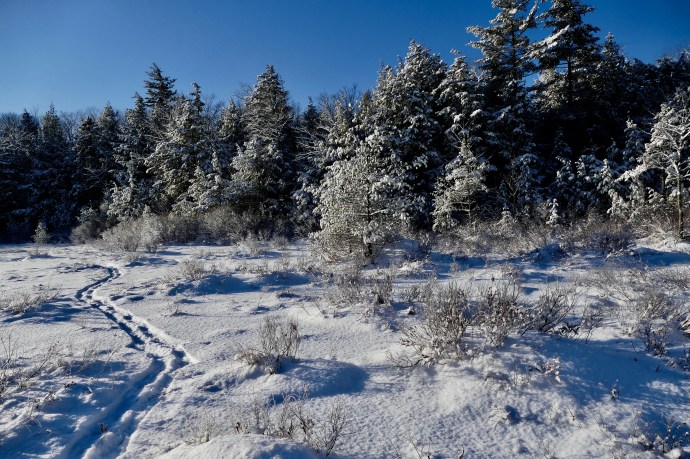
in Thoreau’s Journal:
At 9 A M up river to fair Haven Pond. This is our month of the crusted snow. Was this the Indians? I get over the half buried fences at a stride—and the drifts slope up to the tops of the walls on each side. The crust is melted on the S slopes and lets me in—or where the sun has been reflected (yesterday) from a woodside—& rotted it, but the least inclination to the north is evidence of a hard surface— On the meadows and in level open fields away from the reflection of pines & oak leaves it will generally bear.
in Thoreau’s Journal:
This afternoon the first crust to walk on. It is pleasant to walk over the fields raised a foot or more above their summer level—and the prospect is altogether new…

In this winter often no apparent difference between rivers, ponds & fields.
in Thoreau’s Journal:
If possible, come upon the top of a hill unexpectedly, perhaps through woods,
and then look off from it to the distant earth which lies behind a bluer veil,
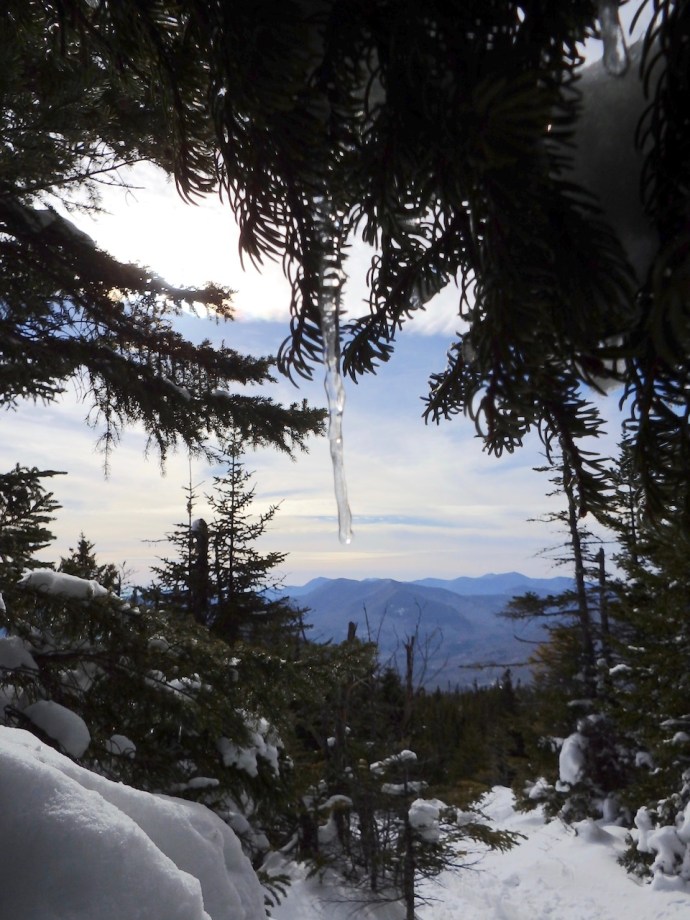
before you can see direct down it, i.e.,
bringing its own near top against the distant landscape.
in Thoreau’s Journal:
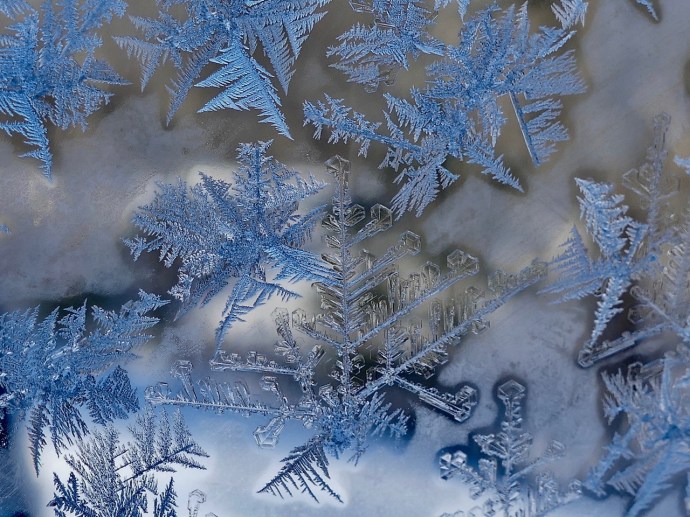
Frostwork keeps its place on the window within three feet of the stove all day in my chamber.
in Thoreau’s Journal:

The trunks & branches of the trees are of different colors at dif. times & in dif. lights & weathers. In sun, rain, & in the night. The oaks bare of leaves on Hubbards hill side are now a light grey in the sun and their boughs seen against the pines behind are a very agreeable maze. The stems of the white pines also are quite grey at this distance with their lichens. I am detained to contemplate the boughs—feathery boughs of the white pines, tier above tier, reflecting a silvery light—with intervals (between them) though which you look, if you so intend your eye, into the darkness of the grove. That is you can see both the silvery lighted & greenish bough—& the shadowy intervals as belonging to one tree—or more truly refer the latter to the shade behind.
in Thoreau’s Journal:

A mild, thawy day. The needles of the pine are the touch-stone for the air—any change in that element is revealed to the practiced eye by their livelier green or increased motion. They are the tell-tales. Now they are (the white pine) a cadaverous, misty blue—anon a lively silvery light plays on them —& they seem to erect themselves unusually—while the pitch pines are a brighter yellowish green than usual—The sun loves to nestle in the boughs of the pine & pass rays through them.

The scent of bruised pine leaves where a sled has passed is a little exciting to me now…
in Thoreau’s Journal:
I would meet the morning and evening on very sincere ground. When the sun introduces me to a new day, I silently say to myself, “Let us be faithful all round. We will do justice and receive it.”

Something like this is the secret charm of Nature’s demeanor towards us, strict conscientiousness, and disregard of us when we have ceased to have regard for ourselves. So she can never offend us. How true she is, and never swerves. In her most genial moment her laws are as steadfastly and relentlessly fulfilled….as in her sternest.
in Thoreau’s Journal:
Already we begin to anticipate spring, to say that the day is spring-like. This is an important difference between this time and a month ago. Is not January the hardest month to get through?

When you have weathered that, you get into the gulf stream of winter, nearer the shores of spring.
in Thoreau’s Journal:

The ponds are yielding a good crop of ice.
in Thoreau’s Journal:
We too have our thaws— They come to our January moods—when our ice cracks—& our sluices break loose — Thought that was frozen up under stern experience gushes forth in feelings & expression— This is a freshet which carries away dams of accumulated ice—
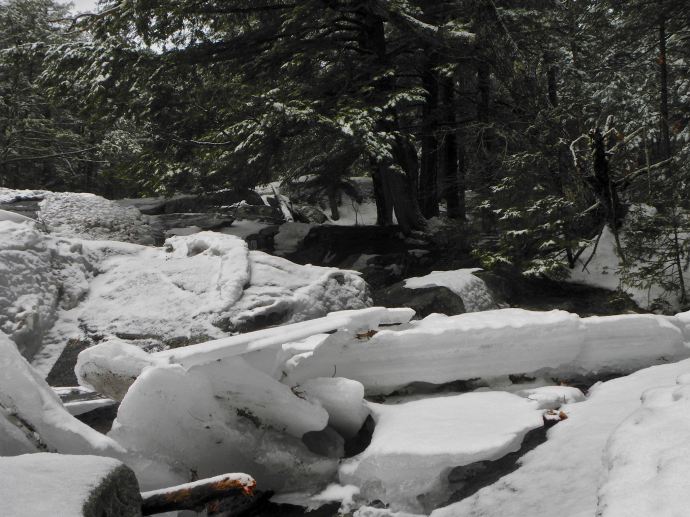
Our thoughts hide unexpressed like the buds under their downy or resinous scales— They would hardly keep a partridge from starving. If you would know what are my winter thoughts, look for them in the partridge’s crop— They are like the laurel buds—, some leaf, some blossom buds—which though food for such indigenous creatures, will not expand into leaves & flowers until summer comes.
Et primates oritur herba imbribus primarius evocata [the first grass springs up, called by the first rains] — says Varro
in Thoreau’s Journal:
Up river on ice & snow to Fair Haven Pond––
There is a few inches of snow perfectly level which now for nearly a week has covered the ice– Going toward the sun you are snow-blinded–– At each clump of willows on the meadow it looks as if there were a hillock––out of which they grow–– This appearance is produced by the willow twigs holding up the ice to height at which it was frozen after the last thaw about 2 feet above the present level.— It forms a regularly rounded hillock. We look at every track in the snow — Every little while there is the track of a fox across the river—turning aside sometimes to a muskrats cabin or a point of ice—where he has left some traces— frequently the larger track of a hound which has followed his trail— It is much easier & pleasanter to walk thus on the river—the snow being shallow & level —& there is no such loud squeaking or crunching of the snow as in the road—and This road is so wide that you do not feel confined in it—& you never meet travelers with whom you have no sympathy. The winter, cold & bound out as it is, is thrown to us like a bone to a famishing dog, & we are expected to get the marrow out of it. While the milkmen in the outskirts are milking so many scores of cows before sunrise these winter mornings, it is our task to milk the winter itself. It is true it is like a cow that is dry & our fingers are numb—& there is none to wake up us— Some desert the field & go into winter quarters in the city— They attend the oratorios while the only music that we hear is the squeaking of the snow under our boots. But the winter was not given to us for no purpose— We must thaw its cold with our genialness. We are tasked to find out & appropriate all the nutriment it yields— If it is a cold & hard season—its fruit no doubt is the more concentrated & nutty. It took the cold & bleakness of November to ripen the walnut—but the human brain is the kernel which the winter itself matures— Not till then does its shell come off— The seasons were not made in vain— Because the fruits of the earth are already ripe—we are not to suppose there is no fruit left for winter to ripen. — It is for man the seasons and the all the fruits exist. The winter was made to concentrate & harden & mature the kernel of his brain—to give tone & firmness & consistency to his thought— Then is the great harvest of the year—the harvest of thought— All previous harvests are stubble to this—mere fodder & green crop. Now we burn with a purer flame like the stars, our oil is winter-strained. We are islanded in Atlantic & Pacific—& Indian Oceans of thought— Bermudas or Friendly or Spice Islands—
Shall we take refuge in cities in November?— shall the nut fall green from the tree? Let not the year be disappointed of its crop— A crazy man walked into an empty pulpit one Sunday & taking up a hymnbook remarked — We have had a good fall for getting in corn & potatoes—let us sing winter— So I say let us sing winter— What else can we sing—and our voices be in harmony with the season.
As we walked up the river—a little flock of chickadees apparently flew to us from a woodside 15 rods off & uttered their lively day day day—& followed us along at a considerable distance—flitting by our side on the button bushes & willows—it is the most if not the only sociable bird we have.
Now is the time to fill ice houses- – Brown filled his last week.
I will be a country man— I will not go to the city—even in winter, any more than the sallows & sweet-gale by the river do— I see their yellow osiers & freckled handsomely imbricated buds still rising above the ice & snow there—to cheer me—
The white rabbit is a large fellow well furred—what does he get to eat—being a vegetable liver—? He must be hardy & cunning in his way— His race have learned by long practice to find their food where a new comer would inevitably starve.
How retired an otter manages to live. He grows to be 4 feet longer without any mortal getting a glimpse of him.
Sometimes one of those great cakes of green ice from Walden or Sam Barretts pond slips from the ice man’s sled in the street and lies there like a great emerald—an object of interest to all travelers.
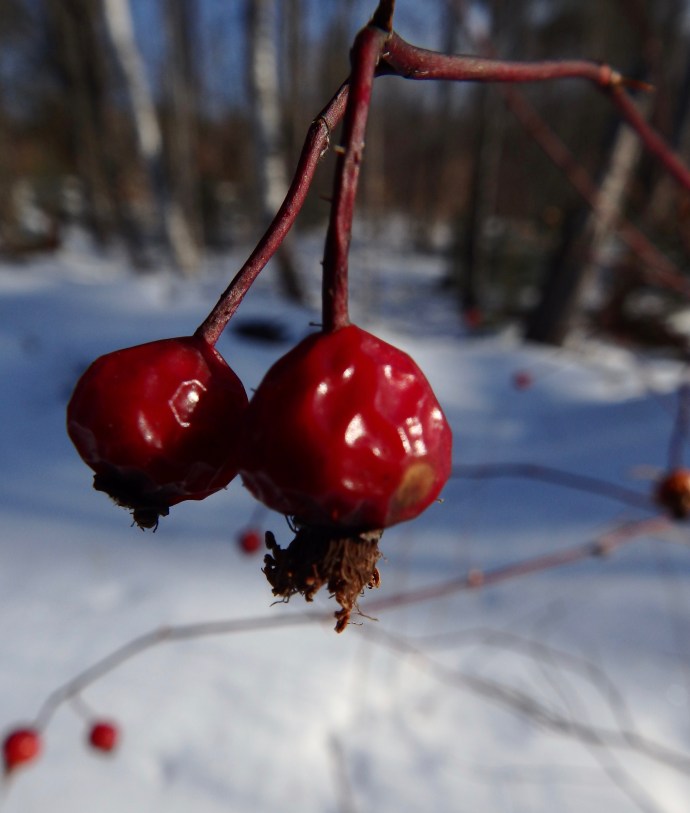
The hips of the late rose are still abundant & perfect amid the button bushes—
in Thoreau’s Journal:
Men lie behind the barrier of a relation as effectually concealed as the landscape by a mist; and when at length some unforeseen accident throws me into a new attitude toward them, I am astounded as if for the first time I saw the sun on the hillside.

in Thoreau’s Journal:
Perhaps I can never find so good a setting for my thoughts as I shall thus have taken them out of.
in Thoreau’s Journal:
I do not know but thoughts written down thus in a journal might be printed in the same form with greater advantage than if the related ones were brought together into separate essays.

They are now allied to life, and are seen by the reader not to be far-fetched….Whether the flower looks better in the nosegay than in the meadow where it grew, and we had to wet our feet to get it! Is the scholastic air any advantage?

in Thoreau’s Journal:
We really have four seasons, each incredible to the other. Winter cannot be mistaken for summer here. Though I see the boat turned up on the shore, and half buried under snow, as I walk over the invisible river, summer is far away with its rustling reeds….


Would you see your mind, look into the sky. Would you know your own moods, be weather-wise. He whom the weather disappoints, disappoints himself.
in Thoreau’s Journal:

What a rich book might be made about buds, including perhaps, sprouts. The impregnable, vivacious willow catkins, but half asleep along the twigs, under the armor of their black scales, the birch and oak sprouts, the rank and lusty dogwood sprouts, the sound, red buds of the blueberry, the small pointed red buds, close to the twig, of the panicled andromeda, the large yellowish buds of the swamp pink, etc. How healthy and vivacious must he be who would treat of these things.
in Thoreau’s Journal:

What is a winter without snow and ice in this latitude?
in Thoreau’s Journal:
When I detect a beauty in any of the recesses of nature, I am reminded by the serene and retired spirit in which it requires to be contemplated—of the inexpressible privacy of a life. How silent and unambitious it is! The beauty there is in mosses will have to be considered from the holiest, quietest nook. —The gods delight in stillness…My truest, serenest moments are too still for emotion. They have woolen feet. In all our lives, we live under the hill, and if we are not gone, we live there still.

in Thoreau’s Journal:
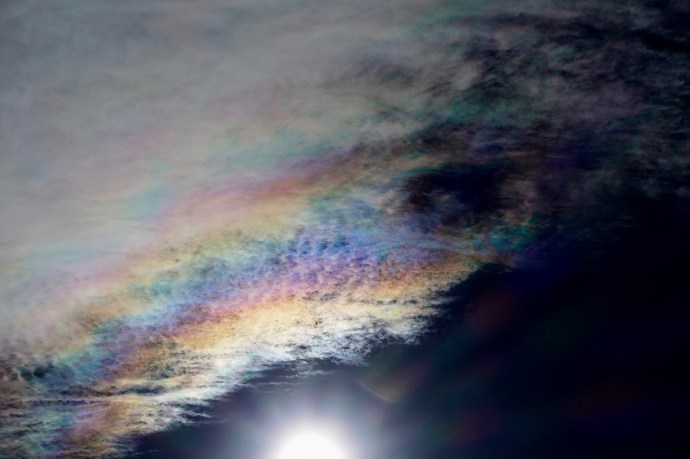
Once or twice of late I have seen the mother-of-pearl tints and rainbow flecks in the western sky. The usual time is when the air is clear and pretty cool, about an hour before sunset.
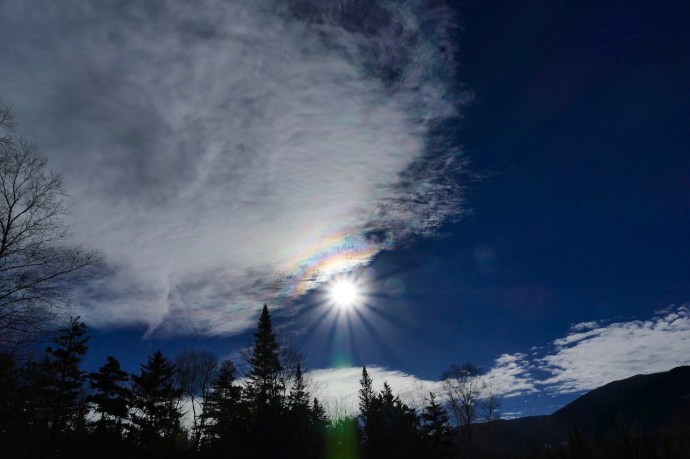
Yesterday I saw a very permanent specimen, like a long knife handle of mother-of-pearl, very pale with and interior blue, and rosaceous tinges. I think the summer sky never exhibits this so finely.
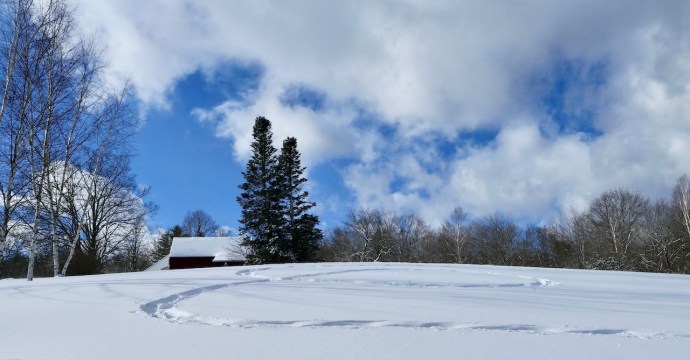
No second snow-storm in the winter can be so fair and interesting as the first.


You must be logged in to post a comment.